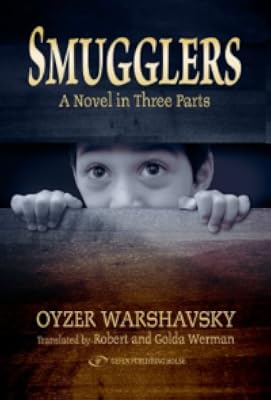
Smugglers. A Novel in Three Parts (No. 1)
by Oyzer Warshawsky
On This Page
Description
Smugglers. A Novel in Three Parts deals with a neglected chapter of history -- the First World War in Poland during the period of the German occupation. The Jews in the Pale of Settlement, mainly small shopkeepers and poor craftsman, suffered from discrimination and persecution under the Russians. When the Germans conquered most of what was once Congress Poland, the Jews had some relief from Russian anti-Semitism, but the economic situation became even more grievous. Famine and typhus were show more rampant and the economic decline left the poor cobblers, tailors and tradesmen without work and with their meager savings depleted. They were desperate. And then they hit upon a scheme. show lessTags
Recommendations









Member Reviews
Told in a storytelling style, Smugglers takes a little getting used to. As you're reading, it's easy to imagine that you're listening to an old man recounting the happenings of his old-world village. Originally published in 1920, you really get a feel from this book of how things were in Poland just after World War I. German occupation, poverty and perseverance are the main themes of this interesting novel.
 This review was written for LibraryThing Early Reviewers.
For lack of a better word, this book is "interesting." I suppose one might have something more useful to say if there were any other reviews to agree or disagree with. However, there are none, and the book was translated after the author's death, making it more difficult, since I can't comment on the writing style of the original text or how it adequately or inadequately expresses the author's vision.
Aside from these not insignificant quibbles, Smugglers is still an "interesting" book. It follows the inner and outer lives of a Jewish community near Warsaw, as they smuggle food past the occupying German guards to be sold to the hungry city-dwellers. Pantel and his oldest son Mendel are the central figures throughout, although the show more narrative jumps around from one family to another, as the smugglers join forces with a few prostitutes who distract the guards' attention long enough to get their partners' goods intothe city. The association of the "shikses" with these marginally pious men causes some friction in their households and most of the novel's conflict, though their interactions are not graphically discussed.
Smugglers is overall very clearly written, though with small flourishes of figurative language indicating a more literary emphasis. The narrative jumps from one family to another can be occasionally confusing (especially since the names can be similar), and readers who don't prefer present tense narration might find that aspect a hindrance. Regardless, the book does indeed provide an engaging glimpse into Polish and Jewish history during a period not so often discussed as the decades following it. show less
Aside from these not insignificant quibbles, Smugglers is still an "interesting" book. It follows the inner and outer lives of a Jewish community near Warsaw, as they smuggle food past the occupying German guards to be sold to the hungry city-dwellers. Pantel and his oldest son Mendel are the central figures throughout, although the show more narrative jumps around from one family to another, as the smugglers join forces with a few prostitutes who distract the guards' attention long enough to get their partners' goods intothe city. The association of the "shikses" with these marginally pious men causes some friction in their households and most of the novel's conflict, though their interactions are not graphically discussed.
Smugglers is overall very clearly written, though with small flourishes of figurative language indicating a more literary emphasis. The narrative jumps from one family to another can be occasionally confusing (especially since the names can be similar), and readers who don't prefer present tense narration might find that aspect a hindrance. Regardless, the book does indeed provide an engaging glimpse into Polish and Jewish history during a period not so often discussed as the decades following it. show less
This review was written for LibraryThing Early Reviewers.It wasn't necessarily a hard book to get through, but it wasn't exactly compelling either. It's hard to critique a book that was released in 1920 based on today's standards, but I think it would have been much improved by a first person voice. I was just too distant from the characters to care as much. It was a fairly intriguing story but if you aren't interested in Yiddish literature, I probably wouldn't recommend it.
This review was written for LibraryThing Early Reviewers.I eagerly awaited the arrival of this book as I generally enjoy Polish fiction & its different cultural perspective. However, I found the writing in this book confusing & juvenile. It jumps around with little or no reason that I can divine & the sentences are grade school level. There's no way to tell if the fault lies with the translator or original writer. I wouldn't have finished it if it weren't an early reviewer book.
This review was written for LibraryThing Early Reviewers.While, not a book I enjoyed reading, Smugglers was a story that had to be told. At times this book was a little confusing because of the vast array of jumping around between families, I do understand why it was done that way. The story was telling. The book reads more like a history book than a novel, though.
This review was written for LibraryThing Early Reviewers.I have read so many stories about WWII, and the Holocaust, it was interesting to read about something about how things were effected by WWI.
This review was written for LibraryThing Early Reviewers.Ratings
Members
- Recently Added By
Author Information

1 Work 24 Members
Common Knowledge
- Original publication date
- 1919
- Important places
- Warsaw, Poland
- Important events
- World War I
- First words
- Pantel the wagon driver stretches out under the covers and sits up, yawning.
- Last words
- (Click to show. Warning: May contain spoilers.)"Natasha! Natasha!" he whispers.
Classifications
- Genres
- Fiction and Literature, General Fiction, Historical Fiction
- DDC/MDS
- 813 — Literature & rhetoric American literature in English American fiction in English
- LCC
- PJ5129 .V286 .S513 — Language and Literature Oriental languages and literatures Oriental philology and literature Hebrew Other languages used by Jews Yiddish
Statistics
- Members
- 24
- Popularity
- 1,109,412
- Reviews
- 6
- Rating
- (2.25)
- Languages
- English
- Media
- Paper
- ISBNs
- 1