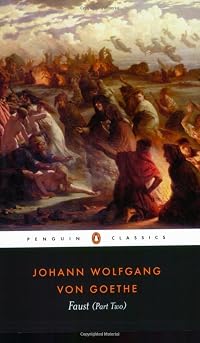
Faust, Part Two
by Johann Wolfgang von Goethe
On This Page
Description
Goethe's Faust, Part Two is distinguished by its extraordinary range of allusion, tone, and style. Full of variety of historical scene and poetic effect, the masterpiece is at times satirical, witty, and even broadly comic, at others grand and soaring. This sparkling new translation of Faust, Part Two now affords English-language readers much of the pleasure afforded readers of the original German. Award-winning translator Martin Greenberg casts Goethe's verse in a natural, vigorous, lucid show more English that preserves Goethe's poetic effects while accurately rendering the sense of the original lines.The book contains a preface by the translator that helps to bridge the abrupt transition from Part One to Part Two. The story is still that of Faust and his compact with Mephistopheles, but no longer narrowly domestic, ranging through classical Greece, medieval and modern Europe, and an exalted conclusion in a Goethean heaven. show lessTags
Recommendations


































Member Reviews
Faust II is a work that has defeated me a number of times in the past: I generally get stuck somewhere in Act II where an apparently endless succession of assorted classical entities come on and do their stuff. However, this time I ploughed on regardless, and got all the way through in three or four sittings. It's worth the effort, because you do start to get a feel for where Goethe is going. It's such a big, complicated work that you certainly can't get everything out of it in one reading. It touches on just about every area of knowledge Goethe had a finger in (to put it another way: everything) - philosophy, mythology, music, geology, economics, painting, hydraulic engineering, religion, war, psychology, civil administration, show more education,...
What struck me most on this reading was what an unexpectedly modern work it is. The classical allusions and medieval trappings of the story give you a vague feeling that it must be very ancient, but actually Goethe completed it in 1831. It's very much part of the modern, industrial, capitalist world. Jane Austen was dead, Walter Scott was dying; steam trains were running in England, and would soon be imported to Germany; Bismarck was at school; Alfred Krupp would have been at school if he hadn't been obliged to take over his late father's steelworks; Dickens was a young court reporter, etc. Especially in Act V, where Faust and Mephistopheles have become capitalist entrepreneurs involved in shipping and land reclamation, it becomes very obvious that Goethe wants the reader to see the play in this context. One of the biggest questions he addresses is where we can find a space for humanity and morality in such a world, where we are no longer bound by the traditional constraints of religion, and where growth of power and wealth are the only indicators we measure ourselves against. show less
What struck me most on this reading was what an unexpectedly modern work it is. The classical allusions and medieval trappings of the story give you a vague feeling that it must be very ancient, but actually Goethe completed it in 1831. It's very much part of the modern, industrial, capitalist world. Jane Austen was dead, Walter Scott was dying; steam trains were running in England, and would soon be imported to Germany; Bismarck was at school; Alfred Krupp would have been at school if he hadn't been obliged to take over his late father's steelworks; Dickens was a young court reporter, etc. Especially in Act V, where Faust and Mephistopheles have become capitalist entrepreneurs involved in shipping and land reclamation, it becomes very obvious that Goethe wants the reader to see the play in this context. One of the biggest questions he addresses is where we can find a space for humanity and morality in such a world, where we are no longer bound by the traditional constraints of religion, and where growth of power and wealth are the only indicators we measure ourselves against. show less
In places this is one wacky read made up of inter-locking sketches told in narrative verse. The story in Part 1 sits in the shadows, in this part there are many new story threads along with numerous characters. Mephistopheles has most of the limelight and the best lines; his sardonic tones turn where the poetry makes what could be a serious read to light and frothy one. This does not have the playfulness of the first part, but I enjoyed the many interlocking sketches with its sprawling, jumbled ideas that are still not always clear where it’s all going.
In structure, this is very different from part one and ends with tying it to its main theme, I’m not going to give the ending away, which has left me with questions. I’m glad I show more came back to read this again as I enjoyed this even more than the first time, but I’ve read more books since then so this time it made more sense to me. show less
In structure, this is very different from part one and ends with tying it to its main theme, I’m not going to give the ending away, which has left me with questions. I’m glad I show more came back to read this again as I enjoyed this even more than the first time, but I’ve read more books since then so this time it made more sense to me. show less
An impressive drama. It was filled, and fused, with so many themes, characters, allusions, references, and poetic prowess. This was Goethe near the height of his powers. I read the drama WAY after reading the first portion, but this did not detract from it at all. Rather, it allowed me to make sense of the first part in relation to the second. The drama spans a wide area of time and there is so much going on, so many great lines and developments, that I could not give this drama any less than four and a half stars. The only detriment is that, in its complexity, I found that some of the prestige is lost. I am nowhere as intelligent as Goethe was and everything that he puts into his book, all combined, mixed, like a concoction of literary show more material, was at times hard to understand. I read this alongside a guide and I presume that, if I hadn't, I would've become lost along the way.
Still, an amazing piece of German literature: 4.5 stars! show less
Still, an amazing piece of German literature: 4.5 stars! show less
I doubt the problem is the translation. There are too many different voices and not enough focus, plot, and continuity around Faust and Mephistopheles. It has the feel of an inferior sequel. There are some good speeches, such as Nereus's, but much of it seems random. It's no accident Goethe deferred publication until after his death.
A sublime and wonderful work. Stuart Atkin's translation commendably shows the power and grandeur of Goethe's masterwork in a complex but somehow still (mostly) accessible English rendition. Reading about the history of the work and of Goethe himself, it's not that it's a wonder that the work is what it is now, but rather that it was ever conceived and finished at all. The first part is wonderful, even in its linearity, but the second part transcends not only the form of the closet drama but of the idea of story in a (then) modern vein juxtaposed with the classical sources from which it sprung forth and attempts to simultaneously break free and do homage to.
Not enough good can be said about this work, it must be read, and it must be show more acknowledged as one of the crowning achievements of Western and world literature. show less
Not enough good can be said about this work, it must be read, and it must be show more acknowledged as one of the crowning achievements of Western and world literature. show less
Sequels are never as good as the originals. :-( It may be sacrilege to say it and the books were meant by Goethe to be read as a unified whole, but part two diverges way too far into classical allegory for my tastes. Only for the hardcore. Bring a headlamp and leave a popcorn trail, you might get lost.
Just a few quotes:
On life; I thought of the mist trail in Yosemite when I read these lines:
“And so I turn, the sun upon my shoulders,
To watch the water-fall, with heart elate,
The cataract pouring, crashing from the boulders,
Split and rejoined a thousand times in spate;
The thunderous water seethes in fleecy spume,
Lifted on high in many a flying plume,
Above the spray-drenched air. And then how splendid
To see the rainbow rising from this show more rage,
Now clear, now dimmed, in cool sweet vapour blended.
So strive the figures on our mortal stage.
This ponder well, the mystery closer seeing;
In mirrored hues we have our life and being.”
On marital dissatisfaction:
“Observe the married creature:
There I begin; and can in every case
The purest bliss by idle whims deface,
So varies mood and hour and human nature.
And holding in his arms what most should charm him,
Each fool will set his dreams on some new yearning;
From highest joy, now grown familiar, turning,
He shuns the sun, and takes the frost to warm him.
With practiced hand I rule in these affairs,
And bring in Asmodeus, trusty devil,
To sow, when time is ripe, conjugal evil,
And thus I wreck the human-race in pairs.” show less
Just a few quotes:
On life; I thought of the mist trail in Yosemite when I read these lines:
“And so I turn, the sun upon my shoulders,
To watch the water-fall, with heart elate,
The cataract pouring, crashing from the boulders,
Split and rejoined a thousand times in spate;
The thunderous water seethes in fleecy spume,
Lifted on high in many a flying plume,
Above the spray-drenched air. And then how splendid
To see the rainbow rising from this show more rage,
Now clear, now dimmed, in cool sweet vapour blended.
So strive the figures on our mortal stage.
This ponder well, the mystery closer seeing;
In mirrored hues we have our life and being.”
On marital dissatisfaction:
“Observe the married creature:
There I begin; and can in every case
The purest bliss by idle whims deface,
So varies mood and hour and human nature.
And holding in his arms what most should charm him,
Each fool will set his dreams on some new yearning;
From highest joy, now grown familiar, turning,
He shuns the sun, and takes the frost to warm him.
With practiced hand I rule in these affairs,
And bring in Asmodeus, trusty devil,
To sow, when time is ripe, conjugal evil,
And thus I wreck the human-race in pairs.” show less
The continuing story of Faust who has made a deal with Mephistopeles (the devil). Together they confuse an Emperor and Faust begins his persuit of Helen of Troy. Mephistopheles takes on different forms to get his way and manipulate those around him, including Faust. There is a change in focus to the Greek myths with a variety of characters like the Sirens, Chiron, Furies, Shinxes, Helen of Troy etc becomming involved.
Faust is an old man by the end of the play and his life eventually runs out. Things are not so easy for Mephistopeles who has put much time and effort into capturing and ensnaring Faust's soul. Heavenly angels appear at the very end and battle Mephistopeles for the soul for which only one side can be triumphant.
It is barely show more connected to part one and I didn't enjoy this section nearly as much sadly. I missed Faust and Mephistopeles whoa re not in the story very much as Goethe became more concerned with the Greek myths. I love my Greek mythology, but I was more interested in what exploits the two main characters were up to and I feel I missed out here. It seemed much more disjointed and I didn't enjoy the ending. show less
Faust is an old man by the end of the play and his life eventually runs out. Things are not so easy for Mephistopeles who has put much time and effort into capturing and ensnaring Faust's soul. Heavenly angels appear at the very end and battle Mephistopeles for the soul for which only one side can be triumphant.
It is barely show more connected to part one and I didn't enjoy this section nearly as much sadly. I missed Faust and Mephistopeles whoa re not in the story very much as Goethe became more concerned with the Greek myths. I love my Greek mythology, but I was more interested in what exploits the two main characters were up to and I feel I missed out here. It seemed much more disjointed and I didn't enjoy the ending. show less
Members
- Recently Added By
Lists

German Literature
518 works; 55 members

Faust legend
30 works; 3 members
Author Information

Johann Wolfgang von Goethe, 1749-1832 Johann Wolfgang von Goethe was born in Frankfurt am Main. He was greatly influenced by his mother, who encouraged his literary aspirations. After troubles at school, he was taught at home and gained an exceptionally wide education. At the age of 16, Goethe began to study law at Leipzig University from 1765 to show more 1768, and he also studied drawing with Adam Oeser. After a period of illness, he resumed his studies in Strasbourg from 1770 to 1771. Goethe practiced law in Frankfurt for two years and in Wetzlar for a year. He contributed to the Frankfurter Gelehrte Anzeigen from 1772 to 1773, and in 1774 he published his first novel, self-revelatory Die Leiden des Jungen Werthers. In 1775 he was welcomed by Duke Karl August into the small court of Weimar, where he worked in several governmental offices. He was a council member and member of the war commission, director of roads and services, and managed the financial affairs of the court. Goethe was released from day-to-day governmental duties to concentrate on writing, although he was still general supervisor for arts and sciences, and director of the court theatres. In the 1790s Goethe contributed to Friedrich von Schiller´s journal Die Horen, published Wilhelm Meister's Apprenticeship, and continued his writings on the ideals of arts and literature in his own journal, Propyläen. The first part of his masterwork, Faust, appeared in 1808, and the second part in 1832. Goethe had worked for most of his life on this drama, and was based on Christopher Marlowe's Faust. From 1791 to 1817, Goethe was the director of the court theatres. He advised Duke Carl August on mining and Jena University, which for a short time attracted the most prominent figures in German philosophy. He edited Kunst and Altertum and Zur Naturwissenschaft. Goethe died in Weimar on March 22, 1832. He and Duke Schiller are buried together, in a mausoleum in the ducal cemetery. (Bowker Author Biography) show less
Some Editions
Awards and Honors
Series
Belongs to Publisher Series
Work Relationships
Is contained in
Sorrows of Young Werther: WITH Elective Affinities, Faust and Italian Journey (Everyman's Library classics) by Johann Wolfgang von Goethe (indirect)
Goethes Sämmtliche Werke : vollständige Ausgabe in zehn Bänden. Bd. 3 by Johann Wolfgang von Goethe (indirect)
Die Leiden des jungen Werther / Iphigenie auf Tauris / Faust I & II by Johann Wolfgang von Goethe (indirect)
Is parodied in
Has as a commentary on the text
Has as a student's study guide
Common Knowledge
- Canonical title
- Faust, Part Two
- Original title
- Faust : Der Tragödie zweiter Teil
- Original publication date
- 1832
- People/Characters
- Faust; Mephistopheles; Helen of Troy; Wagner
- Important places
- Farsala, Thessaly, Greece; Germany; Sparta, Greece; Arcadia, Greece
- Original language
- German
- Disambiguation notice
- Contains only Part 2. Please don't combine with either the complete Faust or with part 1.
Classifications
- Genres
- Fiction and Literature, Poetry
- DDC/MDS
- 832.6 — Literature & rhetoric German & related literatures German drama 1750–1832 : 18th century; classical period; romantic period
- LCC
- PT2026 .F2 — Language and Literature German, Dutch and Scandinavian literatures German literature Individual authors or works 1700-ca. 1860/70 Goethe Translations
- BISAC
Statistics
- Members
- 1,901
- Popularity
- 11,208
- Reviews
- 13
- Rating
- (3.70)
- Languages
- 16 — Danish, Dutch, English, Estonian, Finnish, French, German, Greek, Italian, Korean, Lithuanian, Norwegian (Nynorsk), Norwegian (Bokmål), Portuguese, Spanish, Swedish
- Media
- Paper, Audiobook, Ebook
- ISBNs
- 51
- UPCs
- 2
- ASINs
- 53