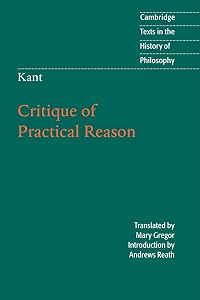
Critique of Practical Reason
by Immanuel Kant
On This Page
Description
The Critique of Practical Reason is the second of Kant's three Critiques, following Critique of Pure Reason. In it he distinguishes between actual practical reason and desire-based practical reason, arguing for the first and against the application of the second. He sees practical reason as something to be cultivated and moreover believes Freedom can be proven by it..
Tags
Recommendations








Member Reviews
Sinto que talvez deva-se ler antes a Fundamentação da metafísica dos costumes, mas o fato é que a segunda crítica, enquanto de linguajar tão complicado quanto o da primeira crítica (a obra prima), não entrega, apesar de todos esforços argumentativos ponderados, nada que seja surpreendente nem consegue, no esforço de conciliação com a cristandade, convencer. A impressão é que a via de escape dos limites da razão pura (especulativa) já foram definidos, e que a exposição do como-se moral apoia-se demais no desconhecimento da existência de traçados psicológicos como a psicopatia. O arcabouço é de fato muito interessante, com a diferenciação entre inclinações e o dever moral (que é intelectual e construído numa show more remissão à razão, acima da vontade de prazeres individuais), e a noção do mundo do entendimento, onde devemos tomar-nos como causas de nossas ações, mostrando um caráter de natureza suprassensível da nossa normatividade, é imprescindível, ao meu ver. Mas a derivação do postulado da razão prática da eternidade da alma a partir da de santidade e sumo bem, bem como a de Deus como arquiteto da existência são bastante insatisfatórias, se já não as pressupomos como necessárias (taí o tom conciliatório com a religião administrada). O céu estrelado sobre mim e a lei moral em mim. Seria melhor dizer: o céu estrelado acima e a lei moral sobre nós, por favor. show less
The book frameworks a set of conditions for practical and speculative reason. Kant traces the logical necessity of the highest good in the composition of the moral law, as well as the role of reason against the inferior faculties of desire and feeling. I read this in succession with 'The Fundamentals of the Metaphysics of Ethics' and Kant's 'Political Writings', both having made an indelible impression on my intellectual and moral sensibilities. The authorship was spectacular and the reading was quick. I realise now that the translations of both is something I should have been grateful for because Lewis White Beck's translation did not carry the flavour of rational sublimity, and my enthusiasm for Kantian writing (more than the content) show more waned at the final chapters. This sits far below 'The Fundamentals of the Metaphysics of Ethics', but the 'Critique of Practical Reason' makes for a decent supplementary text. show less
I found this work very hard to follow. Kant is differentiating what can be determined by reason. He focuses on discovering what can be determined by will (i.e., there is freedom to select something) vs. what already exists a priori. This search for both flexible and inflexible "truth" leads to a discussion of spirituality, and good and bad. The difference between Kant and others is that Kant seeks to "harmonize" rather than reconcile" philosophical points. The Fundamental Law of Pure, Practical Reason: "Act so that the maxim of your will can be valid at the same time as a principle of universal legislation." Kant attempts to climb higher than the mere desires of the Epicureans, heading toward something spiritual but elected via pure show more reason. I find it a hard climb to make. The bulk of this work heads toward a moralistic proof of good and evil and the proof of causality based merely on the possibility of it. Based on practical reason, there are only good and bad objects. show less
Two things fill the mind with ever new and increasing admiration and reverence, the more often and more steadily one reflects on them: the starry heavens above me and the moral law within me. I do not need to search for them and merely conjecture them as though they were veiled in obscurity or in the transcendent region beyond my horizon; I see them before me and connect them immediately with the consciousness of my existence.
100 KAN 4
Awesome !
Members
- Recently Added By
Lists

Filosofía - Clásicos
217 works; 1 member

How to Read a Book's Recommended Reading List
309 works; 10 members

Books Referenced by Izetbegovic's Islam Between East and West
233 works; 2 members

Philosophy, Politics and Economics
61 works; 1 member
Author Information

The greatest of all modern philosophers was born in the Baltic seaport of Konigsberg, East Prussia, the son of a saddler and never left the vicinity of his remote birthplace. Through his family pastor, Immanuel Kant received the opportunity to study at the newly founded Collegium Fredericianum, proceeding to the University of Konigsberg, where he show more was introduced to Wolffian philosophy and modern natural science by the philosopher Martin Knutzen. From 1746 to 1755, he served as tutor in various households near Konigsberg. Between 1755 and 1770, Kant published treatises on a number of scientific and philosophical subjects, including one in which he originated the nebular hypothesis of the origin of the solar system. Some of Kant's writings in the early 1760s attracted the favorable notice of respected philosophers such as J. H. Lambert and Moses Mendelssohn, but a professorship eluded Kant until he was over 45. In 1781 Kant finally published his great work, the Critique of Pure Reason. The early reviews were hostile and uncomprehending, and Kant's attempt to make his theories more accessible in his Prolegomena to Any Future Metaphysics (1783) was largely unsuccessful. Then, partly through the influence of former student J. G. Herder, whose writings on anthropology and history challenged his Enlightenment convictions, Kant turned his attention to issues in the philosophy of morality and history, writing several short essays on the philosophy of history and sketching his ethical theory in the Foundations of the Metaphysics of Morals (1785). Kant's new philosophical approach began to receive attention in 1786 through a series of articles in a widely circulated Gottingen journal by the Jena philosopher K. L. Reinhold. The following year Kant published a new, extensively revised edition of the Critique, following it up with the Critique of Practical Reason (1788), treating the foundations of moral philosophy, and the Critique of Judgment (1790), an examination of aesthetics rounding out his system through a strikingly original treatment of two topics that were widely perceived as high on the philosophical agenda at the time - the philosophical meaning of the taste for beauty and the use of teleology in natural science. From the early 1790s onward, Kant was regarded by the coming generation of philosophers as having overthrown all previous systems and as having opened up a whole new philosophical vista. During the last decade of his philosophical activity, Kant devoted most of his attention to applications of moral philosophy. His two chief works in the 1790s were Religion Within the Bounds of Plain Reason (1793--94) and Metaphysics of Morals (1798), the first part of which contained Kant's theory of right, law, and the political state. At the age of 74, most philosophers who are still active are engaged in consolidating and defending views they have already worked out. Kant, however, had perceived an important gap in his system and had begun rethinking its foundations. These attempts went on for four more years until the ravages of old age finally destroyed Kant's capacity for further intellectual work. The result was a lengthy but disorganized manuscript that was first published in 1920 under the title Opus Postumum. It displays the impact of some of the more radical young thinkers Kant's philosophy itself had inspired. Kant's philosophy focuses attention on the active role of human reason in the process of knowing the world and on its autonomy in giving moral law. Kant saw the development of reason as a collective possession of the human species, a product of nature working through human history. For him the process of free communication between independent minds is the very life of reason, the vocation of which is to remake politics, religion, science, art, and morality as the completion of a destiny whose shape it is our collective task to frame for ourselves. (Bowker Author Biography) Philosopher Immanuel Kant was born in 1724 in Konigsberg, East Prussia. He studied at the University of Konigsberg, where he would act as a lecturer and professor after a brief career as a private tutor. Kant was an incredibly influential philosopher, his theories having impact on the likes of Schopenhauer and Hegel. Kant's most prominent works include Critique of Pure Reason (1781), Foundations of the Metaphysics of Morals (1785) and Critique of Practical Reason (1788). He died in 1804. (Bowker Author Biography) show less
Some Editions
Series
Belongs to Publisher Series
Work Relationships
Is contained in
Schlüsselwerke der Philosophie : die philosophische Basisbibliothek ; mehr als 20.000 Seiten! ; Logik, Ethik, Erkenntni by Mathias Bertram
Common Knowledge
- Canonical title
- Critique of Practical Reason
- Original title
- Kritik der praktischen Vernunft
- Original publication date
- 1788
- Original language*
- saksa
*Some information comes from Common Knowledge in other languages. Click "Edit" for more information.
Classifications
Statistics
- Members
- 2,057
- Popularity
- 10,151
- Reviews
- 11
- Rating
- (3.89)
- Languages
- 20 — Catalan, Chinese, Czech, Danish, Dutch, English, Finnish, French, German, Hungarian, Italian, Japanese, Lithuanian, Norwegian (Bokmål), Polish, Slovak, Spanish, Swedish, Turkish, Portuguese (Portugal)
- Media
- Paper, Audiobook, Ebook
- ISBNs
- 162
- UPCs
- 1
- ASINs
- 39