On This Page
Description
"This lesser-known work is perhaps the perfect distillation of Nikolai Gogol's genius- a tale simultaneously animated by a joyful, nearly slapstick sense of humor alongside a resigned cynicism about the human condition. In a sharp-edged translation from John Cournos, an under-appreciated early translator of Russian literature into English, How The Two Ivans Quarrelled is the story of two long-time friends who have a falling out when one of them calls the other a goose. From there, the show more argument intensifies and the escalation becomes more and more ludicrous. Never losing its generous antic spirit, the story nonetheless transitions from whither a friendship, to whither humanity, as it progresses relentlessly to its moving conclusion." show lessTags
Recommendations











Member Reviews
I've ben meaning to read Gogol ever since reading The Namesake, and this lovely Melville House novella seemed like a good way to jump in.
I WAS NOT EXPECTING THIS. I mean, I expected the skewering of aristocratic Russian society, sure. But I did not expect it to involve this almost slapstick level of absurdity. When my over-the-top cackling drew raised eyebrows from the rest of my family and I tried to read some choice bits to them to explain, I was crying and gasping with laughter.
Of course, the pitch of that absurdity peaks fairly early in the book, then slowly simmers down to shaking-my-head levels, but all the better to drive home the satire and class criticism, rather than leave it feeling just absurd.
I think it's safe to say I'll show more be seeking out more Gogol in the future. show less
I WAS NOT EXPECTING THIS. I mean, I expected the skewering of aristocratic Russian society, sure. But I did not expect it to involve this almost slapstick level of absurdity. When my over-the-top cackling drew raised eyebrows from the rest of my family and I tried to read some choice bits to them to explain, I was crying and gasping with laughter.
Of course, the pitch of that absurdity peaks fairly early in the book, then slowly simmers down to shaking-my-head levels, but all the better to drive home the satire and class criticism, rather than leave it feeling just absurd.
I think it's safe to say I'll show more be seeking out more Gogol in the future. show less
On the surface, it seems like a pretty silly premise: life-long neighbors and friends arguing because one calls the other a "goose." However, it doesn't take long to see that the novella offers a commentary on life and the way we humans, to our own detriment, tend to make mountains out of mole hills. How many relationships have been ruined because of an ill word quickly spoken but not soon forgotten? This isn't my favorite Gogol by any means, but, like all of his other material, it was still worth reading and thinking about.
Two respectable landowners and best friends fall into a petty quarrel over a trivial insult. Their dispute escalates absurdly, involving hilariously worded lawsuits, endless bureaucracy, and the ridiculousness of social vanity in small-town society. Gogol throws in a lawsuit stealing pig for good measure.
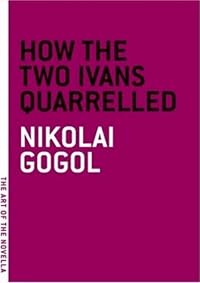
This novella about two long time friends in early 19th century Russia was written in 1835 and recently re-released by Melville House Publishing as part of its "Art of the Novella" series. Ivan Ivanovich and Ivan Nikiforovitch are next door neighbors, long time friends and respected citizens in the town of Mirgorod. During one of their daily meetings a simple conversation turns ugly, as Ivan Nikiforovitch calls his neighbor a name that deeply offends him. The situtation escalates to a war of words, followed by actions by both Ivans that deepen the animosity each feels toward the other. The local authorities and townsfolk are caught up in the drama, particularly after each brings a lawsuit against the other, and a plot is hatched to bring show more the two old friends together before their cases come to trial.
I found How the Two Ivans Quarrelled to be a quick and enjoyable read, one filled with good humor and entertaining characters, which I think that everyone would enjoy. show less
I found How the Two Ivans Quarrelled to be a quick and enjoyable read, one filled with good humor and entertaining characters, which I think that everyone would enjoy. show less
I’ve reviewed four Gogol short stories, including this, in a GR review, HERE.
sympathiek. De twee goede vrienden - uitersten van de Russische landadel - die om een bagatel elkaar naar Siberië wensen kunnen niet anders dan op de lachspieren werken. De stijl van Gogol, boordevol knipoogjes en trucjes waar meer dan honderd jaar later menig postmodernist het eigen blazoen mee op zal poetsen, is ook nu nog fris en luchtig. In elke zin (zelfs in de Engels vertaling) klinkt het Rusland, zoals we dat Rusland liefhebben - het negentiende eeuwse Rusland van Tolstok, Gogol, Tsjechov, Dostojevski, Poesjkin. Geen ander Rusland zal me ooit nog weten raken. Wellicht. Het spel met de namen van Ivan Ivanovich en Ivan Nikiforovitsch, de voortdurende herhaling van die beide namen (en de introductie van de andere Ivan Ivanovich) is show more auditieve honing voor wie graag luidop en met bulderende stem leest.
Maar het einde is een slordigheid, dat of te vroeg komt of achterwege had mogen blijven. Het maakt van een maatschappelijke satire haast een moralistisch fabeltje. Iets dat nog ternauwernood aan de vergetelheid onttrokken wordt door de naam van diens auteur.
http://occamsrazorlibrary.blogspot.com/2010/03/how-two-ivans-quarrelled.html show less
Maar het einde is een slordigheid, dat of te vroeg komt of achterwege had mogen blijven. Het maakt van een maatschappelijke satire haast een moralistisch fabeltje. Iets dat nog ternauwernood aan de vergetelheid onttrokken wordt door de naam van diens auteur.
http://occamsrazorlibrary.blogspot.com/2010/03/how-two-ivans-quarrelled.html show less
May 27, 2010Dutch
Members
- Recently Added By
Author Information

600+ Works 29,107 Members
Nikolai Vasilevich Gogol was born in 1809 in the Ukraine. His father was an amateur playwright who had a small estate with a number of serfs. From the ages of 12 to 19, young Gogol attended a boarding school where he became known for his sharp wit and ability to amuse his classmates. After school he worked as a government clerk. He soon began show more writing memories of his childhood. His quaint depictions of the Ukrainian countryside marked his style and helped to make him famous. Gogol quickly gained fame and formed a friendship with the influential poet, Aleksandr Pushkin. Gogol is largely remembered for his realistic characterizations, his rich imagination, and his humorous style. His works include Mirgorod, a collection of short stories including Taras Bulba. Gogol's wit is evident in his short story, The Nose, where a man's nose wanders off around town in a carriage. Gogol's masterpiece is the novel Dead Souls. In this work, a swindler plots to buy from landowners their dead serfs. Towards the end of Gogol's life, his creative powers faded and he fled to Moscow. Here, he came under the power of a fanatical priest. Ten days before his death he burned some manuscripts of the second part of Dead Souls. He died of starvation in 1852, on the cusp of madness. (Bowker Author Biography) show less
Some Editions
Series

Belongs to Publisher Series
Work Relationships
Is contained in
Common Knowledge
- Canonical title
- How the Two Ivans Quarrelled
- Original title
- Повесть о том, как поссорился Иван Иванович с Иваном Никифоровичем; Povest’ o tom, kak possorilsya Ivan Ivanovich s Ivanom Nikiforovichem
- Alternate titles
- The Squabble; The Tale of How Ivan Ivanovich Quarreled with Ivan Nikiforovich
- Original publication date
- 1834
- People/Characters
- Ivan Ivanovitch; Ivan Nikiforovitch
- Important places
- Russia; Ukraine
- First words
- A fine pelisse has Ivan Ivanovitch!
- Last words
- (Click to show. Warning: May contain spoilers.)It is gloomy in this world, gentlemen!
- Original language
- Russian
Classifications
- Genres
- General Fiction, Fiction and Literature
- DDC/MDS
- 891.733 — Literature & rhetoric Literatures of other languages East Indo-European and Celtic literatures Russian and East Slavic languages Russian fiction 1800–1917
- LCC
- PG3333 .P7 — Language and Literature Slavic languages and literatures. Baltic languages. Albanian language Slavic. Baltic. Albanian Russian literature Individual authors and works 1800-1870 Gogol'
- BISAC
Statistics
- Members
- 225
- Popularity
- 145,714
- Reviews
- 7
- Rating
- (3.72)
- Languages
- 9 — Dutch, English, Finnish, French, German, Greek, Portuguese, Russian, Spanish
- Media
- Paper, Ebook
- ISBNs
- 16
- ASINs
- 6