Voyage of a Summer Sun: Canoeing the Columbia River
by Robin Cody
On This Page
Description
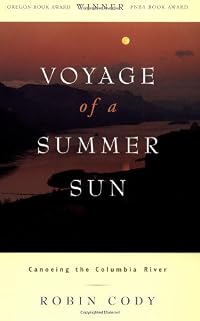
"On the morning of June 18, 1990, high up in the Canadian Rockies, Robin Cody pushed his sixteen-foot, forty-seven-pound Kevlar canoe through tall grass and mud to launch it on peaceful Columbia Lake, the nominal source of the river that heaves more water into the Pacific Ocean than any other in North or South America: the Columbia. For the next eighty-two days, Cody would steer his canoe around massive dams, through killer rapids, and across reservoirs the size of small states, plunging show more 2,750 feet in 1,200 miles and passing right through his hometown of Portland, Oregon, before reaching the open sea. Undertaken with no particular goal in mind, with no great point to prove, the solo voyage would churn up myth, memory, and unexpected truths about the magnificent natural phenomenon that dominates the landscape, economy, and spirit of the Pacific Northwest." "To the tent-dwelling canoeist, animals play an often funny, sometimes scary, role - bear, moose, coyote, beaver, deer, osprey, heron, loon. But, as Cody soon realizes, "nature, in real time, is not a dependable entertainment." Untethered thought takes over, and human contact, human language, is craved. Cody's cravings are met by a host of colorful riverfolk: Virginia Wyena, the grandmother of seventeen who pronounces for him the unspellable Wanapum name for the Columbia; Wayne Houlbrook, a would-be adventure guide and actual companion through daunting Redgrave Canyon; Mary Yadernuk, a seventy-three-year-old trapper of the old school; Ben Seibold, a "wood butcher" on hand for the raising of Grand Coulee Dam during the Great Depression; Lucille Worsham, who counts the fish swimming by her station down in the bowels of Bonneville Dam; even a couple of anonymous gossiping teenagers in a hardware store. A consummate listener, Cody learns that few are satisfied with the contortions the modern Columbia has been made to undergo for the sake of hydraulic and nuclear power, and that the environment is indeed in grave crisis and yet, he can't help but marvel at the orchestration of the river's power system as if its fourteen dams were "the stops on a massive pipe organ." He hears about eco-terrorists who slaughter hatchery salmon that they suspect are diluting the gene pool; about "hummers," radioactive coyote feces in the vicinity of Hanford's notorious B Reactor; about trees shooting like javelins out of man-made reservoirs that weren't logged before they were filled." "As he takes all this in, merely by putting his ear to the river for a good long time, Cody gains as rich an understanding of it as anyone has since 1811, when David Thompson made the first white man's trip along the Columbia, mapping it as he went. With a generous and infectious spirit, Cody draws us into the mysteries of a much altered river tamed, regulated, but still at heart a wilderness."--BOOK JACKET.Title Summary field provided by Blackwell North America, Inc. All Rights Reserved show lessTags
Recommendations









Member Reviews
I bought this book expecting an adventure-on-the-river story, but it's so much more. As the author says, it's the story of the Columbia River, told while Mr. Cody is also describing his epic canoe trip from its source in Canada all the way to the Pacific. It is full of fascinating historical information, priceless conversations with locals, descriptions of the myriad of dams and the impact they have had on man and nature. Anyone who lives in Oregon/Washington will enjoy this book immensely, and I think it should be mandatory reading for area high school students.
My favorite line involves Cody's exchange with an elderly native woman, who recalled a time before the dams, before her people learned English. He repeatedly has to ask her how show more to pronounce their word for this river, and when he cannot reproduce the sounds she makes, he asks, 'How do you spell it?' She replies, 'We don't.' show less
My favorite line involves Cody's exchange with an elderly native woman, who recalled a time before the dams, before her people learned English. He repeatedly has to ask her how show more to pronounce their word for this river, and when he cannot reproduce the sounds she makes, he asks, 'How do you spell it?' She replies, 'We don't.' show less
Cody takes us on a meandering canoe journey from the source of the Columbia river to the sea. Somewhat dated and a little self-indulgent but still interesting. Sasquatch Books gets negative points for the book falling to pieces in my hands as I read it.
Ratings
Members
- Recently Added By
Author Information
7 Works 224 Members
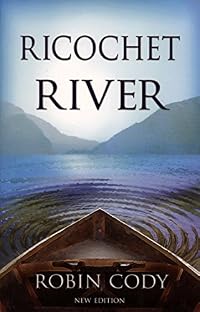
Robin Cody was a teacher before he turned to writing. Cody has written about all aspects of the West, including its people and the culture. One of Cody's novel's, Ricochet River, a coming-of-age story set in the 60s, has found its way into a number of high schools and colleges, where it has replaced A Separate Peace and Catcher in the Rye as show more required reading. Cody has also written the nonfiction book Voyage of a Summer Sun, an account of his solo canoe trip down the Columbia River. In 1986, Cody received the Western Writers of America's Silver Spur Award for nonfiction. (Bowker Author Biography) show less
Awards and Honors
Series
Belongs to Publisher Series
Common Knowledge
- Important places
- Columbia River; Oregon, USA
- Original language
- English
Classifications
- Genres
- Nonfiction, Travel, Sports and Leisure, General Nonfiction, Science & Nature, Biography & Memoir
- DDC/MDS
- 917.9704 — History & geography Geography & travel Geography of and travel in North America West Coast U.S. Washington
- LCC
- F853 .C63 — Local History of the United States, Canada and Latin America United States local history Pacific Northwest. Columbia River and Valley.
- BISAC
Statistics
- Members
- 88
- Popularity
- 362,654
- Reviews
- 2
- Rating
- (4.11)
- Languages
- English
- Media
- Paper
- ISBNs
- 3