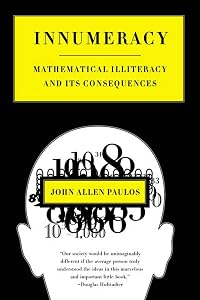
Innumeracy: Mathematical Illiteracy and Its Consequences
by John Allen Paulos
On This Page
Description
Readers of Innumeracy will be rewarded with scores of astonishing facts, a fistful of powerful ideas, and, most important, a clearer, more quantitative way of looking at their world. Why do even well-educated people understand so little about mathematics? And what are the costs of our innumeracy? John Allen Paulos, in his celebrated bestseller first published in 1988, argues that our inability to deal rationally with very large numbers and the probabilities associated with them results in show more misinformed governmental policies, confused personal decisions, and an increased susceptibility to pseudoscience of all kinds. Innumeracy lets us know what we're missing, and how we can do something about it. Sprinkling his discussion of numbers and probabilities with quirky stories and anecdotes, Paulos ranges freely over many aspects of modern life, from contested elections to sports stats, from stock scams and newspaper psychics to diet and medical claims, sex discrimination, insurance, lotteries, and drug testing. show lessTags
Recommendations






Member Recommendations
Member Reviews
My reactions to reading this book in 1993.
An entertaining, funny, and very informative book.
There were some things I did know like the difference between correlation and causality, the filtering effect of pseudosciences (only remembering your seemingly pre-cognitive feelings and dreams – not all the ones that didn’t come true), and a lot of things I didn’t know (mainly all sorts of mathematical paradoxes which are demonstrably true but go against common sense), and some things I always wondered about (like just how many “precognitive” dreams you’d get in the U.S. if only 1 dream in 10,000 came “true”?).
Paulos is straightforward and full of witty, relevant examples which show the relevance of law to politics (the show more non-transistive situations of voting such as A>B>C but C beats A in the election), the law (probability in polygraphs, drug tests, and trials), medicine, and psychology (for instance, should you get discouraged when the doctor says you test positive for a fatal disease). Paulos exposes innumeracy in a wide variety of areas, highlights misuse of statistics and shows how vital a seemingly dry subject can be. I also think he’s right on in denouncing the way math is taught (with elementary school teachers being particularly bad). I also think he’s right to scoff at people who want to be called educated but can’t reason even a little bit mathematically.
My only quibble with this book is oddly, even though I’m only seminummerate, I would have liked some equations formally showing a principle. I can understand, given his audience, why he didn’t put any in though. show less
An entertaining, funny, and very informative book.
There were some things I did know like the difference between correlation and causality, the filtering effect of pseudosciences (only remembering your seemingly pre-cognitive feelings and dreams – not all the ones that didn’t come true), and a lot of things I didn’t know (mainly all sorts of mathematical paradoxes which are demonstrably true but go against common sense), and some things I always wondered about (like just how many “precognitive” dreams you’d get in the U.S. if only 1 dream in 10,000 came “true”?).
Paulos is straightforward and full of witty, relevant examples which show the relevance of law to politics (the show more non-transistive situations of voting such as A>B>C but C beats A in the election), the law (probability in polygraphs, drug tests, and trials), medicine, and psychology (for instance, should you get discouraged when the doctor says you test positive for a fatal disease). Paulos exposes innumeracy in a wide variety of areas, highlights misuse of statistics and shows how vital a seemingly dry subject can be. I also think he’s right on in denouncing the way math is taught (with elementary school teachers being particularly bad). I also think he’s right to scoff at people who want to be called educated but can’t reason even a little bit mathematically.
My only quibble with this book is oddly, even though I’m only seminummerate, I would have liked some equations formally showing a principle. I can understand, given his audience, why he didn’t put any in though. show less
An incredibly fun read, especially considering the subject and my own mathematical deficiencies. This was on my "to read" list for far too long; many less deserving books made it to the top of the pile, probably because I was uncomfortable facing my own shortcomings. I really had only one problem with it, a nitpick, I suppose, but enough of one to rob it of a full fifth star. It was just one passage in the course of dismissing charlatanism of one sort or another where Paulos off-handedly dismisses "simpleminded atheism." He does so in the context of advocating agnosticism as the more reasonable position. It was the kind of dismissal made by the smug and self-righteous. Perhaps he meant something specific by "simpleminded atheism"? Since show more he doesn't distinguish it from perfectly reasonable simple atheism, it's hard to know. A predilection for agnosticism, insufficiently justified, indicates a kind of insidious, mush-brained tolerance for magical bullshit that is particularly out of place in this book.
That one passage aside, I was bucked up and more than a little inspired to hone those limited mathematical chops I do possess. show less
That one passage aside, I was bucked up and more than a little inspired to hone those limited mathematical chops I do possess. show less
Innumeracy is not the inability to count, but rather a lack of a general grasp of numbers and how they work. Its dangers, and they are many, are generally outlined in this book, though it is not nearly as alarmist as it could have been. The target audience is mostly the innumerate and those numerates who are curious or concerned about innumeracy. Though I was familiar with all the mathematical concepts covered, I did learn some new things and discovered some new ways of looking at information. Though far from dense, the writing style is not quite as accessible as I'd hoped, and I suspect most innumerates and math-phobes will pass it by. Which is a shame.
Quick and worthwhile read with some excellent commentary on mathematical education. He delivers a very powerful message that what is lacking in all mathematical education (including mine) is an understanding of statistics. In the book he introduces in a very engaging manner some lovely uses and misuses of probablity.
This book has sat on my shelves for some time; I see that it was copyrighted in 1988 and I think I may have started it once but did not complete it. I have done so now and quite enjoyed it, probably because I count myself among the innumerate and was interested to read more about this affliction. Paulos argues that many educated people who might be aghast at literary or grammatical solecisms, will ignore and not be aware of mathematical gaffes and ignorance, and that this is not healthy from various points of view, not the least of which is the ability to interpret and understand our own world. He has a good point. He explores basic principles and applications of probability and coincidence, applications of simple mathematical show more processes, statistical analyses, and pseudoscience that proliferates in the absence of better understandings.
He describes his objective as that of arousing a sense of numerical proportioin and an appreciation of the irreducibly probablistic nature of life. As he notes:
In an increasingly complex world full of senseless coincidence, what's required in many situations is not more facts...but a better command of known facts, and for this a course in probability is invaluable. Statistical tests and confidence intervals, the difference between cause and correlation, conditional probablility, independence, and the multiplication principle, the art of estimating and the design of experiments, the notion of expected value and of a probability distribution, as well as the most common examples and counter-examples of all of the above, would be much more widely known. Probability, like logic, is not just mathematicians anymore. It permeates our lives.
There are a number of interesting facts and perspectives to be had through this book.
For instance, in making the point about the relative size of large numbers, Paulos notes that a million seconds equals 11 and one-half days, while a billion seconds equals almost 32 years. Comparing sizes, Paulos notes:
Taking a human being to be spherical and about a meter in diameter (assuming a person is squatting), we end end up with some biologically revealing comparisons that are somewhat easier to visualize. The size of the human cell is to that of a person as a person's size is to that of Rhode Island. Likewise, a virus is to a person as a person is to the earth; an atom is to a person as a person is the earth's orbit around the sun; and a proton is to a person as a person is to the distance to Alpha Centauri.
Looking at the G8 leaders, how many different ways could they be arranged for a photograph? A very simple calculation (8 x 7 x 6x 5 x 4 x 3 x 2 x 1) gives the answer of 40,320!
Paulos addresses the question of coincidence which has given rise to no end of charlatans and pseudosciences, and as he notes: "A tendency to drastically underestimate the frequency of coincidence is a prime characteristic of innumerates, who generally accord great significance to correspondences of all sorts while attributing too little significance to quite conclusive but less flashy statistical evidence." Paulos notes that some unlikely event is likely to occur, whereas it's much less likely that a particular one will. The paradoxical conclusion is that it would be very unlikely for unlikely events not to occur. If you don't specify a predicted event precisely, there are an indeterminate number of ways for an event of that general kind to take place. Hence the "power" of prediction of all sorts of charlatans.
Paulos notes that improbabilities are to be expected and should not be invested with any particular significance. For example, the probability of being dealt any particular bridge hand of 13 cards is one in six billion, but it would be absurd to conclude, therefore, that any one hand is impossible to have because it is so very improbable. Also, disproving a claim that something exists is often quite difficult, and this difficulty is often mistaken for evidence that the claim is true (another source of "legitimization" for charlatans).
Further on coincidence, Paulos notes:
...in recent years, the plethora of names and dates and addresses and organizations in a complicated world appears to have triggered many people's inborn tendency to note coincidence and improbability, leading them to postulate connections and forces where there are none, where there is only coincidence.
Our innate desire for meaning and pattern can lead us astray if we don't remind ourselves of the ubiquity of coincidence, an ubiquity which is the consequence of our tendency to filter out the banal and impersonal, of our increasingly convoluted world, and ...of the unexpected frequency of many kinds of coincidence. Belief in the necessary or even probable significance of coincidences is a psychological remnant of our simpler past. It constitutes a kind of psychological illusion to which innumerate people are particularly prone.
(July/00) show less
He describes his objective as that of arousing a sense of numerical proportioin and an appreciation of the irreducibly probablistic nature of life. As he notes:
In an increasingly complex world full of senseless coincidence, what's required in many situations is not more facts...but a better command of known facts, and for this a course in probability is invaluable. Statistical tests and confidence intervals, the difference between cause and correlation, conditional probablility, independence, and the multiplication principle, the art of estimating and the design of experiments, the notion of expected value and of a probability distribution, as well as the most common examples and counter-examples of all of the above, would be much more widely known. Probability, like logic, is not just mathematicians anymore. It permeates our lives.
There are a number of interesting facts and perspectives to be had through this book.
For instance, in making the point about the relative size of large numbers, Paulos notes that a million seconds equals 11 and one-half days, while a billion seconds equals almost 32 years. Comparing sizes, Paulos notes:
Taking a human being to be spherical and about a meter in diameter (assuming a person is squatting), we end end up with some biologically revealing comparisons that are somewhat easier to visualize. The size of the human cell is to that of a person as a person's size is to that of Rhode Island. Likewise, a virus is to a person as a person is to the earth; an atom is to a person as a person is the earth's orbit around the sun; and a proton is to a person as a person is to the distance to Alpha Centauri.
Looking at the G8 leaders, how many different ways could they be arranged for a photograph? A very simple calculation (8 x 7 x 6x 5 x 4 x 3 x 2 x 1) gives the answer of 40,320!
Paulos addresses the question of coincidence which has given rise to no end of charlatans and pseudosciences, and as he notes: "A tendency to drastically underestimate the frequency of coincidence is a prime characteristic of innumerates, who generally accord great significance to correspondences of all sorts while attributing too little significance to quite conclusive but less flashy statistical evidence." Paulos notes that some unlikely event is likely to occur, whereas it's much less likely that a particular one will. The paradoxical conclusion is that it would be very unlikely for unlikely events not to occur. If you don't specify a predicted event precisely, there are an indeterminate number of ways for an event of that general kind to take place. Hence the "power" of prediction of all sorts of charlatans.
Paulos notes that improbabilities are to be expected and should not be invested with any particular significance. For example, the probability of being dealt any particular bridge hand of 13 cards is one in six billion, but it would be absurd to conclude, therefore, that any one hand is impossible to have because it is so very improbable. Also, disproving a claim that something exists is often quite difficult, and this difficulty is often mistaken for evidence that the claim is true (another source of "legitimization" for charlatans).
Further on coincidence, Paulos notes:
...in recent years, the plethora of names and dates and addresses and organizations in a complicated world appears to have triggered many people's inborn tendency to note coincidence and improbability, leading them to postulate connections and forces where there are none, where there is only coincidence.
Our innate desire for meaning and pattern can lead us astray if we don't remind ourselves of the ubiquity of coincidence, an ubiquity which is the consequence of our tendency to filter out the banal and impersonal, of our increasingly convoluted world, and ...of the unexpected frequency of many kinds of coincidence. Belief in the necessary or even probable significance of coincidences is a psychological remnant of our simpler past. It constitutes a kind of psychological illusion to which innumerate people are particularly prone.
(July/00) show less
It's one thing to continue educating myself with book such as these, and make headway towards being fooled less and less by ridiculous statistics and pseudoscience in general. It's another to have it delivered by a clever, snarky individual to make the reading pleasure even more profound. I seriously enjoyed this one.
On one hand, everybody should be made to read this book. It gives nice examples about how statistics work and what numbers actually mean. This is especially important in this day and age where statistics are so misused as to mean something completely different than what is actually shown (Republican claims vs Democrats claims using the same statistics!) I have a good understanding of how numbers work, but there were a few eye-opening discussions here (See Effective Results of a Cancer drug or 50% off of 50% is not 100 %).
One thing, this book uses a lot of math to make the its case. While the math is very valid and essential in statistics, it can bog down the reading. Luckily, the author is able to sum up what the math means in word show more form.
This book is definitely dated. But all the points made are still valid today, maybe even more so where media sensationalized most stories, without very much content. show less
One thing, this book uses a lot of math to make the its case. While the math is very valid and essential in statistics, it can bog down the reading. Luckily, the author is able to sum up what the math means in word show more form.
This book is definitely dated. But all the points made are still valid today, maybe even more so where media sensationalized most stories, without very much content. show less
Members
- Recently Added By
Published Reviews
ThingScore 75
Mr. Paulos is the sort of person who, when he hears that something or other is selling at a fraction of its normal cost, is likely to remark ''that the fraction is probably 4/3.'' He writes that this is often greeted by ''a blank stare.'' He takes it to be one of incomprehension, but a reader of ''Innumeracy'' may suspect behind the look an impulse to throttle Mr. Paulos. Still, there is so show more much of value in his book that one can easily restrain such an urge. He takes us a couple of steps closer to numeracy, and it is all in all an enlightening place to be. show less
added by jlelliott
Lists

Books That Changed Me
158 works; 47 members

Non-Fiction Worth Reading
1,015 works; 261 members

HS Mathematics class library
79 works; 6 members

The Great Courses: Your Deceptive Mind
60 works; 1 member
Author Information

14+ Works 6,276 Members
John Allen Paulos is professor of mathematics at Temple University and the author of eight previous books, including the bestselling Innumeracy and A Mathematician Reads the Newspaper.
Some Editions
Awards and Honors
Distinctions
Notable Lists
Series
Belongs to Publisher Series
Common Knowledge
- Original title
- Innumeracy: Mathematical Illiteracy and Its Consequences
- Original publication date
- 1988
- Dedication
- To Sheila, Leah, and Daniel for numberless reasons
- First words
- "Math was always my worst subject."
- Last words
- (Click to show. Warning: May contain spoilers.)"The desire to arouse a sense of numerical proportion and an appreciation for the irreducibly probabilistic nature of life--this, rather than anger, was the primary motivation for this book."
Classifications
Statistics
- Members
- 2,359
- Popularity
- 8,321
- Reviews
- 37
- Rating
- (3.79)
- Languages
- 12 — Basque, Catalan, Dutch, English, Finnish, French, German, Hungarian, Italian, Portuguese, Spanish, Swedish
- Media
- Paper, Audiobook, Ebook
- ISBNs
- 30
- ASINs
- 17