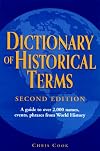
A Dictionary of Historical Terms
by Chris Cook
On This Page
Description
The latest edition of A Dictionary of Historical Terms provides a unique and important work of reference for students and teachers of history. Ranging in time over 1500 years (from the onset of the Dark Ages and the rise of Islam to the closing decade of the twentieth century) the Dictionary provides a wealth of compact definitions of many hundreds of historical terms chosen from every epoch of modern world history. Arranged alphabetically, and thoroughly updated and expanded for this new show more edition, the entries range from medieval Europe to post-colonial Africa, from the Addled Parliament of Stuart England to the Zemstov of imperial Russia. Also included are contemporary terms ranging from Ethnic Cleansing and the Christmas Revolution to the Whitewater Affair and New Labour. Terms relating to social, economic, gender and intellectual issues are also included, while geographical areas as diverse as Latin America, the Arab world and the Pacific are fully covered in this wide-ranging volume. This third edition of the now well-established Macmillan A Dictionary of Historical Terms will provide not only a valuable reference work for college and public libraries but also useful desk top companion for students and teachers. show lessTags
Recommendations






















Member Reviews
With technical terms, such as "irrendentists" (national restoration), "Satyagraha" (passive resistance), and "Whiteboys" (rack renters). For a small book, it has a broad regional and temporal reach: from European -- Justiciar (11th c. Saxon administrator), Pecsovics (Magyar), Pffafenbrief (1370 Swiss)-- to Tohunga (Maori priest), Tiempistas (Paraguayan constitutionalists), and contemporary US politics -- Contras (Nicaraguan exiles), Weathermen (lyrics of Dylan).
Many words reflect surprising origin revealed in this Dictionary form: "Kulak" meaning a 'tight-fisted person', hence used by communists to characterize the farmers who had prospered by the 1906 agrarian reforms and who were liquidated by the millions because they opposed forced show more collectivization.
At a glance, one can pull information and patterns from the record. For example, the number number of movements whose names reflect uniforms and clothing (fashion) -- capuchin, plantagenet, sans-culotte. And to highlight the importance of our words/titles -- Ghandhi used the word "Harijan", meaning "children of God", to describe the lowest caste Untouchables.
A great deal of work across many specialties appears to have gone into the show less
Many words reflect surprising origin revealed in this Dictionary form: "Kulak" meaning a 'tight-fisted person', hence used by communists to characterize the farmers who had prospered by the 1906 agrarian reforms and who were liquidated by the millions because they opposed forced show more collectivization.
At a glance, one can pull information and patterns from the record. For example, the number number of movements whose names reflect uniforms and clothing (fashion) -- capuchin, plantagenet, sans-culotte. And to highlight the importance of our words/titles -- Ghandhi used the word "Harijan", meaning "children of God", to describe the lowest caste Untouchables.
A great deal of work across many specialties appears to have gone into the show less
Ratings
Members
- Recently Added By
Author Information
113+ Works 1,093 Members
Chris Cook is head of the Modern Archives Unit at the London School of Economics. He is the author, editor, and/or compiler of many previous international political reference books, including Facts on File's Asian Political Almanac and The Making of Modern Africa. He lives in the U.K. (Bowker Author Biography)
Some Editions
Common Knowledge
- Canonical title
- A Dictionary of Historical Terms
Classifications
Statistics
- Members
- 124
- Popularity
- 260,102
- Reviews
- 1
- Rating
- (3.71)
- Languages
- English, Spanish
- Media
- Paper
- ISBNs
- 15