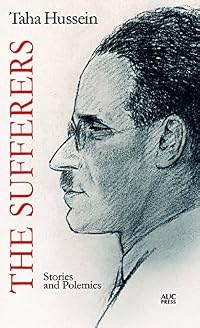
The Sufferers: Stories and Polemics
by Taha Hussein
On This Page
Description
Taha Hussein (1889-1973), blind from early childhood, rose from humble beginnings to pursue a distinguished career in Egyptian public life, but he was most influential through his voluminous, varied, and controversial writings. The stories in The Sufferers were first published in the periodical al-Katib al-Masri in 1946, but were banned by the government when collected in book form in 1947. The collection was finally published in Lebanon, and was only published in Egypt after the 1952 show more Revolution. show lessTags
Members
- Recently Added By
Author Information

109+ Works 423 Members
Taha Husayn, if not the most influential force in modern Arabic literature, is certainly a major one. His numerous publications in literary and cultural criticism, and particularly his autobiography, have variously inspired, proselytized, annoyed, or angered a host of Arab writers and others. Born to a traditional village family near Maghaghah in show more Upper Egypt in 1889, he was stricken as a young boy with blindness. This did not, however, prevent him from receiving the traditional education of the village kuttab school, which centered on learning the Qur'an by heart. In spite of his handicap and modest background, and because of his talent and promise he was sent to Cairo at age 13 to attend the great mosque school of al-Azhar. From there he went on to the Egyptian University (now Cairo University), where he wrote his thesis on the classical poet Abu al-'ala' al-Ma'arri. He continued his studies at the Sorbonne between 1915 and 1919, receiving a doctorate. Upon returning to Egypt, Taha occupied a number of high academic and administrative posts at the Egyptian University and Alexandria University. From 1951 to 1952, he was Minister of Culture. His chief fame in the Arab world---and certainly in the West---rests on his autobiography al-Ayyam (The Days), published in three parts from 1929 to 1967. In English, the first part has been translated as An Egyptian Childhood, the second part as The Stream of Days, and the last part as A Passage to France. Although this work clearly is an account of Taha Husayn's life from childhood in his village through his years at al-Azhar and then in France, it does not read strictly as autobiography. The first two volumes are narrated in the third person, with Taha always referred to as "our friend." The language is clear, concise, and very moving. Perhaps the next most influential, and also very controversial, of Taha's works was Fi al-Shi'r al-Jahili (Concerning Pre-Islamic Poetry), which appeared in 1926. Aimed at breaking traditional approaches to Arabic literature and at stimulating serious literary criticism, the work suggested that the entire corpus of pre-Islamic literature was a forgery. Needless to say, this provoked strong criticism. Another seminal book is Mustaqbal al-Thaqafah al-Misriyah (The Future of Culture in Eqypt), published in 1938, which used new analytic techniques to make classical Arabic literature accessible and relevant to the twentieth century. Taha's best-known works of fiction are Du'a al-Qayrawan (The Call of the Curlew) and al-Adib (The Writer). (Bowker Author Biography) show less
Classifications
- Genres
- Fiction and Literature, General Fiction
- DDC/MDS
- 892.735 — Literature & rhetoric Literatures of other languages Afro-Asiatic literatures Arabic (Egypt, Lebanon, Palestine, Saudi Arabia, Sudan) Arabic fiction 1800–1945
- LCC
- PJ7864 .A35 .M813 — Language and Literature Oriental languages and literatures Oriental philology and literature Arabic Arabic literature Individual authors or works
- BISAC
Statistics
- Members
- 15
- Popularity
- 1,585,434
- Languages
- Arabic, English
- Media
- Paper, Ebook
- ISBNs
- 4
- ASINs
- 1