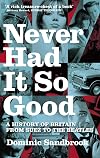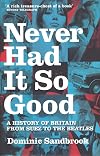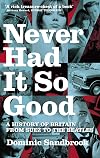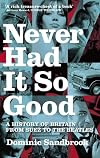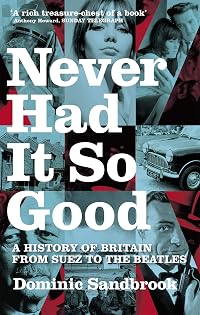
Never Had It So Good: A History of Britain from Suez to the Beatles
by Dominic Sandbrook
Sandbrook's A History of Britain (1)
On This Page
Description
In 1956 the Suez Crisis finally shattered the old myths of the British Empire and paved the way for the tumultuous changes of the decades to come. In NEVER HAD IT SO GOOD, Dominic Sandbrook takes a fresh look at the dramatic story of affluence and decline between 1956 and 1963. Arguing that historians have until now been besotted by the supposed cultural revolution of the Sixties, Sandbrook re-examines the myths of this controversial period and paints a more complicated picture of a society show more caught between conservatism and change. He explores the growth of a modern consumer society, the impact of immigration, the invention of modern pop music and the British retreat from empire. He tells the story of the colourful characters of the period, like Harold Macmillan, Kingsley Amis and Paul McCartney, and brings to life the experience of the first post-imperial generation, from the Notting Hill riots to the first Beatles hits, from the Profumo scandal to the cult of James Bond. In this strikingly impressive debut, he combines academic verve and insight with colourful, dramatic writing to produce a classic, ground-breaking work that will change forever how we think about the Sixties. show lessTags
Recommendations

















Member Reviews
Though it took me a few months, I finally finished this massive book and I am looking forward to reading the sequel, White Heat. I thought Sandbrook did an excellent job of making this period in British history come alive. I enjoy reading popular history and this included a little bit of everything, skillfully interwoven: politics, economics, literature, pop culture, demographics. Sandbrook writes very fluently and his prose is enjoyable to read.
I had many stereotypes about this era. I think of it as a long gray period between the war and the Swinging Sixties. Sandbrook's main thesis is that we should throw away such assumptions in favor of a gradualist perspective that gives due credit to the late 50s and early 60s as a dynamic and show more crucial period that shaped the later decades of the century. I came very heartily to agree with him.
I have one complaint: there were some problems with repetition. Not just repetition of ideas, but re-deployment of quotations from primary sources two and sometimes three times at different points in the text. This felt unnecessary--it's not as if there isn't enough material to work from--and, given the book's length, contributed to a reading experience that sometimes felt unwieldy. show less
I had many stereotypes about this era. I think of it as a long gray period between the war and the Swinging Sixties. Sandbrook's main thesis is that we should throw away such assumptions in favor of a gradualist perspective that gives due credit to the late 50s and early 60s as a dynamic and show more crucial period that shaped the later decades of the century. I came very heartily to agree with him.
I have one complaint: there were some problems with repetition. Not just repetition of ideas, but re-deployment of quotations from primary sources two and sometimes three times at different points in the text. This felt unnecessary--it's not as if there isn't enough material to work from--and, given the book's length, contributed to a reading experience that sometimes felt unwieldy. show less
This is the first volume of a trilogy by Dominic Sandbrook covering the history of Britain from the mid-1950s to the early 1980s. This volume begins with the Suez Crisis in 1956 and ends with the rise of Beatlemania in 1963 and sets the scene for a significant change in government in 1964.
Sandbrook has produced a detailed examination of the political and social history of Britain during these times. His focus is domestic, rarely giving more than an overview of foreign affairs except where these have a significant impact on the home front.
The book exposes a number of themes in British history and society:
- the weakening influence of Britain on the global stage with the failure of Suez, the giving up of colonial holdings and the failure show more to join the Common Market.
- structural cracks in the governance of the country with the growing influence of the political strength of the middle classes and unions.
- an expanding youth oriented society, focusing on music.
- the increasing power of television as a popular communication medium.
Sandbrook writes well. He provides a strong narrative momentum and his analysis is insightful and well-argued.
An excellent, detailed and readable history. show less
Sandbrook has produced a detailed examination of the political and social history of Britain during these times. His focus is domestic, rarely giving more than an overview of foreign affairs except where these have a significant impact on the home front.
The book exposes a number of themes in British history and society:
- the weakening influence of Britain on the global stage with the failure of Suez, the giving up of colonial holdings and the failure show more to join the Common Market.
- structural cracks in the governance of the country with the growing influence of the political strength of the middle classes and unions.
- an expanding youth oriented society, focusing on music.
- the increasing power of television as a popular communication medium.
Sandbrook writes well. He provides a strong narrative momentum and his analysis is insightful and well-argued.
An excellent, detailed and readable history. show less
The first of Sandbrook's 'post-war' series, this is well researched, full of detail and covers a diverse array of material. It escapes the fixation of many history books with politics (I had to wait a long time for an account of the Profumo Affair) although gives creditable coverage. The sections on culture and social history are interesting and the book is a better read for the fact that it has a mild thesis running through it (that of challenging the belief that changes in social attitudes and quality of life were powerful themes in the period).
The book begins with Britain on the eve of the Suez Crisis and ends with the arrival of Sir Alec Douglas-Home in 10 Downing Street, but deals chiefly with the years when Harold Macmillan was Prime Minister. This was a time of national decline, internationally, industrially and imperially, covered impartially and analytically by the author. Dominic Sandbrook also looks at the significant cultural changes in the lives of ordinary people, such as the advent of rock 'n' roll and the end of National Service, though the underlying message is that people got on with their lives, then as now. The book could have done with an editor, as the author occasionally repeats himself, and there was rather more about James Bond than I needed to know, show more whereas the severe winter of 1962-3 was covered in just three sentences. However, these are minor points: Sandbrook's style is witty and engaging but never flippant, and the book is a joy to read. show less
Very detailed, broadly covering politics, significant events, culture and social changes; a little too detailed, Sandbrook loves a fact and certain facts are repeated more than twice
I enjoyed it because I like reading history and this book covered a period of my childhood so it was lived history where I could compare the author's descriptions with my own memories. It's well-written and easy to read. Particularly strong on social and cultural history although sometimes spent far too long on some aspects of popular culture (albeit important aspects) e.g. the Beatles (well trod territory) and James Bond (far too much detail - virtually a fan's eye view).
First volume covering 1956-64. Engaging and enjoyable cultural and political history of a seminal period in 20th century British history. A heap of references if you want to follow up further but not too academic in tone - accessible to anyone interested in the period.
Members
- Recently Added By
Lists

r/AskHistorians' Recommended Books
1,068 works; 19 members

Books Read in 2024
4,727 works; 128 members
Author Information

38+ Works 1,818 Members
Series

Common Knowledge
- Original publication date
- 2005
- Epigraph
- Let's be frank about it; most of our people have never had it so good. Go around the country, go to the industrial towns, go to the farms, and you will see a state of prosperity such as we have never had in my lifetime - nor ... (show all)indeed ever in the history of this country. What is worrying some of us is 'Is it too good to be true?' or perhaps I should say 'Is it too good to last?'
Harold Macmillan, 20 July 1957 - Dedication
- For Ella
Classifications
- Genres
- History, Nonfiction, General Nonfiction
- DDC/MDS
- 941.0855 — History & geography History of Europe British Isles Historical periods of British Isles 1837- Period of Victoria and House of Windsor 1945-1999 1950-1959
- LCC
- DA589.4 .S26 — History of Europe, Asia, Africa and Oceania Great Britain History of Great Britain England History By period Modern, 1485- 20th century
- BISAC
Statistics
- Members
- 350
- Popularity
- 90,578
- Reviews
- 8
- Rating
- (4.15)
- Languages
- English
- Media
- Paper, Audiobook, Ebook
- ISBNs
- 3
- ASINs
- 2