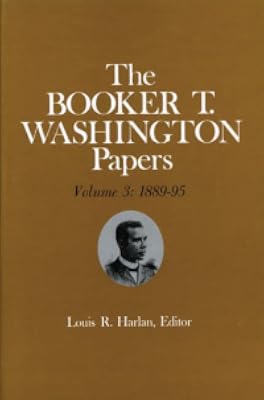
Booker T. Washington Papers Volume 3: 1889-95. Assistant editors, Stuart B. Kaufman and Raymond W. Smock (Volume 3)
by Booker T. Washington
On This Page
Description
Washington's gradual rise to prominence as an educator, race leader, and shrewd political broker is revealed in this volume, which covers his career from May 1889 to September 1895, when he delivered the famous speech often called the Atlanta Compromise address. Much of the volume relates to Washington's role as principal of Tuskegee Institute, where he built a powerful base of operations for his growing influence with white philanthropists in the North, southern white leaders, and the black show more community.''Those who would gain a serious understanding of the nature of the black past will look forward to the subsequent volumes of the Washington papers.''--John H. Bracey, Jr., New York Times Book Review ''The editors have made an auspicious start to what promises to be a distinguished documentary series. They have given us a fascinating view of Booker T. Washington and his world. . . . We can confidently expect to learn much more about the great Tuskegean's several worlds and social roles as the publication of this series proceeds.''--Dewey Grantham, West Virginia History show lessTags
Members
- Recently Added By
Author Information

83+ Works 6,230 Members
Booker Taliaferro Washington, 1856 - 1915 Booker T. Washington was born a slave in Hales Ford, Virginia, near Roanoke. After the U.S. government freed all slaves in 1865, his family moved to Malden, West Virginia. There, Washington worked in coal mines and salt furnaces. He went on to attend the Hampton, Virginia Normal and Agricultural Institute show more from 1872-1875 before joining the staff in 1879. In 1881 he was selected to head the Tuskegee Normal and Industrial Institute, a new teacher-training school for blacks, which he transformed into a thriving institution, later named Tuskegee University. His controversial conviction that blacks could best gain equality in the U.S. by improving their economic situation through education rather than by demanding equal rights was termed the Atlanta Compromise, because Washington accepted inequality and segregation for blacks in exchange for economic advancement. Washington advised two Presidents, Theodore Roosevelt and William Howard Taft, on racial problems and policies, as well as influencing the appointment of several blacks to federal offices. Washington became a shrewd political leader and advised not only Presidents, but also members of Congress and governors. He urged wealthy people to contribute to various black organizations. He also owned or financially supported many black newspapers. In 1900, Washington founded the National Negro Business League to help black business firms. Washington fought silently for equal rights, but was eventually usurped by those who ideas were more radical and demanded more action. Washington was replaced by W. E. B. Du Bois as the foremost black leader of the time, after having spent long years listening to Du Bois deride him for his placation of the white man and the plight of the negro. He died in 1915. (Bowker Author Biography) show less
Classifications
- Genres
- Nonfiction, Anthropology, Sociology
- DDC/MDS
- 301.45196073024 — Society, government, & culture Social sciences, sociology & anthropology Sociology and anthropology Formerly: Social structure Africans and people of African descent
- LCC
- E185.97 .W274 — History of the United States United States Elements in the population Afro-Americans Biography. Genealogy
- BISAC
Statistics
- Members
- 5
- Popularity
- 3,424,824
- Languages
- English
- Media
- Paper
- ISBNs
- 1