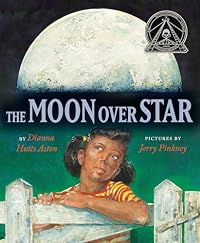
The Moon Over Star
by Dianna Hutts Aston
On This Page
Description
On her family's farm in the town of Star, eight-year-old Mae eagerly follows the progress of the 1969 Apollo 11 flight and moon landing and dreams that she might one day be an astronaut, too.Tags
Recommendations





Member Recommendations

Member Reviews
One summer day, in 1969, a young girl named Mae, together with her extended family, gathered to celebrate a momentous occasion in human history: the landing of three astronauts on the moon. Praying for the safety of those far-off voyagers in church, acting out their adventures with a home-made shuttle of their own, watching Walter Cronkite's broadcast on television, Mae and her family were moved and inspired by the events of this extraordinary day. All of them, (or so it seemed) but Mae's Gramps...
I found myself unexpectedly moved by the conclusion of The Moon Over Star, a fictional examination of the famous lunar landing by Dianna Hutts Aston, whose non-fiction picture-books, like An Egg Is Quiet and A Seed Is Sleepy, have been such show more hits with me. The pencil, ink and watercolor illustrations by Jerry Pinkney were absolutely gorgeous, of course, but the narrative took a little while to win me over. I just didn't feel that involved in the story, at the beginning. But by the end, I was convinced that Aston had done something pretty remarkable: perfectly capturing the wonder of that day, for young Mae (perhaps named in honor of Mae Jemison, the first African-American woman astronaut?), while also ably depicting the bittersweet nature of such celebratory moments, for those whose dreams may have remained unfulfilled.
I liked the fact that the author didn't feel the need to beat us over the head with anything. Gramps didn't feel as enthusiastic as the rest of the family, and while we can intuit that this was owing to the hardships of his life, and possibly an inability to follow some of his own dreams (the passing reference to the magical experience of seeing airplanes for the first time), in the end, the focus is on the love between grandparent and grandchild, and their mutual acceptance of the other's emotional response to the day. Just a lovely little book, really - and one I might not have picked up, had it not been one of our November selections in The Picture-Book Club to which I belong. show less
I found myself unexpectedly moved by the conclusion of The Moon Over Star, a fictional examination of the famous lunar landing by Dianna Hutts Aston, whose non-fiction picture-books, like An Egg Is Quiet and A Seed Is Sleepy, have been such show more hits with me. The pencil, ink and watercolor illustrations by Jerry Pinkney were absolutely gorgeous, of course, but the narrative took a little while to win me over. I just didn't feel that involved in the story, at the beginning. But by the end, I was convinced that Aston had done something pretty remarkable: perfectly capturing the wonder of that day, for young Mae (perhaps named in honor of Mae Jemison, the first African-American woman astronaut?), while also ably depicting the bittersweet nature of such celebratory moments, for those whose dreams may have remained unfulfilled.
I liked the fact that the author didn't feel the need to beat us over the head with anything. Gramps didn't feel as enthusiastic as the rest of the family, and while we can intuit that this was owing to the hardships of his life, and possibly an inability to follow some of his own dreams (the passing reference to the magical experience of seeing airplanes for the first time), in the end, the focus is on the love between grandparent and grandchild, and their mutual acceptance of the other's emotional response to the day. Just a lovely little book, really - and one I might not have picked up, had it not been one of our November selections in The Picture-Book Club to which I belong. show less
It’s July 20, 1969, in this Coretta Scott King Award Honor picture book, and Mae and her African American multigenerational family are about to watch the first man walk on the moon. Mae thinks about this moment all day-- she prays for the astronauts and their children in church that morning, builds a spaceship from barn scraps with her cousins, and then watches the Walter Cronkite broadcast of Neil Armstrong’s famous first steps and words. Grandpa isn’t as excited as Mae is though, and when she talks to him, he explains that as a farmer, he’s never had even a glimmer of a chance to go to the moon-- but that she should keep dreaming. Pinkney’s soft watercolor paintings of the moon and Mae’s life on earth coordinate with the show more poetic text to create a dreamlike quality. Themes of hope, change, and dreams for the future run throughout. Though a work of fiction, this is an excellent introduction to the various cultural changes in the U.S. in the 1960’s. Recommended for grades 1-3. show less
This is a very good book about the moon landing. Told lyrically, it illuminates the experience of watching the moon landing in 1969. It captures not only the excitement, but also the division that existed over the value of the moon landing. The grandfather in the story offers a alternate perspective on the issue. It's well done.
This book was a winner in terms of hopes and dreams. It is about a little black girl who grows up in a town named Star. Her family and her witness the first walk on the moon by the United States. She has a close relationship with her "Gramps", who let's her know that basically whatever she does, do not let anything or anyone kill your dreams.
When I read this book, I liked the writing and characters that appeared to be essential contents of the story. First, the writing were short passages that were organized in patterns in each page. In several passages, the writing was indented into one word. Throughout the story, the author provided some descriptive settings to reflect on what exactly happens. For instance, the writing displayed some environmental noises, like the sounds of the crickets at night. I think the short passages are quite simple enough for the readers to engage in the story. My second interest of the book was the character. I liked the main character named Mae, who is very knowledgeable. For example, Mae understood the approximate distance between the Earth and show more the moon. I find that Dianna Hutts Aston's story was an inspiration of reflecting to the historical event when the first human beings walked on the moon. As the central idea of the story, I learned that people can take a large step to many opportunities that mankind has in store for them. show less
In my opinion, this was a beautiful book. What I liked most was the language and the imagery that came with it. In a conversation between a little girl and her grandfather, the author writes, “’Gramps, will you watch it with me tonight…the moon walk?’ ‘I’m mighty worn out today,’ he said, ‘but maybe.’ Suddenly, I could see how tired he was. Lifetime-tired. There were deep lines in his face…” those lines in particular are so well written because not only do they carry emotion, they give the reader a good mental image. In addition, I really like the way the author ended he book. She ended it with a very poetic line, which leaves the reader's mind drifting away. The last page reads, “Gramps had looked to the moon show more all his life. It told him when to plant and when to harvest. And once upon a summer’s night, it told me to dream.” Those lines really resonated with me. The illustrations were nicely drawn and painted and had great detail. They showed exactly what the text was conveying. The main message of this story is to dream big; even if you’re from a small, farm town, you can still have huge aspirations. show less
Summary:
This books tells the experience of the moon landing from he perspective of a young African American girl. The book tells how she and everyone in her family was very excited , except for Grandpa. The end of he book focuses on the young girl having a sort of insight into her grandfather's life. She suddenly realizes Grandpa might of had dreams that never came true and that life has worn him out. The books ends with a conversation between Mae and er grandfather. She tells him she want's to be an astronaut. He advises her to keep dreaming but always appreciate what you already have.
Review:
I gave this book it's high rating because i think the author does a wonderful job of making the character's absolutely real. The children playing show more space ship after watching the spaceship launch for example. That is exactly what children would do. Every day activities in the story seamlessly blend in with a once in a lifetime event.
The story really does seem like it could be exactly what happened which i think is a wonderful accomplishment in the genre the author is writing in. Lastly the author does a wonderful job of introducing the theme of unachieved dreams with the Grandfather. It is a very complex theme but in the book it is well integrated.
Over all i think this is a great book. The characters are really consistent and real. The setting is interesting and the story line believable. show less
This books tells the experience of the moon landing from he perspective of a young African American girl. The book tells how she and everyone in her family was very excited , except for Grandpa. The end of he book focuses on the young girl having a sort of insight into her grandfather's life. She suddenly realizes Grandpa might of had dreams that never came true and that life has worn him out. The books ends with a conversation between Mae and er grandfather. She tells him she want's to be an astronaut. He advises her to keep dreaming but always appreciate what you already have.
Review:
I gave this book it's high rating because i think the author does a wonderful job of making the character's absolutely real. The children playing show more space ship after watching the spaceship launch for example. That is exactly what children would do. Every day activities in the story seamlessly blend in with a once in a lifetime event.
The story really does seem like it could be exactly what happened which i think is a wonderful accomplishment in the genre the author is writing in. Lastly the author does a wonderful job of introducing the theme of unachieved dreams with the Grandfather. It is a very complex theme but in the book it is well integrated.
Over all i think this is a great book. The characters are really consistent and real. The setting is interesting and the story line believable. show less
Members
- Recently Added By
Author Information

17 Works 7,902 Members
All Editions
Awards and Honors
Common Knowledge
- Important places
- The Moon
- Important events
- Apollo program (1961 | 1975); Apollo 11 (1969-07-16 | 1969-07-24); Apollo 11 Moon Landing (1969-07-20)
- Dedication
- To my daughter, Elizabeth Rose Aston --DHA
To my wife Gloria, my bright star, and in memory of my mother, Williemae, my moon --JP - First words
- Once upon a summer's morning, in 1969, Grandpa led the singing in church, the light of Sunday gleaming on his silvery head.
- Quotations
- That's one small step for man, one giant leap for mankind.
- Last words
- (Click to show. Warning: May contain spoilers.)And once upon a summer's night, it told me to dream.
- Canonical DDC/MDS
- 813
Classifications
Statistics
- Members
- 293
- Popularity
- 108,904
- Reviews
- 44
- Rating
- (4.25)
- Languages
- English
- Media
- Paper, Audiobook
- ISBNs
- 10
- ASINs
- 1