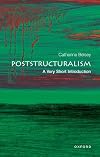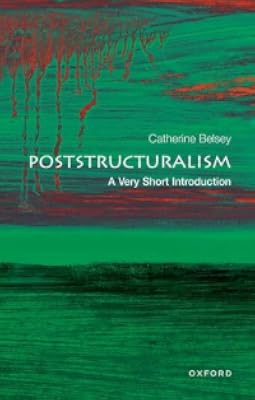
Poststructuralism: A Very Short Introduction
by Catherine Belsey
On This Page
Description
Poststructuralism challenges traditional ways of thinking about the relations between human beings, culture, and the world. Language and meaning are reappraised, and with them assumptions about what it is possible for us to know. Poststructuralism resists certainties and offers ways to consider our place in the world that compete with conventional explanations. In this Very Short Introduction, Catherine Belsey examines key figures such as Roland Barthes, Jacques Derrida, Michel Foucault, show more Julia Kristeva, Gilles Deleuze, and Sarah Kofman, drawing examples from sources as diverse as M. C. Escher, politics, Shakespeare, climate change, love, primatology, and pandemics. show lessTags
Recommendations



Member Reviews
Belsey somehow manages to condense numerous philosophers and their complex materials into five short chapters, and somehow still could find space for humour and descriptive asides.
I made the mistake of starting whilst travelling, or more to the point of thinking that because it was a short introduction I would be able to read some on the uBahn in between stations - not only do I not recommend that, but I would suggest aiming to read and relatively short space of time. The book very sensibly builds upon itself as it goes, and it's easy to get lost if you leave too much space in between and are not familiar with the terminology.
That didn't need to reread was a testament to the writing, but you get more out of it if you read it over a few show more days (enough time to digest, not enough to forget/confuse) show less
I made the mistake of starting whilst travelling, or more to the point of thinking that because it was a short introduction I would be able to read some on the uBahn in between stations - not only do I not recommend that, but I would suggest aiming to read and relatively short space of time. The book very sensibly builds upon itself as it goes, and it's easy to get lost if you leave too much space in between and are not familiar with the terminology.
That didn't need to reread was a testament to the writing, but you get more out of it if you read it over a few show more days (enough time to digest, not enough to forget/confuse) show less
For anyone who has come across concepts in poststructuralism and postmodernism (i.e. Derrida, Lacan, Barthes, Zizek, Lyotard) and cannot make the most humble glimmer of sense out of any of it, don't despair! As Belsey points out, poststructuralism is all about postponing any signification at all! And any harmony in these philosopher's ideas would go against the grain of their most unifying principle: that there can be no unifying principle.
To cut out the facetiousness, this is truly a good introduction to poststructuralism which should be a satisfying pleasure to anyone with the least interest in contemporary (continental) philosophy. It cleared up many things for me, and pointed to a good many follow up sources in its bibliography. show more Highly recommended. show less
To cut out the facetiousness, this is truly a good introduction to poststructuralism which should be a satisfying pleasure to anyone with the least interest in contemporary (continental) philosophy. It cleared up many things for me, and pointed to a good many follow up sources in its bibliography. show more Highly recommended. show less
Varied between the incomprehensible, banal, and unconvincing. Just didn't work as a humorous introduction to life on other planets.
Good introduction to the topic. I really like these Very Short Introductions.
Introdução curta ao pós-estruturalismo, apresentando aspectos importantes do trabalho de Barthes, Kristeva, Foucault, Lacan, Derrida, Lyotard, Zizek e pinçando algo sobre Althusser. Tem como tema que organiza o conjunto a reação à teoria da linguagem de Saussure, o que de início me preocupou - dado que, embora importante na época, certamente não se avança tanto no entendimento da linguagem ao criticar o referencialismo/extensionalismo sem ter uma compreensão do caráter normativo-social-inferencial, que só foi desenvolvido depois. Então, quando introduzimos um assunto assim, ou os esforços de deconstrução, morte do autor, linguagem como alienígena etc, eu consideraria mais apropriado um pouco mais de distanciamento - o show more desafio é passar como os pensamentos e sacadas foram interessantes, mas sem comprar demais as consequências teóricas. E nesse sentido eu gostaria de um livro mais localizado e com um capítulo sobre o legado pós-estruturalista e desenvolvimentos (um exemplo: uma menção rápida a Deleuze-Guattari respondendo a falta lacaniana). Mesmo a glosa sobre como Zizek não se filia ao ismo poderia indicar porque ele não compra as voltas derridianas etc. show less
Nov 6, 2025Portuguese
Ratings
Members
- Recently Added By
Lists

Oxford Online: Literary Theory Recommended Reading
35 works; 2 members
Author Information

Series
Belongs to Publisher Series
Common Knowledge
- Canonical title
- Poststructuralism: A Very Short Introduction
- Original publication date
- 2002
- First words
- When Lewis Carroll's Humpty Dumpty discusses the question of meaning with Alice in Through the Looking Glass, which of them is right?
- Last words
- (Click to show. Warning: May contain spoilers.)Above all, it asks, like Lyotard's fable, that we reflect on it.
Classifications
- Genres
- Literature Studies and Criticism, Nonfiction, Philosophy, General Nonfiction
- DDC/MDS
- 149.96 — Philosophy & psychology Philosophical schools of thought Other philosophical systems and doctrines Other systems Structuralism And Poststructuralism
- LCC
- B841.4 .B45 — Philosophy, Psychology and Religion Philosophy (General) By period Modern Special topics and schools of philosophy
- BISAC
Statistics
- Members
- 520
- Popularity
- 57,951
- Reviews
- 5
- Rating
- (3.62)
- Languages
- Bosnian, English, German
- Media
- Paper, Audiobook, Ebook
- ISBNs
- 10
- UPCs
- 1
- ASINs
- 6