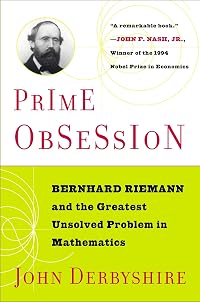
Prime Obsession: Bernhard Riemann and the Greatest Unsolved Problem in Mathematics
by John Derbyshire
On This Page
Description
In August 1859 Bernhard Riemann, a little-known 32-year old mathematician, presented a paper to the Berlin Academy titled: "On the Number of Prime Numbers Less Than a Given Quantity." In the middle of that paper, Riemann made an incidental remark - a guess, a hypothesis. What he tossed out to the assembled mathematicians that day has proven to be almost cruelly compelling to countless scholars in the ensuing years. Today, after 150 years of careful research and exhaustive study, the question show more remains. Is the hypothesis true or false? Riemann's basic inquiry, the primary topic of his paper, concerned a straightforward but nevertheless important matter of arithmetic - defining a precise formula to track and identify the occurrence of prime numbers. But it is that incidental remark - the Riemann Hypothesis - that is the truly astonishing legacy of his 1859 paper. Because Riemann was able to see beyond the pattern of the primes to discern traces of something mysterious and mathematically elegant shrouded in the shadows - subtle variations in the distribution of those prime numbers. Brilliant for its clarity, astounding for its potential consequences, the Hypothesis took on enormous importance in mathematics. Indeed, the successful solution to this puzzle would herald a revolution in prime number theory. Proving or disproving it became the greatest challenge of the age. It has become clear that the Riemann Hypothesis, whose resolution seems to hang tantalizingly just beyond our grasp, holds the key to a variety of scientific and mathematical investigations. The making and breaking of modern codes, which depend on the properties of the prime numbers, have roots in the Hypothesis. In a series of extraordinary developments during the 1970s, it emerged that even the physics of the atomic nucleus is connected in ways not yet fully understood to this strange conundrum. Hunting down the solution to the Riemann Hypothesis has become an obsession for many - the veritable "great white whale" of mathematical research. Yet despite determined efforts by generations of mathematicians, the Riemann Hypothesis defies resolution. Alternating passages of extraordinarily lucid mathematical exposition with chapters of elegantly composed biography and history, Prime Obsession is a fascinating and fluent account of an epic mathematical mystery that continues to challenge and excite the world. Posited a century and a half ago, the Riemann Hypothesis is an intellectual feast for the cognoscenti and the curious alike. Not just a story of numbers and calculations, Prime Obsession is the engrossing tale of a relentless hunt for an elusive proof - and those who have been consumed by it. show lessTags
Recommendations






Member Recommendations
by anonymous user
Member Reviews
"This isn't magic. There's a reason this stuff works," my high school math teacher used to say. Of course, there are some contentions, hypotheses, in math where we don't know if they work, if they are true.
For professional mathematicians, one of the most important of these is the Riemann Hypothesis. Everlasting fame amongst mathematicians, and, incidentally, a million dollars is waiting for the person who can nail the truth of the "RH" down.
Unlike some famous math problems, the gist of the RH is not readily apparent to most non-mathematicians. Derbyshire has to spend some time explaining what is meant by "All non-trivial zeros of the zeta function have real part one-half." And, as someone whose formal math instruction ended with four show more years of high school math and who reads the very occasional popular math book by Gleick, Peterson, or Paulos, I'm pretty much the target audience Derbyshire pitches that explanation to.
The book's style reminded me of the science histories of James Burke. But where Burke's work is a pinball version of history, caroming from person to person, theory to theory, Derbyshire's is a train of mathematical explanation covering the work leading up to, and proceeding from, the RH. Occasionally, Derbyshire stops at some station, pulls up the blind, and looks at some area of tangential interest: famous mathematicians including Gauss, Hilbert, Russell, Dyson, and Turing (who thought RH untrue and attempted to build a computing device to disprove it); German educational reforms of the early 19th century; the Cambridge Five spies; and, most often, since this book is ostensibly a biography of him, the life of Bernhard Riemann. But it's not long before we're back on that math train again. This is not to shortchange the non-math interludes of the book. Derbyshire's quick asides gave me a lot of ideas for further reading. And, if less than half of the book's 422 pages cover Riemann's life, you still get some idea of his protean mind so important not only to mathematics but modern physics.
Derbyshire's claim that, if you don't understand the RH after he explains it you never will, seems credible. I won't claim I immediately followed his chain of explanations the first time around. But that had more to do with trying to read this book in 15 minute intervals over a week rather than Derbyshire's prose. Upon reviewing many sections again, things became clearer.
The book briefly notes some of the consequences of RH, practical and theoretical. A lot of math is based on the assumption it's true. And the RH may have some mysterious relation to the world of quantum physics. In the commercial and military worlds, where encryption methods based on prime numbers are important, the RH, which has to do with the distribution of primes, may have significant importance if proved true.
I think one of the best things about this book is that, briefly, in a simple way, a non-mathematician like me can get some small idea of the excitement mathematicians feel upon discovering some curious pattern in the world of numbers.
The only complaint I have with this book is its format. Is it too much to ask that, in the age of computerized typesetting and with an author whose footnotes are all worth reading, that we put those footnotes at the bottom of the relevant page and not at the end of the book? show less
For professional mathematicians, one of the most important of these is the Riemann Hypothesis. Everlasting fame amongst mathematicians, and, incidentally, a million dollars is waiting for the person who can nail the truth of the "RH" down.
Unlike some famous math problems, the gist of the RH is not readily apparent to most non-mathematicians. Derbyshire has to spend some time explaining what is meant by "All non-trivial zeros of the zeta function have real part one-half." And, as someone whose formal math instruction ended with four show more years of high school math and who reads the very occasional popular math book by Gleick, Peterson, or Paulos, I'm pretty much the target audience Derbyshire pitches that explanation to.
The book's style reminded me of the science histories of James Burke. But where Burke's work is a pinball version of history, caroming from person to person, theory to theory, Derbyshire's is a train of mathematical explanation covering the work leading up to, and proceeding from, the RH. Occasionally, Derbyshire stops at some station, pulls up the blind, and looks at some area of tangential interest: famous mathematicians including Gauss, Hilbert, Russell, Dyson, and Turing (who thought RH untrue and attempted to build a computing device to disprove it); German educational reforms of the early 19th century; the Cambridge Five spies; and, most often, since this book is ostensibly a biography of him, the life of Bernhard Riemann. But it's not long before we're back on that math train again. This is not to shortchange the non-math interludes of the book. Derbyshire's quick asides gave me a lot of ideas for further reading. And, if less than half of the book's 422 pages cover Riemann's life, you still get some idea of his protean mind so important not only to mathematics but modern physics.
Derbyshire's claim that, if you don't understand the RH after he explains it you never will, seems credible. I won't claim I immediately followed his chain of explanations the first time around. But that had more to do with trying to read this book in 15 minute intervals over a week rather than Derbyshire's prose. Upon reviewing many sections again, things became clearer.
The book briefly notes some of the consequences of RH, practical and theoretical. A lot of math is based on the assumption it's true. And the RH may have some mysterious relation to the world of quantum physics. In the commercial and military worlds, where encryption methods based on prime numbers are important, the RH, which has to do with the distribution of primes, may have significant importance if proved true.
I think one of the best things about this book is that, briefly, in a simple way, a non-mathematician like me can get some small idea of the excitement mathematicians feel upon discovering some curious pattern in the world of numbers.
The only complaint I have with this book is its format. Is it too much to ask that, in the age of computerized typesetting and with an author whose footnotes are all worth reading, that we put those footnotes at the bottom of the relevant page and not at the end of the book? show less
Ho iniziato la lettura di questo libro dubitando della decisione di averlo acquistato,spaventato dalle formule matematiche intraviste sfogliandolo.Gi? dalle primissime pagine,mi sono dovuto ricredere.L'Autore accompagna per mano il lettore nelle profondit? matematiche dell'ipotesi di Riemann,cercando di spiegare il pi?? possibile organicamente e senza essere pedante e pesante.L'alternanza di capitoli "matematici" e capitoli "storici" ?¨ stata un'ottima scelta narrativa.
Well that was thoroughly enjoyable; John Derbyshire’s ‘Prime Obsession’ recounts the story of the Riemann Hypothesis a piece of math that was brilliantly intuitive back in 1859 when Bernard Riemann first presented it and is still unproven despite being close to the heart of large swathes of Math and Physics. John Derbyshire kept warning me that the Math towards the end of the book would have to be taken on trust and sure enough in the last two chapters I was lost; however I did get a distinct flavor of the cooking and I felt that I knew not only something of the big picture but a great deal about the people behind the Math. There is plenty of character in this story and some excellent anecdotes, I would not hesitate to recommend show more it to anyone with solid High School Math but I suspect that the readership is self selecting and quite probably it is those with a firm math interest who will plum for this mathematically erudite (and simply erudite!) account of the prime of our mathematical lives. show less
I bought this book thinking it was a biography of Riemann. It's not. Riemann shows up for a little bit at the beginning, but the vast majority of this book is not about him. Fair enough, allegedly he kept no diary and made no friends, so there's very little known about him. But the title is exceptionally misleading.
My second concern is "who is the intended audience of this book?" Like, it goes through exceptional trouble to explain natural numbers, but a few chapters later assumes you're capable of following difficult arguments requiring calculus over infinite series. It goes on forever about what a matrix is, but then completely glosses over eigenvalues, despite using them heavily for its later arguments. The final chapter is just one show more huge derivation of a result that nobody outside of analysis would ever care about.
If you're a math hobbiest, this book is going to be too hard for you. If you have a math undergraduate degree, this book is going to be both too hard for you AND immensely boring at the beginning. The history presented is grantedly interesting. I'd suggest just skipping over the math bits regardless of your skill and skimming through the history. Save yourself some time and frustration. show less
My second concern is "who is the intended audience of this book?" Like, it goes through exceptional trouble to explain natural numbers, but a few chapters later assumes you're capable of following difficult arguments requiring calculus over infinite series. It goes on forever about what a matrix is, but then completely glosses over eigenvalues, despite using them heavily for its later arguments. The final chapter is just one show more huge derivation of a result that nobody outside of analysis would ever care about.
If you're a math hobbiest, this book is going to be too hard for you. If you have a math undergraduate degree, this book is going to be both too hard for you AND immensely boring at the beginning. The history presented is grantedly interesting. I'd suggest just skipping over the math bits regardless of your skill and skimming through the history. Save yourself some time and frustration. show less
Easily the best of three recently published books about the Riemann Hypothesis, distinguished by its willingness to get into enough mathematical detail to give a good feel for the connection between the Riemann zeroes and the distribution of prime numbers. Readers unused to complex numbers may find some of the material heavy going, but those with a basic grounding in mathematics should be able to follow most of the material, and those whose maths includes a course in the theory of complex functions will enjoy a further reminder of the power and beauty of this fascinating branch of mathematics. My only gripe (more against the publishers than the author) is the title: to imply that Riemann, one of the greatest intuitive mathematicians of show more all time, was in any way "obsessive" is a cheap shot. show less
One of the most irritating narrators ever. The history chapters were fascinating and the math itself was fine, but his explanations were pedantic, patronizing, and self-absorbed.
I first read this around 2008, and re-read it (quickly) in 2020. Really enjoyed it - lots of meaty but understandable maths, intertwined with the stories of the mathematicians. In another life I would go back and read it again.
Members
- Recently Added By
Lists

HS Mathematics class library
79 works; 6 members
Author Information

15+ Works 1,831 Members
John Derbyshire is a mathematician and linguist by education, a systems analyst by profession, and a celebrated writer in his spare time. His work appears frequently in the National Review and The New Criterion. Born and raised in England, he has made his home in the United States for the past 15 years. He currently lives in Huntington, New York, show more with his wife and two children show less
Awards and Honors
Series
Belongs to Publisher Series
Common Knowledge
- Original publication date
- 2003
- People/Characters
- Bernhard Riemann
Classifications
Statistics
- Members
- 1,015
- Popularity
- 25,799
- Reviews
- 13
- Rating
- (4.07)
- Languages
- 9 — Chinese, Czech, English, Finnish, French, Greek, Italian, Korean, Portuguese
- Media
- Paper, Ebook
- ISBNs
- 17
- ASINs
- 7