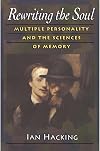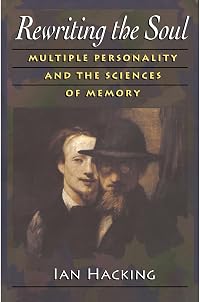
Rewriting the Soul: Multiple Personality and the Sciences of Memory
by Ian Hacking
On This Page
Description
Twenty-five years ago one could list by name the tiny number of multiple personalities recorded in the history of Western medicine, but today hundreds of people receive treatment for dissociative disorders in every sizable town in North America. Clinicians, backed by a grassroots movement of patients and therapists, find child sexual abuse to be the primary cause of the illness, while critics accuse the "MPD" community of fostering false memories of childhood trauma. Here the distinguished show more philosopher Ian Hacking uses the MPD epidemic and its links with the contemporary concept of child abuse to scrutinize today's moral and political climate, especially our power struggles about memory and our efforts to cope with psychological injuries. What is it like to suffer from multiple personality? Most diagnosed patients are women: why does gender matter? How does defining an illness affect the behavior of those who suffer from it? And, more generally, how do systems of knowledge about kinds of people interact with the people who are known about? Answering these and similar questions, Hacking explores the development of the modern multiple personality movement. He then turns to a fascinating series of historical vignettes about an earlier wave of multiples, people who were diagnosed as new ways of thinking about memory emerged, particularly in France, toward the end of the nineteenth century. Fervently occupied with the study of hypnotism, hysteria, sleepwalking, and fugue, scientists of this period aimed to take the soul away from the religious sphere. What better way to do this than to make memory a surrogate for the soul and then subject it to empirical investigation? Made possible by these nineteenth-century developments, the current outbreak of dissociative disorders is embedded in new political settings. Rewriting the Soul concludes with a powerful analysis linking historical and contemporary material in a fresh contribution to the archaeology of knowledge. As Foucault once identified a politics that centers on the body and another that classifies and organizes the human population, Hacking has now provided a masterful description of the politics of memory : the scientizing of the soul and the wounds it can receive. show lessTags
Recommendations




















Member Reviews
Ian Hacking is a subtle, thoughtful, and often frustrating writer. In Rewriting the Soul, he takes a genealogical approach to Multiple Personality Disorder, epidemic at the time of writing in the early 1990s, and links it to political movements, 19th century French psychiatry, and the philosophy of self and memory. All science, particularly the human sciences like psychiatry, are informed by politics, but Multiple Personality Disorder is is more informed than most. The appearance of alters, personality fragments, is linked to recovered memories of abuse, either mundane child abuse at the hands of close relatives or esoteric (and entirely fictional) ritualized satanic abuse.
Hacking is n expert both in 19th century psychiatry and the show more intricacies of the modern multiple personality disorder movement, and ably shreds any commonplace notion of a singular self based on factual memory by showing all the ways in which this commonplace self breaks down at the fringes of medicine. To the question, "Is MPD real?" Hacking replies 'Yes. But it is a grave moral wound inflicted upon people by psychological entrepreneurs.' For a philosopher, a seeker after truth, the scanty evidentiary basis of MPD must be infuriating, especially given the way that it afflicts the lives and communities of people diagnosed with it. But I'm not sure that Hacking earns his normative critique, or an alternative formulation of the self not reliant on a fallible and fluid memory. show less
Hacking is n expert both in 19th century psychiatry and the show more intricacies of the modern multiple personality disorder movement, and ably shreds any commonplace notion of a singular self based on factual memory by showing all the ways in which this commonplace self breaks down at the fringes of medicine. To the question, "Is MPD real?" Hacking replies 'Yes. But it is a grave moral wound inflicted upon people by psychological entrepreneurs.' For a philosopher, a seeker after truth, the scanty evidentiary basis of MPD must be infuriating, especially given the way that it afflicts the lives and communities of people diagnosed with it. But I'm not sure that Hacking earns his normative critique, or an alternative formulation of the self not reliant on a fallible and fluid memory. show less
Fuuuck! I have lots to say...but can't seem to think of how to say it right now. This book truly makes you think. Multiple Personality, memory, biopolitics, false memories, ways of being, semantic contagion, child abuse, false consciousness.
My biggest qualm is he could have kept writing for 500 more pages and it would have been necessary. God damnit I want more.
My biggest qualm is he could have kept writing for 500 more pages and it would have been necessary. God damnit I want more.
Like many of the essays that Stephen Jay Gould writes narrating surprising connections in the history of evolutionary science, Hacking's Rewriting the Soul tells part of the background story of the MPD diagnosis, placing it in its historical context. (SDAs and x-sdas will be interested in the role of mesmerism in this history. I am still thinking through the significance for Ellen White studies.) Hacking seems to be sympathetic to pragmatist philosophy, but there are some interesting places where he is decidedly not pragmatist. In 3 or so places in this book, he argues against consequentialist ethics, but he does so in a way that surprises me given that Hacking is an historian of statistics. The shape of the argument is this: Given an show more act, he argues that simply because that act produces no harmful consequences or even all good consequences, that act can still be ethically bad, appearing to agree with this definition from Wikipedia: "Deontologists who are also moral absolutists believe that some actions are wrong no matter what consequences follow from them" (http://en.wikipedia.org/wiki/Deontolo...). But the type of actions in question are part of a class where there is good statistical grounds for believing that, on average, acts of that type produce bad consequences. So given that a particular act in that class produced no bad, or even all good, consequences is not an persuasive criticism of consequentialist ethics. I have a hard time making any sense of a class of acts that rarely, if ever, produce bad consequences--despite that--being moral bad on deontological or moral absolutist grounds. show less
150 HAC 2
Ratings
Members
- Recently Added By
Author Information

35+ Works 2,453 Members
Ian Hacking holds the chair of philosophy and history of scientific concepts at the College de France
Awards and Honors
Common Knowledge
- Canonical title
- Rewriting the Soul: Multiple Personality and the Sciences of Memory
Classifications
- Genres
- Nonfiction, Philosophy, Science & Nature, General Nonfiction, History
- DDC/MDS
- 153.1 — Philosophy & psychology Psychology Conscious mental processes and intelligence Learning, Memory, And Motivation
- LCC
- RC569.5 .M8 .H33 — Medicine Internal medicine Internal medicine Neurosciences. Biological psychiatry. Neuropsychiatry Psychiatry Psychopathology Personality disorders. Behavior problems
- BISAC
Statistics
- Members
- 210
- Popularity
- 155,205
- Reviews
- 4
- Rating
- (3.83)
- Languages
- 5 — English, French, German, Italian, Portuguese
- Media
- Paper, Ebook
- ISBNs
- 12
- ASINs
- 2