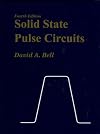
Solid State Pulse Circuits
by David A. Bell
23 Members (4.33)
On This Page
Description
The first chapters explain the characteristics of pulse waveforms and RC circuits that must be understood before the study of pulse circuitry can commence. The operation of diodes, BJTs, FETs, and op-amps in switching circuits is covered next and leads to the design and analysis of inverters, Schmitt trigger circuits, multivibrators, IC timer circuits, ramp generators, and function generators. Logic gates, logic circuits, and IC logic families are also explained. After individual circuits show more and gates are studied, they are used as building blocks to explain digital counting, digital frequency meters, ADCs and DACs, pulse modulation, time division multiplexing. Many design and analysis examples are offered throughout the text. The circuit design approach is a simple step-by-step procedure. Device data sheets in the appendices are referred to, and standard-value components are selected. show lessTags
Recommendations




















Member Reviews
Members
- Recently Added By
Author Information
14 Works 108 Members
David A. Bell taught electronics at Lambton College in Sarnia, Ontario, for many years prior to his retirement and continues to write and teach in the field. His texts have been published in many countries around the world and have sold hundreds of thousands of copies through numerous editions.
Common Knowledge
- Canonical title
- Solid State Pulse Circuits
Classifications
- Genres
- Nonfiction, Technology
- DDC/MDS
- 621.3815 — Technology Engineering Applied physics Electrical, magnetic, optical, communications, computer engineering; electronics, lighting Electronics, communications engineering Electronics
- LCC
- TK7868 .P8 .B44 — Technology Electrical engineering. Electronics. Nuclear engineering Electrical engineering. Electronics. Nuclear Electronics
- BISAC
Statistics
- Members
- 23
- Popularity
- 1,141,907
- Rating
- (4.33)
- Languages
- English
- Media
- Paper
- ISBNs
- 9