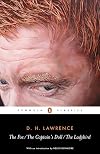
The Fox / Captain's Doll / The Ladybird.
by D. H. Lawrence
On This Page
Description
The acclaimed author of Sons and Lovers explores the effects of war on humanity in three novellas. Written between November 1920 and December 1921, these novellas were enthusiastically received by D. H. Lawrence's readers. Including the original ending of The Fox, the Cambridge edition adds new depth to the legacy of Lawrence's story of a disruptive fox in a troublesome time. A visit to Austria in 1920 inspired the characters and settings of The Captain's Doll, diving into a storied show more relationship between a Scottish soldier and a German countess in occupied Germany. Also featuring the original unedited edition of The Ladybird, a heartbreaking tale of a wounded soldier and the English nurse who tended his wounds, this is a complete collection of three of Lawrence's brilliantly crafted war stories about human emotions and relationships. show lessTags
Recommendations


























Member Reviews
St Mawr: The title is the name of a horse, bought by American heiress Lou for her husband, Australian and baronial heir, Rico. But this is DH Lawrence, so a horse is not just a horse of course of course. After a stay in London, with much riding in Hyde Park, the couple decamp with Lou’s acerbic mother to the wilds of Wales, where Rico seems to be more interested in a female friend who lives nearby. When St Mawr, who is very spirited, throws Rico, he ends up bed-ridden, and Lou decides she’s had enough. She follows her mother to London, and then across the Atlantic to the US. Where she eventually buys a run-down ranch somewhere in New Mexico. There are also a pair of grooms, a taciturn Welshman who came with St Mawr, and the show more mother’s, who is a Native American. In between the manly charms of the grooms, and the metaphor galloping through the text, Lawrence seems to have forgotten his plot. Still, it’s a lot more disciplined than, say, Sons and Lovers, although that’s much the better novel.
Te Virgin and the Gypsy: I decided to read this “short novel” before watching the 1970 film adaptation sent to me by Amazon rental. It was apparently written around 1926, but discovered among DH Lawrence’s papers after his death in 1930 (the novel, that is, not the film adaptation), and published later that same year. It… actually reads like a parody. Flighty virginal young woman is attracted by animal charm of handsome gipsy, but then a local dam bursts and floods the area and the gipsy saves the young woman from the waters. So that’s 1930’s prize for Most Obvious Sexual Metaphor Ever to David Herbert, and this is a man who never let a metaphor for sex or sexuality go unmolested. There’s also some anti-semitism on display – the virgin makes friends with a Jewish divorcee (who is not actually divorced) and her laid-back boyfriend, and there are over-frequent references to the woman’s ethnicity. Lawrence was always very good about writing about landscape, although that’s not so much in evidence in this short novel. But he was also really good at interiority and there’s plenty of that on display here. It’s not Lawrence’s best work of those I’ve read – although it seems to have been critically well-received. show less
Te Virgin and the Gypsy: I decided to read this “short novel” before watching the 1970 film adaptation sent to me by Amazon rental. It was apparently written around 1926, but discovered among DH Lawrence’s papers after his death in 1930 (the novel, that is, not the film adaptation), and published later that same year. It… actually reads like a parody. Flighty virginal young woman is attracted by animal charm of handsome gipsy, but then a local dam bursts and floods the area and the gipsy saves the young woman from the waters. So that’s 1930’s prize for Most Obvious Sexual Metaphor Ever to David Herbert, and this is a man who never let a metaphor for sex or sexuality go unmolested. There’s also some anti-semitism on display – the virgin makes friends with a Jewish divorcee (who is not actually divorced) and her laid-back boyfriend, and there are over-frequent references to the woman’s ethnicity. Lawrence was always very good about writing about landscape, although that’s not so much in evidence in this short novel. But he was also really good at interiority and there’s plenty of that on display here. It’s not Lawrence’s best work of those I’ve read – although it seems to have been critically well-received. show less
i liked the fox. found the ladybird irritating and the doll all over the place
Bevat : Het lieveheersbeestje
De vos
De pop van de kapitein
De vos
De pop van de kapitein
Ratings
Members
- Recently Added By
Lists

Books Read in 2006
424 works; 8 members

Read in 2006
140 works; 1 member
Author Information

898+ Works 60,734 Members
D(avid) H(erbert) Lawrence was born on September 11, 1885. His father was a coal miner and Lawrence grew up in a mining town in England. He always hated the mines, however, and frequently used them in his writing to represent both darkness and industrialism, which he despised because he felt it was scarring the English countryside. Lawrence show more attended high school and college in Nottingham and, after graduation, became a school teacher in Croyden in 1908. Although his first two novels had been unsuccessful, he turned to writing full time when a serious illness forced him to stop teaching. Lawrence spent much of his adult life abroad in Europe, particularly Italy, where he wrote some of his most significant and most controversial novels, including Sons and Lovers and Lady Chatterly's Lover. Lawrence and his wife, Frieda, who had left her first husband and her children to live with him, spent several years touring Europe and also lived in New Mexico for a time. Lawrence had been a frail child, and he suffered much of his life from tuberculosis. Eventually, he retired to a sanitorium in Nice, France. He died in France in 1930, at age 44. In his relatively short life, he produced more than 50 volumes of short stories, poems, plays, essays, travel journals, and letters, in addition to the novels for which he is best known. (Bowker Author Biography) show less
Some Editions
Series
Belongs to Publisher Series
Prisma Klassieken (71)
Work Relationships
Contains
Common Knowledge
- Canonical title
- The Fox; the Captain's Doll; the Ladybird; The Fox / Captain's Doll / The Ladybird.
- Original title
- The Ladybird | Martin Secker | London, March 1923; The Captain's Doll | Thomas Seltzer | New York, April 1923
- Original publication date
- 1983 (Nederlands) (Nederlands)
- Disambiguation notice
- Contains The Fox, The Captain's Doll, and The Ladybird. Don't combine with any other collection.
Classifications
Statistics
- Members
- 466
- Popularity
- 65,555
- Reviews
- 3
- Rating
- (3.65)
- Languages
- Dutch, English, German
- Media
- Paper, Ebook
- ISBNs
- 13
- ASINs
- 11