The Trail of the Serpent
by Mary Elizabeth Braddon
On This Page
Description
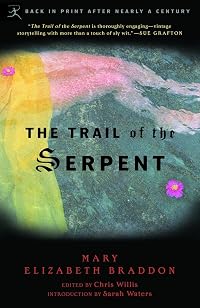
Mary Elizabeth Braddon (1837-1915), Victorian England's bestselling woman writer, blends Dickensian humor with chilling suspense in this "exuberantly campy" (Kirkus Reviews) mystery. The novel features Jabez North, a manipulative orphan who becomes a ruthless killer; Valerie de Cevennes, a stunning heiress who falls into North's diabolical trap; and Mr. Peters, a mute detective who communicates his brilliant reasoning through sign language.This edition includes a critical Afterword and show more endnotes by Victorian scholar Dr. Chris Willis. show lessTags
Recommendations





















Member Reviews
OMG - where has Mary Elizabeth Braddon been all my life? She was a contemporary of Dickens, the precursor of Wilkie Collins, and (the foreward argues) instrumental in establishing the detective fiction genre - so you'd think her works would be more widely available. Alas, no - female writers of "sensational fiction" weren't taken seriously back in the 19th century and didn't fare much better in the 20th century, so her works (excepting her "Lady Audley's Secret") gradually passed out of print. Thank you, Modern Library, for bringing back this gem!
"The Trail of the Serpent" has everything you could want in a "sensational novel" of the Victorian era: foundlings, wastrels, prodigal sons, identical twins separated at birth, bigamy, greed, show more love, hate, secret marriages, murder, madness, depravity, alchemy, secret societies, abject poverty, egregious wealth, a mute detective (how's that for "woke"?), and practically every other melodramatic trope you can imagine, all tied together by the machinations of a gloriously clever, deliciously evil villain determined to do whatever it takes to rise from obscurity to the heights of European society.
Which could be a hot mess in the hands of a schlock, but make no mistake about it - Braddon can write! She's intelligent, witty, and a gifted storyteller. Yes, her plot is sensational, but it's also stuffed with biting social commentary, delicious satire/irony, and laugh-out-loud comedic set-pieces.
Kirkus Review calls this "exuberantly campy" and it's hard to improve on this as a two-word summary. But Trail of the Serpent isn't just fun; it marks an important transition from the sensational, serialized novels of the day to the more serious literary writing of Dickens and his ilk. So go ahead and read it for the fun, then boast about reading it for the literary cred! show less
"The Trail of the Serpent" has everything you could want in a "sensational novel" of the Victorian era: foundlings, wastrels, prodigal sons, identical twins separated at birth, bigamy, greed, show more love, hate, secret marriages, murder, madness, depravity, alchemy, secret societies, abject poverty, egregious wealth, a mute detective (how's that for "woke"?), and practically every other melodramatic trope you can imagine, all tied together by the machinations of a gloriously clever, deliciously evil villain determined to do whatever it takes to rise from obscurity to the heights of European society.
Which could be a hot mess in the hands of a schlock, but make no mistake about it - Braddon can write! She's intelligent, witty, and a gifted storyteller. Yes, her plot is sensational, but it's also stuffed with biting social commentary, delicious satire/irony, and laugh-out-loud comedic set-pieces.
Kirkus Review calls this "exuberantly campy" and it's hard to improve on this as a two-word summary. But Trail of the Serpent isn't just fun; it marks an important transition from the sensational, serialized novels of the day to the more serious literary writing of Dickens and his ilk. So go ahead and read it for the fun, then boast about reading it for the literary cred! show less
If you’re going to take up reading Victorian Sensation Novels, you’re going to have to come to grips with a few things. First is coincidence. The things are dirty with them. Entire plots and resolutions are built on them. They are the foundation. People and events seemingly insignificant will later be revealed to not only be connected, but important in ways no one could even guess. Second is exaggeration. At least it seems that way in this century. At the time though people’s reactions to events and actions were proper and correct. People did worry themselves to death over what we deem unimportant these days. Public opinion, mostly. No one dies of shame about anything these days, but the wrong word or look or hat could send show more someone into a tailspin in 1865. Third is that your sense of tension and dread comes not from being ignorant of the main mystery, but from the solving of it by the characters not in the know and how many of them will be hurt along the way. At least with Braddon it seems this way. The main secret isn’t one for the reader, but the joy of reading one of her books comes from watching the others figure it out and bring the villain to justice. If you like tinkering with clues and parsing dropped hints to find a solution to a central puzzle, Victorian Sensation Novels probably won’t float your boat. If you like watching events unfold with maximum melodrama, coincidences and flair and you have no problem with following a big cast, VSNs are right up your alley. Happy endings guaranteed.
The Trail of the Serpent is an early book and it shows. It’s not nearly as tight as say Lady Audley’s Secret. There are scenes, people and descriptions that don’t directly move the plot forward or add any necessary information. They’re extraneous and often not tied up later to anything that is necessary or important. They’re window-dressing and in later books, Braddon doesn’t get caught up in them like she does here. I’ve read that TTotS was retooled and republished, and it could stand some more of that.
Don’t let that put you off, though. If you like Wilkie Collins for his snakey plots and dastardly villains, you’ll like Braddon, too. She doesn’t get as preachy as Collins and she doesn’t use his epistolary/multi-POV style, but she tells a ripping good tale. Even though this is an early book, she still uses little hooks like this - “If he had known that such a little incident as that could have a dark and dreadful influence on his life, surely he would have thought himself foredoomed and set apart for a cruel destiny.”
Our main victim, Richard, is a bit of a dope and I think Braddon created him a bit too pathetically at the beginning and it doesn’t check up with the schemer he becomes later. Still he didn’t have too many scenes and so wasn’t too annoying. We did get a lot of scenes with our villain though and that’s different from later novels when I found myself wanting to know more from the bad guy directly. The Serpent of the title gets lots of screen time, he’s fun to watch and is a thorough bastard. Braddon gives him what he deserves in the end.
Even though he isn’t running an official investigation, Mr. Peters is trying to help Richard and find the real killer. He’s mute, but not deaf and the descriptions of how he has to communicate before the invention of any standardized Sign Language are great. He basically writes letters into other people’s palms which takes a long time to communicate anything. Take this example - “At this moment the bell hung at the shop-door [...] rang violently, and our old friend Mr. Peters burst into the shop, and through the shop into the parlour, in a state of such excitement that his very fingers seemed out of breath.”
Braddon also has great, galloping sentences that really capture the tumultuous impact London has on a newcomer - “But oh, the shops - what emporiums of splendor! What delightful excitement in being nearly run over every minute! - to say nothing of that delicious chance of being knocked down by the crowd which is collected round a drunken woman expostulating with a policeman. Of course there must be a general election, or a great fire, or a man hanging, or a mad ox at large, or a murder just committed in the next street, or something wonderful going on, or there never could be such crowds of excited pedestrians, and such tearing and rushing, and smashing of cabs, carts, omnibuses, and parcel-delivery vans, all of them driven by charioteers in the last stage of insanity...” How great is that?
I won’t write too much more, but I did LOVE this unknowingly prophetic quote about the state of journalism in Braddon’s time -
“The two papers which appeared on Friday had accounts varying in every item, and the one paper which appeared on Saturday had a happy amalgamation of the two conflicting accounts - demonstrating thereby the triumph of paste and scissors over penny-a-liners’ copy.”
Sound familiar? show less
The Trail of the Serpent is an early book and it shows. It’s not nearly as tight as say Lady Audley’s Secret. There are scenes, people and descriptions that don’t directly move the plot forward or add any necessary information. They’re extraneous and often not tied up later to anything that is necessary or important. They’re window-dressing and in later books, Braddon doesn’t get caught up in them like she does here. I’ve read that TTotS was retooled and republished, and it could stand some more of that.
Don’t let that put you off, though. If you like Wilkie Collins for his snakey plots and dastardly villains, you’ll like Braddon, too. She doesn’t get as preachy as Collins and she doesn’t use his epistolary/multi-POV style, but she tells a ripping good tale. Even though this is an early book, she still uses little hooks like this - “If he had known that such a little incident as that could have a dark and dreadful influence on his life, surely he would have thought himself foredoomed and set apart for a cruel destiny.”
Our main victim, Richard, is a bit of a dope and I think Braddon created him a bit too pathetically at the beginning and it doesn’t check up with the schemer he becomes later. Still he didn’t have too many scenes and so wasn’t too annoying. We did get a lot of scenes with our villain though and that’s different from later novels when I found myself wanting to know more from the bad guy directly. The Serpent of the title gets lots of screen time, he’s fun to watch and is a thorough bastard. Braddon gives him what he deserves in the end.
Even though he isn’t running an official investigation, Mr. Peters is trying to help Richard and find the real killer. He’s mute, but not deaf and the descriptions of how he has to communicate before the invention of any standardized Sign Language are great. He basically writes letters into other people’s palms which takes a long time to communicate anything. Take this example - “At this moment the bell hung at the shop-door [...] rang violently, and our old friend Mr. Peters burst into the shop, and through the shop into the parlour, in a state of such excitement that his very fingers seemed out of breath.”
Braddon also has great, galloping sentences that really capture the tumultuous impact London has on a newcomer - “But oh, the shops - what emporiums of splendor! What delightful excitement in being nearly run over every minute! - to say nothing of that delicious chance of being knocked down by the crowd which is collected round a drunken woman expostulating with a policeman. Of course there must be a general election, or a great fire, or a man hanging, or a mad ox at large, or a murder just committed in the next street, or something wonderful going on, or there never could be such crowds of excited pedestrians, and such tearing and rushing, and smashing of cabs, carts, omnibuses, and parcel-delivery vans, all of them driven by charioteers in the last stage of insanity...” How great is that?
I won’t write too much more, but I did LOVE this unknowingly prophetic quote about the state of journalism in Braddon’s time -
“The two papers which appeared on Friday had accounts varying in every item, and the one paper which appeared on Saturday had a happy amalgamation of the two conflicting accounts - demonstrating thereby the triumph of paste and scissors over penny-a-liners’ copy.”
Sound familiar? show less
Think of the worst of the villains, like Simon Legree or Bill Sikes, and multiply their evil, add in cunning and calculation, and you will have a pretty good portrait of Jabez North. Even his name sort of makes you want to shrink backward, does it not? Written in 1860, The Trail of the Serpent is credited with being the first British detective fiction ever published. She predates Wilkie Collins’ Moonstone by eight years. She is known to have influenced both Collins and Conan Doyle, and this alone makes Elizabeth Braddon worth reading, but she was one of the most popular writers of her time for a reason, this book is just pure fun.
She is not only clever and able to weave intricate plots, but she has a marvelous sense of humor, very sly show more and subtle. In describing a lunatic at the asylum, she writes ”this gentleman also sighed for an introduction to poor Dick, for Maria Martin had come to him in a vision all the way from the Red Barn, to tell him that the prisoner was his first cousin, through the marriage of his uncle with the third daughter of Henry the Eighth’s seventh wife, and he considered it only natural and proper that such near relations should become intimately acquainted with each other. Such bits of humor are sprinkled throughout the novel and often turn a serious event into a bit of a chuckle.
There is everything present in this novel to make a good detective novel work. There is an innocent man framed for a crime; a heartless villain who will stop at nothing and has no regard for anyone other than himself, including his own flesh-and-blood; an undervalued detective, whose handicap of being dumb is turned to his advantage; and a set of believable coincidences that make all the characters come together within a world that spans the continent. This is not a who-dunnit. We know who our villain is from the first chapter. The fun here is in seeing how he manages both his crimes and his victims and how our detective pulls together the evidence to bring him to justice.
My only complaint (and it is a very small one) would be that Braddon felt it necessary to tie up all the characters in a final chapter that seemed very anticlimactic to me. If she had left this out, I would have felt a greater sense of satisfaction. Others might disagree, however, and want to know what happens to everyone after the end has come.
I picked this book to fill a slot on my Quest for Women Authors challenge. I needed an entry for
1860 and this filled the bill. I had read Lady Audley’s Secret, so I knew Braddon was an author I might enjoy, to my surprise, I liked this much more than Lady Audley, which is her most famous work. I suspect she will become much more widely read now that Modern Library has undertaken to republish some of her novels. If you like Victorian literature or detective fiction, this novel is one you won’t want to miss. show less
She is not only clever and able to weave intricate plots, but she has a marvelous sense of humor, very sly show more and subtle. In describing a lunatic at the asylum, she writes ”this gentleman also sighed for an introduction to poor Dick, for Maria Martin had come to him in a vision all the way from the Red Barn, to tell him that the prisoner was his first cousin, through the marriage of his uncle with the third daughter of Henry the Eighth’s seventh wife, and he considered it only natural and proper that such near relations should become intimately acquainted with each other. Such bits of humor are sprinkled throughout the novel and often turn a serious event into a bit of a chuckle.
There is everything present in this novel to make a good detective novel work. There is an innocent man framed for a crime; a heartless villain who will stop at nothing and has no regard for anyone other than himself, including his own flesh-and-blood; an undervalued detective, whose handicap of being dumb is turned to his advantage; and a set of believable coincidences that make all the characters come together within a world that spans the continent. This is not a who-dunnit. We know who our villain is from the first chapter. The fun here is in seeing how he manages both his crimes and his victims and how our detective pulls together the evidence to bring him to justice.
My only complaint (and it is a very small one) would be that Braddon felt it necessary to tie up all the characters in a final chapter that seemed very anticlimactic to me. If she had left this out, I would have felt a greater sense of satisfaction. Others might disagree, however, and want to know what happens to everyone after the end has come.
I picked this book to fill a slot on my Quest for Women Authors challenge. I needed an entry for
1860 and this filled the bill. I had read Lady Audley’s Secret, so I knew Braddon was an author I might enjoy, to my surprise, I liked this much more than Lady Audley, which is her most famous work. I suspect she will become much more widely read now that Modern Library has undertaken to republish some of her novels. If you like Victorian literature or detective fiction, this novel is one you won’t want to miss. show less
I listened to this on the podcast Phoebe Reads a Mystery. I was really into it, but ended up stalling toward the end because I got weirdly busy. The story is really fun with a great villain and great good guys and great supporting characters.
Despite being a lover of British 19th century fiction generally, Mary Elizabeth Braddon is an author I've never read before although I've heard of her books. The Trail of the Serpent was one of her first books, originally published serially as Three Times Dead in 1860 it flopped dramatically . Braddon then rewrote it and it was republished in 1861 as The Trail of the Serpent and sold 1,000 copies within a week of publication. Although out of copyright, there's no ebook edition of this book available and until The Modern Library issued a reprint a few years ago, it seems to have been out of print for almost 100 years (according to the blurb on the cover anyway). Given all this, before reading the book I was expecting something that felt show more like an early novel in a writer's career; something that showed promise, that might be interesting to read if you wanted to consider the development of the author or the particular genre but something that perhaps wouldn't be considered a classic in its own right. Something perhaps like Wilkie Collins' Basil.
Instead I was pleasantly surprise to find The Trail of the Serpent to be a really good book and felt rather sheepish about having made all those assumptions before reading it. It's a mix of detective and sensation fiction with touches of Dickensian humour and social commentary but without Dickens' sentimentality. Murder, revenge and the slow but steady hunt to bring the killer to justice led by Mr Peters, a mute, although not deaf, detective who communicates through sign language.
I thoroughly enjoyed it and if this is the quality of one of Braddon's overlooked books then I can't wait to read her most famous work, Lady Audley's Secret.
It's also probably the first detective novel - it's definitely earlier than the other two major claimants (The Moonstone and The Notting Hill Mystery) but the introduction to my copy of The Notting Hill Mystery says that The Trail of the Serpent 'is in no way a detective novel' which I'm flummoxed by. It's got a detective, he's a main part of the storyline (rather than only being part of a smallish subplot like Inspector Bucket in Bleak House), he solves the crime, he tracks down the killer - seems like a detective novel to me, but apparently not. show less
Instead I was pleasantly surprise to find The Trail of the Serpent to be a really good book and felt rather sheepish about having made all those assumptions before reading it. It's a mix of detective and sensation fiction with touches of Dickensian humour and social commentary but without Dickens' sentimentality. Murder, revenge and the slow but steady hunt to bring the killer to justice led by Mr Peters, a mute, although not deaf, detective who communicates through sign language.
I thoroughly enjoyed it and if this is the quality of one of Braddon's overlooked books then I can't wait to read her most famous work, Lady Audley's Secret.
It's also probably the first detective novel - it's definitely earlier than the other two major claimants (The Moonstone and The Notting Hill Mystery) but the introduction to my copy of The Notting Hill Mystery says that The Trail of the Serpent 'is in no way a detective novel' which I'm flummoxed by. It's got a detective, he's a main part of the storyline (rather than only being part of a smallish subplot like Inspector Bucket in Bleak House), he solves the crime, he tracks down the killer - seems like a detective novel to me, but apparently not. show less
Very readable, very plot-driven, and very sensational! This has all the elements of a good sensation novel, is fast-paced, and has a great villain. I am so glad it is back in print! I really enjoyed reading it.
If you've read a lot of this genre, some of the twists won't be too surprising, but Braddon still takes the reader on a fun and wild ride. And definitely some of the twists I never saw coming. The book is surprisingly funny in parts, and the handicapped detective is shown in a human and respectful manner that surprised me a bit. The courtroom scenes are unusual and well-written. There is probably a reason why Braddon is less canonical than Dickens, and I don't think it's just because she was a woman--her writing just doesn't have show more the same flair as his. However, she was at her best with sensation novels like this, and only Wilkie Collins can top her. show less
If you've read a lot of this genre, some of the twists won't be too surprising, but Braddon still takes the reader on a fun and wild ride. And definitely some of the twists I never saw coming. The book is surprisingly funny in parts, and the handicapped detective is shown in a human and respectful manner that surprised me a bit. The courtroom scenes are unusual and well-written. There is probably a reason why Braddon is less canonical than Dickens, and I don't think it's just because she was a woman--her writing just doesn't have show more the same flair as his. However, she was at her best with sensation novels like this, and only Wilkie Collins can top her. show less
Good news: the characters. The mute detective Peters, and the alchemist Blurosset are particularly wonderful, but there are a host of other memorable ones. Nice job, Braddon.
Bad news: the plot. Do the contrivances and coincidences of Dumas, Dickens and Hugo irritate you? For heaven's sake, then, do not read this book. Right from minute one, the dumbest shit happens. The three authors I just mentioned are not being lazy when unlikely things happen; they're communicating something about their worldview. Braddon, though, is being lazy. Sorry, but it's totally true.
So, y'know, I had fun. I'm glad I read it. I'd check out more of her stuff.
Is it sexist to say I feel like Braddon writes like a dude? I don't even know what I mean by that. I show more guess it just feels like...kindof a dude book. Women don't play a very important role in the story. show less
Bad news: the plot. Do the contrivances and coincidences of Dumas, Dickens and Hugo irritate you? For heaven's sake, then, do not read this book. Right from minute one, the dumbest shit happens. The three authors I just mentioned are not being lazy when unlikely things happen; they're communicating something about their worldview. Braddon, though, is being lazy. Sorry, but it's totally true.
So, y'know, I had fun. I'm glad I read it. I'd check out more of her stuff.
Is it sexist to say I feel like Braddon writes like a dude? I don't even know what I mean by that. I show more guess it just feels like...kindof a dude book. Women don't play a very important role in the story. show less
Members
- Recently Added By
Lists

Dishonourable Mentions of 2013
189 works; 62 members

Lesser known books of well known authors
39 works; 17 members

...read all, pay nowt (Books set in Yorkshire)
86 works; 14 members
Talk Discussions
Past Discussions
The Trail Of The Serpent by Mary Elizabeth Braddon - lyzard tutoring SqueakyChu in 75 Books Challenge for 2013 (March 2015)
Author Information

152+ Works 5,031 Members
Mary Elizabeth Braddon, the daughter of a solicitor, was educated privately. As a young woman, she acted under an assumed name for three years in order to support herself and her mother. In 1860 she met John Maxwell, a publisher of periodicals, whose wife was in an asylum for the insane. Braddon acted as stepmother to Maxwell's five children and show more bore him five illegitimate children before the couple married, in 1874, when Maxwell's wife died. Braddon's most famous novel, Lady Audley's Secret (1862), was first published serially in Robin Goodfellow and The Sixpenny Magazine. One of the earliest sensationalist novels, it sold nearly one million copies during Braddon's lifetime. Its plot involves bigamy, the protagonist's desertion of her child, her murder of her first husband, and her thoughts of poisoning her second husband. The novel shocked and outraged her contemporary, Margaret Oliphant, who said Braddon had invented "the fair-haired demon of modern fiction." Throughout her long literary career, during which she wrote more than 80 novels and edited several magazines, Braddon was often excoriated for her penchant for sensationalizing violence, crime, and sexual indiscretion. Nevertheless, Braddon had many well-known devotees, among them William Makepeace Thackeray, Edward Bulwer-Lytton, and Robert Louis Stevenson. Braddon died in 1915. (Bowker Author Biography) show less
Some Editions
Series
Belongs to Publisher Series
Work Relationships
Common Knowledge
- Canonical title
- The Trail of the Serpent
- Original publication date
- 1861
- People/Characters
- Jabez North; Valerie de Cevennes; Mr. Peters; Laurent Blurosset; Augustus Darley; Isabel Darley (show all 7); Richard Marwood
- Important places
- Slopperton-on-the Sloshy, England, UK; Paris, France
- Epigraph
- "Poor race of men, said the pitying Spirit,
Dearly ye pay for your primal fall;
Some flowers of Eden ye yet inherit,
But the trail of the Serpent is over them all."
Thomas Moore - First words
- I don't suppose it rained harder in the good town of Slopperton-on-the Sloshy than it rained anywhere else.
- Quotations
- Money is of little use to me except in the necessary expenses of chemicals I use. (Monsieur Blurosset, chemist)
Who can tell whether their folly may not perhaps be better than our wisdom? - Last words
- (Click to show. Warning: May contain spoilers.)Few in this work-a-day world so fortunate as you who win in your prime of life the fulfilment of the dear dream of your youth!
- Blurbers
- Perry, Anne; Hill, Reginald
Classifications
Statistics
- Members
- 205
- Popularity
- 159,374
- Reviews
- 8
- Rating
- (3.66)
- Languages
- Chinese, English, French
- Media
- Paper, Ebook
- ISBNs
- 14
- ASINs
- 6