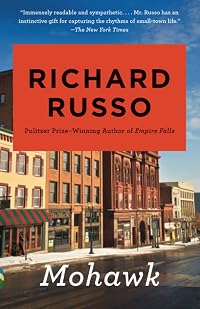
Mohawk
by Richard Russo
On This Page
Description
Mohawk, New York, is one of those small towns that lie almost entirely on the wrong side of the tracks. Its citizens, too, have fallen on hard times. Dallas Younger, a star athlete in high school, now drifts from tavern to poker game, losing money, and, inevitably, another set of false teeth. His ex-wife, Anne, is stuck in a losing battle with her mother over the care of her sick father. And their son, Randall, is deliberately neglecting his school work--because in a place like Mohawk it show more doesn't pay to be too smart. In Mohawk Richard Russo explores these lives with profound compassion and flint-hard wit. Out of derailed ambitions and old loves, secret hatreds and communal myths, he has created a richly plotted, densely populated, and wonderfully written novel that captures every nuance of America's backyard. show lessTags
Recommendations





Member Reviews
I fell in love with the works of Richard Russo when I read his Pulitzer Prize winning "Empire Falls". Since then, I've read most of what he has written; and to varying degrees loved it all. My favorites, in addition to Empire, are "Nobody's Fool", and a book I recently read called "Mohawk". Mohawk is the first book Russo ever wrote. If you know Russo at all, you know that his books read like a bluesy Bruce Springsteen song. They tend to be about a small blue collar town where the town's main employer has been polluting the air and water for years, and is edging ever closer to bankruptcy. And as the employer goes (in Mohawk the employer is a tannery) so goes the town. Russo examines the lives of the people who stay in such a dying town. show more Why do they stay? What is the story of their Glory Days, and how do they cope with the loss of those days? And is the tannery a villain for sucking the townspeople dry, and leaving them with nothing but a poison river, or a hero for giving many years of a break-even economy to an otherwise destitute townspeople? Mohawk was a very enjoyable and thought provoking book. show less
Straight Man is one of my favorite novels of all time, so when I saw that Russo had also written a novel set in a small town in central New York, I had to buy it immediately. I've finally maneuvered free-time for reading into my schedule---what a pleasure it was! Seeing that I live right next to "Mohawk, New York," the town in which the novel is set, I felt even more connected to the characters as names of all of the surrounding areas of my life kept coming up (Even though there isn't a Mohawk County).
Russo has a way of describing deep and sensitive characters and plot events with levity. It's pure enjoyment to read, and at the same time gives valuable vicarious life experience. I just want to say I love Mather Grouse and how could show more anyone even tolerate the obnoxious sisters Milly and Mrs. Grouse--but you love them anyway! I saw all of the insufferable flaws of half a dozen people in my life in these characters, but their Mohawkian fictional equivalents are nonetheless lovable. So I feel that I can face, say, my ex (another Dallas Younger), with a bit more tolerance at this point.
Mather Grouse hits home when he tells his daughter that "People sometimes get in the habit of being loyal to a mistake. They can devote their whole lives to it." Adelle has tried to tell me as much, but Mather seemed to be more credible, I suppose. I have this quote on an index card and I tossed it carelessly into my disorganized desk so that I can find it when fate allows.
I'm reminded why I love reading so much, and I'm inspired to read "She's Come Undone" again--I'm missing a female character that I can really relate to. I've been reading too many stories with male protagonists lately.
Enjoy! I HIGHLY recommend this book, especially to locals! show less
Russo has a way of describing deep and sensitive characters and plot events with levity. It's pure enjoyment to read, and at the same time gives valuable vicarious life experience. I just want to say I love Mather Grouse and how could show more anyone even tolerate the obnoxious sisters Milly and Mrs. Grouse--but you love them anyway! I saw all of the insufferable flaws of half a dozen people in my life in these characters, but their Mohawkian fictional equivalents are nonetheless lovable. So I feel that I can face, say, my ex (another Dallas Younger), with a bit more tolerance at this point.
Mather Grouse hits home when he tells his daughter that "People sometimes get in the habit of being loyal to a mistake. They can devote their whole lives to it." Adelle has tried to tell me as much, but Mather seemed to be more credible, I suppose. I have this quote on an index card and I tossed it carelessly into my disorganized desk so that I can find it when fate allows.
I'm reminded why I love reading so much, and I'm inspired to read "She's Come Undone" again--I'm missing a female character that I can really relate to. I've been reading too many stories with male protagonists lately.
Enjoy! I HIGHLY recommend this book, especially to locals! show less
This book challenged me to ask myself what comprises a "good book".
On the one hand, the part of me that majored in English in college loved every delicious page of this well-crafted work. Superb character sketches, insightful themes (can true love be wrong? are our lives directed by fate or self-will? why do we remain loyal to our mistakes? why do we seek to rationalize that which is inherently irrational?), some imaginative symbolism, the author's honest, graceful voice and technical skill - especially the way Russo paces the novel so that information & insights emerge organically, in the context of the story rather than via awkward expository text - kept me on my toes throughout the story, grinning with scholarly pleasure each time a show more plot deftly wrapped in on itself or a particularly ingenious turn of phrase suddenly illuminated a theme or universal truth. I love, too, that Russo doesn't condescend to his readers, trusting us to make inferences and recognize themes and to spot irony without hitting us over the head with it.
On the other hand, the reader in me craved something more ... filling. Characters that change and grow rather than remaining fixed points. (I recognize that this is a major theme of the story, but that doesn't make it any more satisfying.) A plot dominant enough to unite and give purpose to the fragmented, endlessly intersecting strands of storyline. Conflicts that rise above - or at least make more noble/meaningful - the everyday conflicts of duty, loyalty, selfishness, desire & honor that shape these characters' lives. This story simply doesn't stand up when it comes to capturing the reader's imagination - or heart.
I haven't yet read Empire Falls, but if Russo ever figures out how to blend his technical brilliance with characters & a story that capture the reader's attention and empathy, he is destined to become a formidable literary figure. I get English major goosebumps just thinking about it! show less
On the one hand, the part of me that majored in English in college loved every delicious page of this well-crafted work. Superb character sketches, insightful themes (can true love be wrong? are our lives directed by fate or self-will? why do we remain loyal to our mistakes? why do we seek to rationalize that which is inherently irrational?), some imaginative symbolism, the author's honest, graceful voice and technical skill - especially the way Russo paces the novel so that information & insights emerge organically, in the context of the story rather than via awkward expository text - kept me on my toes throughout the story, grinning with scholarly pleasure each time a show more plot deftly wrapped in on itself or a particularly ingenious turn of phrase suddenly illuminated a theme or universal truth. I love, too, that Russo doesn't condescend to his readers, trusting us to make inferences and recognize themes and to spot irony without hitting us over the head with it.
On the other hand, the reader in me craved something more ... filling. Characters that change and grow rather than remaining fixed points. (I recognize that this is a major theme of the story, but that doesn't make it any more satisfying.) A plot dominant enough to unite and give purpose to the fragmented, endlessly intersecting strands of storyline. Conflicts that rise above - or at least make more noble/meaningful - the everyday conflicts of duty, loyalty, selfishness, desire & honor that shape these characters' lives. This story simply doesn't stand up when it comes to capturing the reader's imagination - or heart.
I haven't yet read Empire Falls, but if Russo ever figures out how to blend his technical brilliance with characters & a story that capture the reader's attention and empathy, he is destined to become a formidable literary figure. I get English major goosebumps just thinking about it! show less
This was Russo's first novel and while it's not as accomplished, obviously, as his later work, it covers some familiar ground - a down-at-the-heels town, ordinary people struggling through life, a snapshot of American life in a particular time and place. In this one, it's the late 1960s in a dying industrial town in upstate New York. I really enjoyed the first part of the novel, with its wide cast of characters and dry humor. The second part, set a few years later, was darker and the ending felt rushed.
4 stars
4 stars
I am somewhat familiar with the Mohawk Valley between Utica and Schenectady so this book had resonance to me. The "Mohawk" village in the novel surely is Gloversville where there was a flourishing leather industry until the mid-twentieth century. Mohawk is one of a number of small towns on the "outs", where nothing much is happening except young people leaving for greener pastures. (There is an actual village named Mohawk and it's a lot like Gloversville.)
Russo captures the lives of the town's inhabitants well. They understand that things will not get better for them; in a sense, they are trapped by history and family ties that they know they will never escape.
Anne Younger, a bright and attractive woman, did not follow until too late show more her father's advice to leave Mohawk for the greater opportunities in more prosperous places. She married Dallas Younger, a high school star who was self-centered and unreliable. Their marriage did not last and Anne, after a stint in the big city returns to Mohawk with her young son, Randall. Anne lives with father and mother, Mather and Mrs. Grouse. Mather is a reticent and principled man, retired from the tannery, somewhat austere and friendless. Mrs. Grouse is a bit punctilious and difficult. Anne has been in love for years with Dan Wood, the husband of her cousin. Dallas is not closely connected to his family, often drunk and involved in gambling.
Wild Bill Gaffney is the son of Rory, a domineering man, retired from the tannery where Mather also worked. Wild Bill is mentally retarded from some incident vaguely described that we later learn was a severe beating by Rory. His uncle, Rory's brother, is the town cop who seems ineffectual and held in low esteem by the towns people. Harry Saunders runs the Mohawk Grill, a hangout and social gathering spot in the town.
While the story is much focused on portraying the lives of the characters in this decaying town, many of whom are of low character and shiftlessness, there is a plot line involving Randall. Randall grows up and leaves for college where after a few semesters he drops out and returns to Mohawk, planning on somehow avoiding the draft (this around 1972). Randall takes up with BG, a girl a few years younger who is staying in a trailer behind Rory's house. Rory has been stealing hides from the tannery and enlists Randall to take them downstate. Randall plans on double crossing Rory, but ends up in a situation where Officer Gaffney (who has been going mad) shoots Rory, Wild Bill and then himself. Randall is charged with murder, but his story, backed up by BG, is so strong that the charges are dropped. At the novel's conclusion, Randall runs away to keep from being drafted.
Anne's cousin, Diana, dies and Anne could at last fulfill her and Dan's desire for each other. It isn't clear whether this is going to happen and it looks more likely that the lives of the people of Mohawk will continue on the same plane as before.
What makes Russo's novel so good is his depiction of the characters. They are trapped by circumstances that they can't or won't attempt to control. Their lives are linked to Mohawk's fortunes and not much positive with happen to them or the town. show less
Russo captures the lives of the town's inhabitants well. They understand that things will not get better for them; in a sense, they are trapped by history and family ties that they know they will never escape.
Anne Younger, a bright and attractive woman, did not follow until too late show more her father's advice to leave Mohawk for the greater opportunities in more prosperous places. She married Dallas Younger, a high school star who was self-centered and unreliable. Their marriage did not last and Anne, after a stint in the big city returns to Mohawk with her young son, Randall. Anne lives with father and mother, Mather and Mrs. Grouse. Mather is a reticent and principled man, retired from the tannery, somewhat austere and friendless. Mrs. Grouse is a bit punctilious and difficult. Anne has been in love for years with Dan Wood, the husband of her cousin. Dallas is not closely connected to his family, often drunk and involved in gambling.
Wild Bill Gaffney is the son of Rory, a domineering man, retired from the tannery where Mather also worked. Wild Bill is mentally retarded from some incident vaguely described that we later learn was a severe beating by Rory. His uncle, Rory's brother, is the town cop who seems ineffectual and held in low esteem by the towns people. Harry Saunders runs the Mohawk Grill, a hangout and social gathering spot in the town.
While the story is much focused on portraying the lives of the characters in this decaying town, many of whom are of low character and shiftlessness, there is a plot line involving Randall. Randall grows up and leaves for college where after a few semesters he drops out and returns to Mohawk, planning on somehow avoiding the draft (this around 1972). Randall takes up with BG, a girl a few years younger who is staying in a trailer behind Rory's house. Rory has been stealing hides from the tannery and enlists Randall to take them downstate. Randall plans on double crossing Rory, but ends up in a situation where Officer Gaffney (who has been going mad) shoots Rory, Wild Bill and then himself. Randall is charged with murder, but his story, backed up by BG, is so strong that the charges are dropped. At the novel's conclusion, Randall runs away to keep from being drafted.
Anne's cousin, Diana, dies and Anne could at last fulfill her and Dan's desire for each other. It isn't clear whether this is going to happen and it looks more likely that the lives of the people of Mohawk will continue on the same plane as before.
What makes Russo's novel so good is his depiction of the characters. They are trapped by circumstances that they can't or won't attempt to control. Their lives are linked to Mohawk's fortunes and not much positive with happen to them or the town. show less
I read Richard Russo's first book , Mohawk, after having read several of his newer titles. I admire Russo's story telling style and his great characterization . Empire Falls was the first book I read and I was hooked. I went back to read Mohawk mainly because I grew up in the area Russo writes about and I know the small village life. Mohawk is definitely the beginning of where Russo goes as an author and storyteller. It is not my favorite but in context with his later books, I am glad I read it.
The town of Mohawk has seen “better” days---days in which the local tanneries and leather mills were thriving and a man could make an honest living—or a dishonest one, if he preferred—by working in them. Now, cheap imports, synthetics, and investigations of corruption are taking away the profitability of the leather industry; decades of chemical pollution have turned Mohawk’s creeks and ground water deadly; there isn’t much to recommend life in this small upstate New York town anymore. Richard Russo explores the intertwined lives of several residents who, whether voluntarily or inevitably, find themselves tied to the community as it goes to pieces. It’s hard to admire any of the characters in this novel, or to sympathize show more with most of them. They all seem to be stuck in a mediocre life with no clue how to improve even a few minutes of it at a time. Those with principles are just as miserable as those without. I’m not sure what the take-away should be from this tale, and it suffers from a few “first novel” shortcomings. I certainly didn’t love it, but if I had never read Russo before, I believe I would have seen promise here, and probably would have felt that I wanted to try him again. As it is, I know he’s proved himself capable of better stuff, and I’m glad to have seen how he started.
February 2016 show less
February 2016 show less
Members
- Recently Added By
Lists

Books Read in 2023
5,547 works; 145 members

Books Set in Small Towns and Villages
278 works; 16 members
Stephen King's 'On Writing' reading list
95 works; 4 members
Author Information

36+ Works 29,010 Members
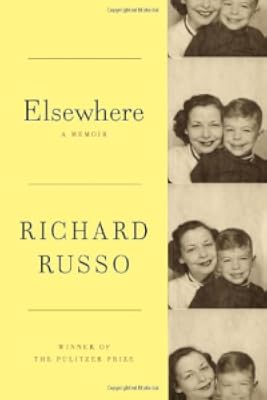
Richard Russo was born in Johnstown, New York on July 15, 1949. He received a Bachelor's degree, a Master of Fine Arts degree, and a Doctor of Philosophy degree from the University of Arizona. He taught at numerous colleges including Southern Illinois University Carbondale and Colby College. He has written numerous books including Mokawk, The Risk show more Pool, Straight Man, Bridge of Sighs, and That Old Cape Magic, as well as a short story collection, The Whore's Child. His novel Empire Falls won the 2002 Pulitzer Prize for Fiction and Nobody's Fool was made into a movie starring Paul Newman, Bruce Willis and Melanie Griffith. His memoir was entitled Elsewhere. He also co-wrote the 1998 film Twilight with director Robert Benton and the teleplay for the HBO adaptation of Empire Falls. (Bowker Author Biography) Richard Russo lives in coastal Maine with his wife & two daughters. (Publisher Fact Sheets) show less
Some Editions
Work Relationships
Is contained in
Common Knowledge
- Original publication date
- 1986-09
- People/Characters
- Randall Younger; Dallas Younger; Anne Grouse; Mather Grouse; Mrs. Grouse; William Gaffney (Wild Bill) (show all 13); Dan Wood; Diana Wood; Harry Saunders; Rory Gaffney; Officer Gaffney; B. Gaffney (B.G.); Loraine Younger
- Important places
- Mohawk, New York, USA
- Epigraph
- But Faith, like a jackal, feeds among the tombs, and even from these dead doubts she gathers her most vital hope.
- Herman Melville, Moby-Dick - Dedication
- For Barbara, Emily, and Kate
And for Dick LaVarn
In Loving Memory - First words
- The back door to the Mohawk Grill opens on an alley it shares with the junior high.
- Last words
- (Click to show. Warning: May contain spoilers.)"He's due, all right, that son-of-a-bitch."
- Blurbers
- Irving, John; Hannah, Barry; Buford, Bill
Classifications
Statistics
- Members
- 1,045
- Popularity
- 24,684
- Reviews
- 21
- Rating
- (3.78)
- Languages
- 5 — Catalan, Dutch, English, French, German
- Media
- Paper, Audiobook, Ebook
- ISBNs
- 20
- ASINs
- 4