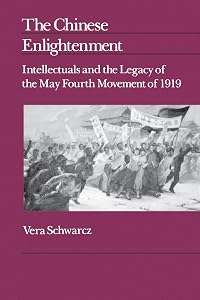
The Chinese Enlightenment: Intellectuals and the Legacy of the May Fourth Movement of 1919 (Center for Chinese Studies, UC Berkeley)
by Vera Schwarcz
On This Page
Description
It is widely accepted, both inside China and in the West, that contemporary Chinese history begins with the May Fourth Movement. Vera Schwarcz's imaginative new study provides China scholars and historians with an analysis of what makes that event a turning point in the intellectual, spiritual, cultural and political life of twentieth-century China.Tags
Recommendations













Member Reviews
This book examines the May Fourth Movement and its impact on Chinese society, both short and long term. Schwarcz defines the enlightenment as an attempt to reform and modernize the nation’s character. She accentuates the iconoclasm of May Fourth thought, which many intellectuals explicitly calling for “idol-smashing” and questioning all assumptions. Yet the movement itself did not, in fact, move China substantially. It had little impact on its target audience, the Chinese populace. Instead Schwarcz argues that it was a failed attempt at defining, or redefining, the national character. She claims that it was “the first of a series of incomplete efforts to uproot feudalism while pursuing the cause of nationalist revolution”. show more
Schwarz argues that the division of the movement had a profound effect. The movement centered around Beijing University, where there was an intellectual divide between the students and teachers. The teachers had lived through the revolutions of 1911 and were wary to advocate another revolution. The students, however, were more radical and demanded more drastic and immediate changes. Teachers’ attempt to rein in students backfired, fueling further radicalization and distrust of the established authority. Although the movement itself was short lived, the students’ participation in it would have longer effects, with many members of the movement later becoming CCP cadres, including one CCP founder Chen Duxiu. This is where Schwarcz sees the movement’s long term effect. The radicalized students established a new intellectual elite that would eventually have the power to implement some of its ideas.
It's reliance of oral histories without substantial documentary support makes its accuracy a little suspect, as the interviews were done over fifty years after the events in question, but it is still a very valuable work. show less
Schwarz argues that the division of the movement had a profound effect. The movement centered around Beijing University, where there was an intellectual divide between the students and teachers. The teachers had lived through the revolutions of 1911 and were wary to advocate another revolution. The students, however, were more radical and demanded more drastic and immediate changes. Teachers’ attempt to rein in students backfired, fueling further radicalization and distrust of the established authority. Although the movement itself was short lived, the students’ participation in it would have longer effects, with many members of the movement later becoming CCP cadres, including one CCP founder Chen Duxiu. This is where Schwarcz sees the movement’s long term effect. The radicalized students established a new intellectual elite that would eventually have the power to implement some of its ideas.
It's reliance of oral histories without substantial documentary support makes its accuracy a little suspect, as the interviews were done over fifty years after the events in question, but it is still a very valuable work. show less
Department of History, University of Hong Kong
Ratings
Members
- Recently Added By
Lists

The China Project Book List
100 works; 2 members

In Our Time books
4,934 works; 2 members
Author Information
10 Works 83 Members
Awards and Honors
Notable Lists
Classifications
Statistics
- Members
- 38
- Popularity
- 764,129
- Reviews
- 2
- Rating
- (3.33)
- Languages
- English
- Media
- Paper, Ebook
- ISBNs
- 3
- ASINs
- 1