A Dictionary of American Idioms
by Adam Makkai
On This Page
Description
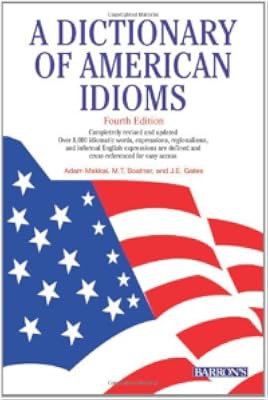
More than 8,000 idiomatic words and phrases specific to American-style English are presented in this updated dictionary, complete with definitions and sample sentences. Especially useful for TOEFL test-takers and other students in America for whom English is a second language, this book explains and clarifies many of the similes and metaphors that newcomers to American English find mystifying. It is also useful to native-born Americans who are sometimes confused by regional colloquialisms show more encountered in reading or on TV. Idioms undergo constant change in every living language, some of them falling out of use, while new words and phrases become part of the standard vocabulary. This dictionary's new fourth edition takes account of the latest idiomatic changes and provides a solid background to informal American English.--From publisher description. show lessTags
Recommendations























Member Reviews
As defined in the Preface, an "idiom" is a new meaning assigned to a word or phrase that already has its own meaning. English is heavily idiomatic, an observation the editors try to explain while pointing out that all known languages (there are many yet to be explored) have idioms.
The work describes more than 4000 idioms with definitions, usage, and by parts of speech. The types are described in the Preface: Lexemic idioms reflect the parts of speech: verbal, nominal, adverbial, adjective. Others are identified by size and form: Tournures are the longer phrases ("seize the bull by the horns"), and some are "frozen" or inflexible. (You are not likely to be understood if you say "the bucket has been kicked by the cowboy".)
Finally, the show more book includes established "sayings and proverbs" which are idiomatic: "don't wash your dirty linen in public", and "don't count your chickens before they hatch".
Although Adam Makkai is old enough to know, he defines "big lie" in relation to Watergate, rather than to King Leopold of Belgium, whose use of it was eulogized by Joseph Goebbels. This illustrates the Editor's choice of current illustration rather than etymological reference. For some reason, perhaps peculiar to idiomography, the editors are INTENT upon clear understanding. They spell out the meanings with illustration, usages, and context. This further reflects their belief that "the use of idioms is...extremely important. It can strike a chord of solidarity with the listener." [vii] This certainly does: Struck, the chord is. show less
The work describes more than 4000 idioms with definitions, usage, and by parts of speech. The types are described in the Preface: Lexemic idioms reflect the parts of speech: verbal, nominal, adverbial, adjective. Others are identified by size and form: Tournures are the longer phrases ("seize the bull by the horns"), and some are "frozen" or inflexible. (You are not likely to be understood if you say "the bucket has been kicked by the cowboy".)
Finally, the show more book includes established "sayings and proverbs" which are idiomatic: "don't wash your dirty linen in public", and "don't count your chickens before they hatch".
Although Adam Makkai is old enough to know, he defines "big lie" in relation to Watergate, rather than to King Leopold of Belgium, whose use of it was eulogized by Joseph Goebbels. This illustrates the Editor's choice of current illustration rather than etymological reference. For some reason, perhaps peculiar to idiomography, the editors are INTENT upon clear understanding. They spell out the meanings with illustration, usages, and context. This further reflects their belief that "the use of idioms is...extremely important. It can strike a chord of solidarity with the listener." [vii] This certainly does: Struck, the chord is. show less
Ratings
Members
- Recently Added By
Author Information
17+ Works 434 Members
Classifications
Statistics
- Members
- 263
- Popularity
- 123,813
- Reviews
- 1
- Rating
- (3.80)
- Languages
- English, Korean
- Media
- Paper, Ebook
- ISBNs
- 11