On This Page
Description
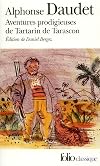
CROWNED BY THE FRENCH ACADEMYAlphonse Daudet was a French novelist and playwright. His father was a silk manufacturer who suffered reverses and lost his property. Daudet took a post as a schoolteacher at Ales, Gard, but found it intolerable, and moved to Paris to live with his brother, Ernest, who was working as a journalist. Daudet wrote poetry and several plays, and secured employment as a secretary to Morny, a Minister of Napoleon III.Tatarin of Tarascon is a tale of the adventures of show more Tartarin, a local hero of Tarascon, a small town in southern France.The book spawned two sequels: Tartarin sur les Alpes and Port-Tarascon, as well as three film adaptations. Unpopular in the area of Tarascon when first issued, the Tatarin adventures made Tarascon famous, and there is now a museum in Tarascon devoted to Tatarin. show lessTags
Recommendations




















Member Reviews
A short and very amusing little novel (88p). Our hero, Tartarin, is a Quixote-like character, his imagination fired by adventure stories and his accumulation of weapons. But while he finds life in provincial southern France dull - at local hunting trips the men are reduced to throwing their caps in the air and shooting at them due to a paucity of wildlife - Tartarin also has a luxury-loving Sancho Panza side to his character, and consequently has never had a real adventure.
"Quixote-Tartarin firing up on the stories of Gustave Aimard and shouting "Up and at 'em!" and Sancho-Tartarin thinking only of the rheumatics ahead and murmuring "I mean to stay at home."
But after an encounter with a lion in a local menagerie, the rumour goes about show more that Tartarin is off to hunt lions in Algeria, and reluctantly he has to make the journey...
His adventures in Africa are highly entertaining and comical featuring a Moorish lady-of-the-night, a camel, a not-to-be-trusted Montenegrin prince ... and even a lion.
Great translation renders the original in convincing Victorian English. show less
"Quixote-Tartarin firing up on the stories of Gustave Aimard and shouting "Up and at 'em!" and Sancho-Tartarin thinking only of the rheumatics ahead and murmuring "I mean to stay at home."
But after an encounter with a lion in a local menagerie, the rumour goes about show more that Tartarin is off to hunt lions in Algeria, and reluctantly he has to make the journey...
His adventures in Africa are highly entertaining and comical featuring a Moorish lady-of-the-night, a camel, a not-to-be-trusted Montenegrin prince ... and even a lion.
Great translation renders the original in convincing Victorian English. show less
10/10
This undoubtedly reflects a nostalgia rating -- but for all of that it has stood the test of time rather well.
I was put back on this magical mystery tour by a chance remark of Fionnuala's in her 2019 year-in-review comments: that a tartarin is both a braggart, and a finely woven cloth. Both connected in my mind with the indefatigable Tartarin de Tarascon, who, braggart though he was, took us all on a (finely-woven) magic carpet ride, in the year when we were 10 or 11.
Other than the fact that 39 children (yes, class sizes were that big, back then, and more) probably didn't understand half of the nuances and jokes that were delivered, we were all completely mesmerized by the adventure, the journey and the delivery. You couldn't show more hear a pin drop, in that classroom, for a half hour every afternoon, as M. Dufault became Tartarin for us.
I would suggest that never had we heard, in our little hamlet, stories that were so rich, wherein the words and descriptions were swimming with such meaning and taste one could almost eat them with a spoon.
Enfin, devant le guéridon, un homme était assis, de quarante à quarante-cinq ans, petit, gros, trapu, rougeaud, en bras de chemise, avec des caleçons de flanelle, une forte barbe courte et des yeux flamboyants, d'une main il tenait un livre, de l'autre il brandissait une énorme pipe à couvercle de fer, et, tout en lisant je ne sais quel formidable récit de chasseurs de chevelures, il faisait, en avançant sa lèvre inférieure, une moue terrible, qui donnait à sa brave figure de petit rentier tarasconnais ce même caractère de férocité bonasse qui régnait dans toute la maison. Cet homme, c'était Tartarin, Tartarin de Tarascon, l'intrépide, le grand, l'incomparable Tartarin de Tarascon.
This was the first of many stories that M. Dufault would read to us, through the full of one scholastic year: alternating between French and English novels, we explored the furthest horizons of the imagination. More than most, Daudet remained in our hearts and engendered in us a desire to immerse ourselves in books -- to explore every corner of where these magical pages would take us.
More than half of that class of schoolmates became teachers: professors, instructors, lecturers, in various levels of schools, from elementary to university. They didn't all specialize in literature, of course, but they certainly brought their flare for the dramatic into their students' lives.
Daudet's rich imaginings, his deliberate exaggeration of the mundane and trivial; his colourful, exotic, incandescent descriptions of bird, beast and man, all gave us the breath to pursue our dreams.
Daudet was a much troubled soul; and no doubt, some of his literature would not gain an audience in today's more culturally sensitive world. (Thank goodness humankind does have the capacity to evolve in a positive way, from time to time.) But for all of that, I don't care, because I can distinguish between what was and what is; and I can distinguish between the spirit of adventure, and the cold heart facts of a cruel society.
He will always remain both Quichotte and Pansa for me -- the best of both worlds -- as I suspect he has remained for the other 38 that listened with me, in those old school days. Merci, M. Dufault, wherever you are. show less
This undoubtedly reflects a nostalgia rating -- but for all of that it has stood the test of time rather well.
I was put back on this magical mystery tour by a chance remark of Fionnuala's in her 2019 year-in-review comments: that a tartarin is both a braggart, and a finely woven cloth. Both connected in my mind with the indefatigable Tartarin de Tarascon, who, braggart though he was, took us all on a (finely-woven) magic carpet ride, in the year when we were 10 or 11.
Other than the fact that 39 children (yes, class sizes were that big, back then, and more) probably didn't understand half of the nuances and jokes that were delivered, we were all completely mesmerized by the adventure, the journey and the delivery. You couldn't show more hear a pin drop, in that classroom, for a half hour every afternoon, as M. Dufault became Tartarin for us.
I would suggest that never had we heard, in our little hamlet, stories that were so rich, wherein the words and descriptions were swimming with such meaning and taste one could almost eat them with a spoon.
Enfin, devant le guéridon, un homme était assis, de quarante à quarante-cinq ans, petit, gros, trapu, rougeaud, en bras de chemise, avec des caleçons de flanelle, une forte barbe courte et des yeux flamboyants, d'une main il tenait un livre, de l'autre il brandissait une énorme pipe à couvercle de fer, et, tout en lisant je ne sais quel formidable récit de chasseurs de chevelures, il faisait, en avançant sa lèvre inférieure, une moue terrible, qui donnait à sa brave figure de petit rentier tarasconnais ce même caractère de férocité bonasse qui régnait dans toute la maison. Cet homme, c'était Tartarin, Tartarin de Tarascon, l'intrépide, le grand, l'incomparable Tartarin de Tarascon.
This was the first of many stories that M. Dufault would read to us, through the full of one scholastic year: alternating between French and English novels, we explored the furthest horizons of the imagination. More than most, Daudet remained in our hearts and engendered in us a desire to immerse ourselves in books -- to explore every corner of where these magical pages would take us.
More than half of that class of schoolmates became teachers: professors, instructors, lecturers, in various levels of schools, from elementary to university. They didn't all specialize in literature, of course, but they certainly brought their flare for the dramatic into their students' lives.
Daudet's rich imaginings, his deliberate exaggeration of the mundane and trivial; his colourful, exotic, incandescent descriptions of bird, beast and man, all gave us the breath to pursue our dreams.
Daudet was a much troubled soul; and no doubt, some of his literature would not gain an audience in today's more culturally sensitive world. (Thank goodness humankind does have the capacity to evolve in a positive way, from time to time.) But for all of that, I don't care, because I can distinguish between what was and what is; and I can distinguish between the spirit of adventure, and the cold heart facts of a cruel society.
He will always remain both Quichotte and Pansa for me -- the best of both worlds -- as I suspect he has remained for the other 38 that listened with me, in those old school days. Merci, M. Dufault, wherever you are. show less
Tartarin is the prefiguration of a Mediterranian type, being rather economical with the truth. He could be Quijote and Sancho in one person.
Ongelofelijk vermakelijk, zeer vertellende stijl vol ironie; ondertoon van kritiek op het burgermannetje. Typerende overdrijvingen, in lijn van Rabelais.
Verdediging zuiderse mentaliteit.
Verdediging zuiderse mentaliteit.
Aug 29, 2010Dutch
Le charme de la Provence, le soleil de la Provence, la gaieté de la Provence, toutes ces qualités se retrouvent dans ce plaisant chef d'oeuvre avec la douceur de vivre qui pouvait exister au siècle passé dans une petite ville du Midi. Douceur de vivre que savoure Tartarin mais qui pèse un peu à ce bourgeois épris d'héroïsme. De là, son goût de la vantardise qui finira par le lancer - pas trop rassuré - dans sa rocambolesque épopée africaine. Il y déploiera l'énergie et la persévérance qui feront de lui un héros, un héros attendrissant et un peu comique, mais un héros tout de même.
Aug 14, 2010French
Romanzo del XIX secolo in lingua originale. Presentazione di Jacques-Henry Bornecque
Jul 24, 2015Italian
Adaptado para niños - Versión abrebviada
Aug 22, 2021Spanish
Members
- Recently Added By
Lists

CCE 1000 Good Books List
1,033 works; 12 members

French Fiction of the 18th and 19th Centuries in English Translation
169 works; 3 members

Trinity College Booklist (1951): Class Nine, Foreign Literatures
161 works; 3 members

Van Gogh's reading list
11 works; 1 member
Author Information

379+ Works 4,952 Members
Novelist and short-story writer Alphonse Daudet was born on May 13, 1840 in Nimes, France. At the age of 14, he wrote his first novel. He worked as a teacher in Alais, a journalist in Paris, and as a private secretary for Duke de Morny from 1861 to 1865. He married fellow writer Julia Allard in 1867. He enlisted in the army during the show more Franco-Prussian war. He is primarily remembered for his sentimental tales of provincial life in the south of France. His novel Fromont the Younger and Risler the Elder won an award from the Academie Francaise. He died on December 16, 1897 in Paris. (Bowker Author Biography) show less
Some Editions
Series

Belongs to Publisher Series
Limited Editions Club (S:1.09)
Insel-Bücherei (Nr. 42)
insel taschenbuch (0084)
Gli Oscar [Mondadori] (180)
Everyman's Library (423)
Work Relationships
Common Knowledge
- Canonical title
- Tartarin of Tarascon
- Original title
- Tartarin de Tarascon
- Original publication date
- 1872
Classifications
Statistics
- Members
- 815
- Popularity
- 33,970
- Reviews
- 10
- Rating
- (3.46)
- Languages
- 16 — Catalan, Czech, Dutch, English, Esperanto, Finnish, French, German, Greek, Hungarian, Italian, Portuguese (Portugal), Russian, Spanish, Swedish, Turkish
- Media
- Paper, Audiobook, Ebook
- ISBNs
- 181
- ASINs
- 55