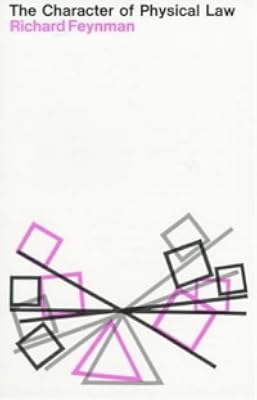
The Character of Physical Law
by Richard Feynman
On This Page
Description
In these Messenger Lectures, originally delivered at Cornell University and recorded for television by the BBC, Richard Feynman offers an overview of selected physical laws and gathers their common features into one broad principle of invariance. He maintains at the outset that the importance of a physical law is not "how clever we are to have found it out but…how clever nature is to pay attention to it" and steers his discussions toward a final exposition of the elegance and simplicity of show more all scientific laws. Rather than an essay on the most significant achievements in modern science, The Character of Physical Law is a statement of what is most remarkable in nature. Feynman's enlightened approach, his wit, and his enthusiasm make this a memorable exposition of the scientist's craft. The law of gravitation is the author's principal example. Relating the details of its discovery and stressing its mathematical character, he uses it to demonstrate the essential interaction of mathematics and physics. He views mathematics as the key to any system of scientific laws, suggesting that if it were possible to fill out the structure of scientific theory completely, the result would be an integrated set of mathematical axioms. The principles of conservation, symmetry, and time irreversibility are then considered in relation to developments in classical and modern physics, and in his final lecture, Feynman develops his own analysis of the process and future of scientific discovery. Like any set of oral reflections, The Character of Physical Law has special value as a demonstration of the mind in action. The reader is particularly lucky in Richard Feynman-one of the most eminent and imaginative modern physicists. show lessTags
Recommendations





Member Reviews
A transcription of a series of seven lectures given in 1964 by the legendary physicist Richard Feynman on the subject of the laws of nature and how we go about learning them. Feynman was a notoriously informal lecturer who worked without prepared speeches, and I think his style suffers a bit here from being transferred into print, despite having been cleaned up slightly for publication. There are places where I'm quite sure the lecture would have been more effective live and in person, and even a few spots where I had a little trouble following. Regardless, this is still a marvelous exploration of the subject, as Feynman discusses the fundamental laws of the universe, with all their neat interconnections and their profound mysteries. show more This book gave me new insights into aspects of physics I thought I already understood, and it contains what is probably the best explanation of the law of energy conservation that I have ever seen. Most importantly, Feynman understood, perhaps better than anyone else ever has, that science is not about facts, it's about figuring things out, and he was very, very good at helping other people to understand that, too. show less
This is a fantastic little book for which we have to thank the BBC: They decided to film these lectures and subsequently publish transcripts of them, at a time before Feynman had turned into a one-man industry and every one of Feynman`s students`first-draft lecture notes became as diamond dust.
The title tells one enough about the contents; if you have any interest in the topic you should read this book. It is almost but not completely non-mathematical. If you can cope with the algebra contained within F=GMm/R - well, that's as hard as it gets.
The aspect of the book that particularly interested me this time around is in Chapter two (and reprised somewhat in the final lecture). Feynman takes the above given equation, which expresses show more Newton's Law of Universal Gravitation and says - that's all very well, but you can express it in another way that's to do with how something called a potential varies locally - and if you do it will always give exactly the same answer! And, not content with that, you can express it another way that is to do with finding the minimum of a certain thing called the Action. (Technically it doesn't have to be a minimum, just somewhere where the tangent to the graph of the Action would be horizontal.) Done this way, the answers always come out the same as the other two ways! What's the point of that? Three ways to say the same thing!
But here's the interesting, indeed profound thing: when it came to understanding quantum mechanics (which doesn't deal with gravity) it was found that both potentials and a principle of minimum (stationary, strictly) Action were needed. So the different ways of expressing Newton's gravity law turned out profoundly useful in understanding a different set of phenomena, namely the nuclear forces and electromagnetism.
So if you are involved in trying to understand fundamental physics it would probably be healthy to actively search for different mathematical methods of expressing the laws as we understand them now!
Incidently, I doubt you will ever come across a more accessible introduction to the essential mystery of quantum mechanics (the photon/electron double slit experiment) than that given in this lecture, in which Feynman gave his famous quote, "...I think I can safely say nobody understands quantum mechanics." show less
The title tells one enough about the contents; if you have any interest in the topic you should read this book. It is almost but not completely non-mathematical. If you can cope with the algebra contained within F=GMm/R - well, that's as hard as it gets.
The aspect of the book that particularly interested me this time around is in Chapter two (and reprised somewhat in the final lecture). Feynman takes the above given equation, which expresses show more Newton's Law of Universal Gravitation and says - that's all very well, but you can express it in another way that's to do with how something called a potential varies locally - and if you do it will always give exactly the same answer! And, not content with that, you can express it another way that is to do with finding the minimum of a certain thing called the Action. (Technically it doesn't have to be a minimum, just somewhere where the tangent to the graph of the Action would be horizontal.) Done this way, the answers always come out the same as the other two ways! What's the point of that? Three ways to say the same thing!
But here's the interesting, indeed profound thing: when it came to understanding quantum mechanics (which doesn't deal with gravity) it was found that both potentials and a principle of minimum (stationary, strictly) Action were needed. So the different ways of expressing Newton's gravity law turned out profoundly useful in understanding a different set of phenomena, namely the nuclear forces and electromagnetism.
So if you are involved in trying to understand fundamental physics it would probably be healthy to actively search for different mathematical methods of expressing the laws as we understand them now!
Incidently, I doubt you will ever come across a more accessible introduction to the essential mystery of quantum mechanics (the photon/electron double slit experiment) than that given in this lecture, in which Feynman gave his famous quote, "...I think I can safely say nobody understands quantum mechanics." show less
What an enlightenment, how sheer the awe, how great the pleasure. An extraordinary genius, an amazing teacher, and perhaps the most curious human being to ever walk on earth. These lectures are not only an education but a kind of osmotic transfer of Feynman's curiosity to the immediate generation that learnt from him, and to many more include ours. However this osmosis is not ideal in a sense that concentration of curiosity on both sides can never be equal.
I like Richard Feynman and the way he explains things. As with any great scholar, he does know how to explain and teach laymen. The lecture was interesting to listen to and though some of it bounced off of me, it was still informative.
This book is a transcription of a series of lectures Feynman gave in 1964 for an audience of non-physicists. Much of it is similar to what you find in good popular science books today, but Feynman has an original touch that makes this book worth reading. I particularly liked how often he emphasized the things he didn't know rather than the things he knew. The final chapter on how difficult it is to discover new laws was also very interesting.
How delightful is Nature for Feynman and his peers. This glimpse on the Physicist method (more than the actual explanations of some laws) is a great takeaway. I already feel the approach, both in technic and in philosophy, can be applied to any kind of intellectual work.
This book is a transcript, hence it is sometimes hard to process. The videos can be seen online, that’s a great experience overall. Also it makes reading with Feynman accent in mind mandatory from now on :)
This book is a transcript, hence it is sometimes hard to process. The videos can be seen online, that’s a great experience overall. Also it makes reading with Feynman accent in mind mandatory from now on :)
"The Character of Physical Law" by Richard Feynman is an excellent explanation of how Physics works and what it does. It is told simply enough that anyone who did well in high school can understand 95% of it. Feynman has a great talent for making things as simple as possible. He uses a few well-chosen concrete examples to demonstrate more general principles (such as conservation), illustrate methods of making discoveries, and show how Physics is related to Mathematics.
Recommended for anyone with the slightest interest in Physics and should be read by every intelligent person who believes science is a collection of facts, rather than a process of making ever better guesses about nature.
Feynman shared the 1965 Nobel Prize in Physics.
Recommended for anyone with the slightest interest in Physics and should be read by every intelligent person who believes science is a collection of facts, rather than a process of making ever better guesses about nature.
Feynman shared the 1965 Nobel Prize in Physics.
Members
- Recently Added By
Lists

Best Science Books for Non-Scientists
113 works; 57 members

Alan Kay's Reading List
103 works; 3 members

Books Read in 2012
816 works; 31 members

Books referenced in Jim Holt's Why Does the World Exist?
119 works; 1 member

The r/AskScience Reading List
159 works; 3 members

Maybe This Year? Books to Look Forward To
412 works; 9 members
Author Information

153+ Works 41,284 Members
Some Editions
Awards and Honors
Notable Lists
Series
Belongs to Publisher Series
Work Relationships
Is abridged in
Common Knowledge
- Canonical title
- The Character of Physical Law
- Original publication date
- 1965
- People/Characters
- Isaac Newton
- First words
- It is odd, but on the infrequent occasions when I have been called upon in a formal place to play the bongo drums, the introducer never seems to find it necessary to mention that I also do theoretical physics.
- Last words
- (Click to show. Warning: May contain spoilers.)What is it about nature that lets this happen, that it is possible to guess from one part what the rest is going to do? That is an unscientific question: I do not know how to answer it, and therefore I am going to give an unscientific answer. I think it is because nature has a simplicity and therefore a great beauty.
Classifications
- Genres
- Science & Nature, Nonfiction, General Nonfiction, Philosophy
- DDC/MDS
- 530 — Natural sciences & mathematics Physics Physics
- LCC
- QC28 .F4 — Science Physics Physics General
- BISAC
Statistics
- Members
- 1,763
- Popularity
- 12,511
- Reviews
- 18
- Rating
- (4.07)
- Languages
- 16 — Chinese, Czech, English, Finnish, French, German, Greek, Hungarian, Italian, Japanese, Polish, Portuguese, Russian, Croatian, Spanish, Turkish
- Media
- Paper, Audiobook, Ebook
- ISBNs
- 42
- UPCs
- 1
- ASINs
- 18