The Great Shame: And the Triumph of the Irish in the English-Speaking World
by Thomas Keneally
On This Page
Description
"In the nineteenth century, Ireland lost half of its population to famine, emigration to the United States and Canada, and the forced transportation of convicts to Australia. The forebears of Thomas Keneally, author of Schindler's List, were victims of that tragedy, and in The Great Shame Keneally has written the full story of the Irish diaspora with the narrative grip and flair of a novel. Based on unique research among little-known sources, this book surveys eighty years of Irish history show more through the eyes of political prisoners - including Keneally's ancestors - who left Ireland in chains and eventually found glory, in one form or another, in Australia and America."--BOOK JACKET. show lessTags
Recommendations












Member Reviews
I really, really have to give this book five stars. It is densely packed with personal stories, history, background, and so many different continents that anything less would not do it justice.
Kenealy turns his brilliance in storytelling and research to his own Irish ancestry, and this is no "Danny Boy" warbled in a Boston pub. This is the gritty, realistic shame of the British penal system that sent rebellious Irish off to colonies in Van Diemen's Land (modern Tasmania) regardless of marital status (Keneally's married ancestors never saw one another again) or whether they had a reason for their actions. There were many rebellions and many transports, and the "Great Shame" of the book is manifold: the Irish who were never able to show more flourish in their own country, the treatment of the Irish by the British government, and the achievements of many of the transported Irish in their new countries.
There were landholders in the burgeoning Tasmanian and Australian Outback posts, including Perth, Civil War leaders (yes, on both sides), a Governor of Montana, and the rise of such movements as the Fenians. And these many stories, continuing with the Young Irelanders, is what makes this book so dense. As Keneally's ancestor lived in Van Diemen's Land, Keneally weaves in the life of other Irish conscripts forced to make a new life in a new land far from their homeland. Then he moves to Australia, prisoner escapes and the details it took to get them smuggled onboard ships, their reception by the Irish in San Francisco, their rise to prominence in New York and New York's politics, and he does not stint in the details. Some of the men were good, and some not so much: one Young Irelander became a Tennessee slaveholder, not seeing the parallels between his oppressing of other humans and his own oppression in Ireland.
I found it necessary to read a chapter at a time; others may be able to read this book at one sitting, and I salute them. It was worth the time and effort, though, that went into this book. show less
Kenealy turns his brilliance in storytelling and research to his own Irish ancestry, and this is no "Danny Boy" warbled in a Boston pub. This is the gritty, realistic shame of the British penal system that sent rebellious Irish off to colonies in Van Diemen's Land (modern Tasmania) regardless of marital status (Keneally's married ancestors never saw one another again) or whether they had a reason for their actions. There were many rebellions and many transports, and the "Great Shame" of the book is manifold: the Irish who were never able to show more flourish in their own country, the treatment of the Irish by the British government, and the achievements of many of the transported Irish in their new countries.
There were landholders in the burgeoning Tasmanian and Australian Outback posts, including Perth, Civil War leaders (yes, on both sides), a Governor of Montana, and the rise of such movements as the Fenians. And these many stories, continuing with the Young Irelanders, is what makes this book so dense. As Keneally's ancestor lived in Van Diemen's Land, Keneally weaves in the life of other Irish conscripts forced to make a new life in a new land far from their homeland. Then he moves to Australia, prisoner escapes and the details it took to get them smuggled onboard ships, their reception by the Irish in San Francisco, their rise to prominence in New York and New York's politics, and he does not stint in the details. Some of the men were good, and some not so much: one Young Irelander became a Tennessee slaveholder, not seeing the parallels between his oppressing of other humans and his own oppression in Ireland.
I found it necessary to read a chapter at a time; others may be able to read this book at one sitting, and I salute them. It was worth the time and effort, though, that went into this book. show less
From the beloved author of Schindler’s List comes a sprawling account of the lives of dozens of Irish men (and some women) who fled or were transported from Ireland to farflung places, including principally the penal colonies of Australia, the United States, Central America, and Continental Europe. The story begins with one of Keneally’s own relatives by marriage, a minor figure named Hugh Larkin who is meant to typify the Irish in his relative anonymity, his revolutionary tendencies, his forced family-separating transportation, and his new life abroad (including a new wife and family). Quickly, however, the stories Keneally retells are those of the more famous: John Mitchell, William Smith-Obrien, the poet Esperanza and her son show more Oscar Wilde, Thomas Meagher, John Boyle O’Reilly, Charles Stewart Parnell and dozens of other familiar names. Keneally is a magnificent juggler; for the most part he manages to keep all the balls in the air as he tells these interwoven stories over the decades from the 1820s into the early 20th century. Certain accounts are riveting; the elaborately plotted escape of six Fenians from the penal colony aboard a New Bedford whaler is a tale of great suspense. Other choices seemed a little odd: a minute-by-minute account of the last hours of John Boyle O’Reilly lacked both tension and interest. This sprawling tome needed an editor. (Indeed, the text was marred by careless grammar errors, such as the use of the phrase court martials instead of courts martial.)
Keneally has made great use of original sources, from which he recites at length, and he is a master at deploying particulars to convey a sense of the whole -- at times, however, one wondered whether continuously referring to one member of the diaspora as "Saint Kevin" from beginning to end was a bit laborious and I wasn't sure I needed to hear about the (sad) end of every single one of his offspring, no matter how tangential to the history.
The title and subtitle were also confusing. While Keneally attempts to explain the use of the word “shame” in an afterword, one does not sense in his retelling either shame concerning the failure to build an Irish state or survivor’s guilt. Indeed, I read more frustration than shame into these stories -- primarily at the unending streak of factionalism and backstabbing that typified every effort to launch a free Ireland in the period. As for “triumph” of the Irish in the English-speaking world, the lives told were indeed in some cases very successful and even redemptive, but as many ended in the gutter dead of alcoholism or its complications. Triumph did not seem like le mot juste for this disparate collection of lives. show less
Keneally has made great use of original sources, from which he recites at length, and he is a master at deploying particulars to convey a sense of the whole -- at times, however, one wondered whether continuously referring to one member of the diaspora as "Saint Kevin" from beginning to end was a bit laborious and I wasn't sure I needed to hear about the (sad) end of every single one of his offspring, no matter how tangential to the history.
The title and subtitle were also confusing. While Keneally attempts to explain the use of the word “shame” in an afterword, one does not sense in his retelling either shame concerning the failure to build an Irish state or survivor’s guilt. Indeed, I read more frustration than shame into these stories -- primarily at the unending streak of factionalism and backstabbing that typified every effort to launch a free Ireland in the period. As for “triumph” of the Irish in the English-speaking world, the lives told were indeed in some cases very successful and even redemptive, but as many ended in the gutter dead of alcoholism or its complications. Triumph did not seem like le mot juste for this disparate collection of lives. show less
I did not think much of the writing in Schindler's List, which I recently read, and here I found that the style was not due to Keneally being cajoled into writing that book but that it really is his own. He drops the "and" from a series of three when the conjunction would clarify and he uses fragments without intention. Not like this. Where they do not add to his point. But detract.
Plus I just finished Governess about miserable C19 people so maybe I should take a break from miserable C19 people before facing more, especially in a voice I don't like.
(He writes -- in the 1990s! -- that in the 1830s the "droit de seigneur" was still in effect in Ireland. I'm sure peasants suffered rape aplenty but I'm surer that this "right" was neither show more codified nor regularly practiced.) show less
Plus I just finished Governess about miserable C19 people so maybe I should take a break from miserable C19 people before facing more, especially in a voice I don't like.
(He writes -- in the 1990s! -- that in the 1830s the "droit de seigneur" was still in effect in Ireland. I'm sure peasants suffered rape aplenty but I'm surer that this "right" was neither show more codified nor regularly practiced.) show less
This is not Keneally's greatest book - I'm glad I read it, but . . . He tells the story of Irish resistance to British rule during the 19th century through the stories of key individuals who were captured and sent to Australia as convicts. One of the minor players he describes is the ancestor of his wife. The problem is that there is too much mind-numbing detail about the activities of the individuals being followed, and not enough background information on the Irish resistance to the British to allow the lay reader to put the events into context. Read March 2011.
An absoulutly fabulous book! I thought that the author did a great job of following different peoples lives from Ireland to Australia and then in some cases on to the USA. Lots of details, which made it very interesting. Definatly for someone who is interested in history!
4214 The Great Shame and the Triumph of the Irish in the English-Speaking World, by Thomas Keneally (read 1 Oct 2006) This 1999 book by the author of the famed Schindler's List (read by me with much appreciation 12 Jan 2003) tells of Irish prisoners exiled to Australia, including an ancestor of Keneally's wife, and Young Irelanders after 1848, and Fenians sent there in 1868. There are a lot of names, and Keneally tells of each one, though their stories are not of equal interest. He spends a lot of time on Thomas Meagher, who escaped Australia, gets to the USA, is a Union general in the Civil War, and ends up in Montana. There are also interesting chapters on the ship Catalpa, and its effort to get some Fenians imprisoned in west show more Australia free. Much of the book tells of interesting things and anyone with a weakness for Irish history (which I have, though I have not a drop of Irish blood) will find parts of the account absorbing. I did object to the author's frequent use of the word "Democrat" as an adjective, which it is not--the adjective is 'Democratic'. The book is 678 pages, most of which are highly interesting. show less
Although I have tagged this book unfinished in my library, I did not give up on it because it was in any way bad. It is a very detailed account of 19th century Irish history. I was anticipating it containing rather more detail about the potato famine and rather less detail about Irish settlers in the new world and convicts transported to Australia - this is not a criticism, but just not quite what I was after reading, having been prompted to read it after finishing Edward Rutherfurd's Ireland: Awakening.
I may well return to this some day.
I may well return to this some day.
Members
- Recently Added By
Author Information

83+ Works 19,931 Members
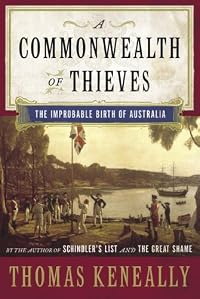
Thomas Keneally was born in Sydney, Australia on October 7, 1935. Although he initially studied for the Catholic priesthood, he abandoned that idea in 1960, turning to teaching and clerical work before writing and publishing his first novel, The Place at Whitton, in 1964. Since that time he has been a full-time writer, aside from the occasional show more stint as a lecturer or writer-in-residence. He won the Booker Prize in 1982 for Schindler's Ark, which Stephen Spielberg adapted into the film Schindler's List. He won the Miles Franklin Award twice with Bring Larks and Heroes and Three Cheers for the Paraclete. His other fiction books include The Chant of Jimmy Blacksmith, Gossip from the Forest, Confederates, The People's Train, Bettany's Book, An Angel in Australia, The Widow and Her Hero, and The Daughters of Mars. His nonfiction works include Searching for Schindler, Three Famines, The Commonwealth of Thieves, The Great Shame, and American Scoundrel. In 1983, he was awarded the order of Australia for his services to Australian Literature. Thomas Keneally is the recipient of the 2015 Australia Council Award for Lifetime Achievement in Literature. The award, formerly known as the Writers' Emeritus Award, recognises 'the achievements of eminent literary writers over the age of 60 who have made an outstanding and lifelong contribution to Australian literature. (Bowker Author Biography) show less
Common Knowledge
- Important places
- Ireland
Classifications
- Genres
- History, Nonfiction, General Nonfiction
- DDC/MDS
- 304.80941509034 — Society, Government, and Culture Social sciences, sociology & anthropology Factors affecting social behavior Movement of people History, geography, biography
- LCC
- DA950.1 .K46 — History of Europe, Asia, Africa and Oceania Great Britain History of Great Britain Ireland History By period
- BISAC
Statistics
- Members
- 806
- Popularity
- 34,177
- Reviews
- 10
- Rating
- (3.63)
- Languages
- English
- Media
- Paper, Audiobook, Ebook
- ISBNs
- 18
- ASINs
- 19