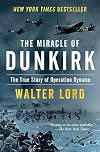
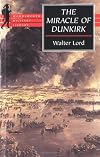
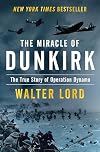
The Miracle of Dunkirk: The True Story of Operation Dynamo
by Walter Lord
On This Page
Description
The true story of the World War II evacuation portrayed in the Christopher Nolan film Dunkirk, by the #1 New York Times–bestselling author of Day of Infamy.In May 1940, the remnants of the French and British armies, broken by Hitler's blitzkrieg, retreated to Dunkirk. Hemmed in by overwhelming Nazi strength, the 338,000 men gathered on the beach were all that stood between Hitler and Western Europe. Crush them, and the path to Paris and London was clear.
Unable to retreat any farther, the show more Allied soldiers set up defense positions and prayed for deliverance. Prime Minister Winston Churchill ordered an evacuation on May 26, expecting to save no more than a handful of his men. But Britain would not let its soldiers down. Hundreds of fishing boats, pleasure yachts, and commercial vessels streamed into the Channel to back up the Royal Navy, and in a week nearly the entire army was ferried safely back to England.
Based on interviews with hundreds of survivors and told by "a master narrator," The Miracle of Dunkirk is a striking history of a week when the outcome of World War II hung in the balance (Arthur Schlesinger Jr.).
. show less
Tags
Recommendations
























Member Reviews
Another readable book from the consummate narrative historian Walter Lord. If it at first seems slightly odd to have an American writing at length about such an important piece of modern British national mythology, this is dispelled as Lord delivers an astute, organised and – importantly – unsentimental account. He recounts the accurate examples of that famous 'Dunkirk spirit' – the armada of little ships, the "collective refusal of men to be discouraged" by a relentless series of crises (pg. xi-xii) – but also the more unedifying moments, including mental breakdowns, the shooting of panic-stricken soldiers in order to maintain order, and the near-mutinies among those lauded little ships. Aside from underselling (in my view) the show more RAF's role in the evacuation, Lord brings order to the chaos of Operation Dynamo.
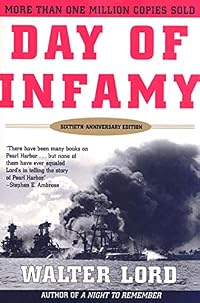
The haphazard and improvisational nature of the operation is brought out in full, sometimes to the book's narrative detriment. Whilst it may be more or less inevitable due to the chaotic and bottle-necked arena of the Channel port, with participants going many days without sleep, Lord's usual 'eye-witness' approach works less well than in some of his other books like A Night to Remember and Day of Infamy. Tellingly, those two books describe events that occur on a single day (as their titles suggest), whereas The Miracle of Dunkirk unspools over eleven days. Sequence and focus are sometimes lost, and the reader can be turned about.
Where Lord is always at his best is in providing texture to history. Included in the narrative are not only the regular, expected accounts of battered infantrymen and naval officers, but those remarkable little curios that only seem to emerge in times of stress and war. Lord has a nose for this sort of thing, and The Miracle of Dunkirk finds time to tell us about Jack Churchill, the eccentric British soldier who killed a German with a bow and arrow six hundred years after Crécy (pg. 72) and the improbable arrival among the 'little ships' of 66-year-old Charles Herbert Lightoller, formerly Second Officer on the Titanic (pg. 226). He points out the curious nature of the British "offering the French free use of a French facility in a French port" (pg. 181) and the enduring examples of British phlegm (noting the paucity of defensive weaponry among the little ships, one skipper observes that "even a record of the 1812 Overture would be better than nothing" (pg. 160)).
Such things are often sneered at nowadays, the Dunkirk spirit increasingly seen as a Little Englander myth that has encouraged the horridness of Brexit, but Lord shows that, as ever, the reality was much more nuanced. Dunkirk was the capstone of a disaster that had played out across Belgium and France (and arguably in the corridors of power since Versailles), but was in itself a success. It was not a victory (as Churchill was at pains to point out) but it was an achievement, rather than a German reprieve. From unit commanders all the way up to Hitler's OKW, the Germans were worried about losses and attrition among their all-important Panzers, and still had to mop up the French army to the south (pg. 29). Armchair generals might say the Germans made mistakes (or, worse, that they 'let the BEF go') and the British got lucky but, as Lord convincingly argues, it was for them "far better to risk a miracle at Dunkirk than risk a second Miracle of the Marne" (pg. 273), a reference to the First World War battle which rallied the French after a successful German invasion. Lord understands these dilemmas of history, and at Dunkirk shows it in all its texture and veracity. While pundits might debate the viability of Britain going it alone at a time of hostility from the Continent, books like this one show that success or collapse depends to a great extent upon that collective ability to face a relentless series of crises with a refusal to be discouraged. show less
The haphazard and improvisational nature of the operation is brought out in full, sometimes to the book's narrative detriment. Whilst it may be more or less inevitable due to the chaotic and bottle-necked arena of the Channel port, with participants going many days without sleep, Lord's usual 'eye-witness' approach works less well than in some of his other books like A Night to Remember and Day of Infamy. Tellingly, those two books describe events that occur on a single day (as their titles suggest), whereas The Miracle of Dunkirk unspools over eleven days. Sequence and focus are sometimes lost, and the reader can be turned about.
Where Lord is always at his best is in providing texture to history. Included in the narrative are not only the regular, expected accounts of battered infantrymen and naval officers, but those remarkable little curios that only seem to emerge in times of stress and war. Lord has a nose for this sort of thing, and The Miracle of Dunkirk finds time to tell us about Jack Churchill, the eccentric British soldier who killed a German with a bow and arrow six hundred years after Crécy (pg. 72) and the improbable arrival among the 'little ships' of 66-year-old Charles Herbert Lightoller, formerly Second Officer on the Titanic (pg. 226). He points out the curious nature of the British "offering the French free use of a French facility in a French port" (pg. 181) and the enduring examples of British phlegm (noting the paucity of defensive weaponry among the little ships, one skipper observes that "even a record of the 1812 Overture would be better than nothing" (pg. 160)).
Such things are often sneered at nowadays, the Dunkirk spirit increasingly seen as a Little Englander myth that has encouraged the horridness of Brexit, but Lord shows that, as ever, the reality was much more nuanced. Dunkirk was the capstone of a disaster that had played out across Belgium and France (and arguably in the corridors of power since Versailles), but was in itself a success. It was not a victory (as Churchill was at pains to point out) but it was an achievement, rather than a German reprieve. From unit commanders all the way up to Hitler's OKW, the Germans were worried about losses and attrition among their all-important Panzers, and still had to mop up the French army to the south (pg. 29). Armchair generals might say the Germans made mistakes (or, worse, that they 'let the BEF go') and the British got lucky but, as Lord convincingly argues, it was for them "far better to risk a miracle at Dunkirk than risk a second Miracle of the Marne" (pg. 273), a reference to the First World War battle which rallied the French after a successful German invasion. Lord understands these dilemmas of history, and at Dunkirk shows it in all its texture and veracity. While pundits might debate the viability of Britain going it alone at a time of hostility from the Continent, books like this one show that success or collapse depends to a great extent upon that collective ability to face a relentless series of crises with a refusal to be discouraged. show less
Summary: A historical account of Operation Dynamo, the evacuation of 338,000 Allied troops as the German blitzkrieg shattered Allied defenses and occupied France.
A new generation learned about the “miracle” of Dunkirk this summer through the Christopher Nolan film. In conjunction with this release, Open Road released a digital version of Walter Lord’s classic The Miracle of Dunkirk. Lord is most famous for his highly readable account of A Night to Remember about the sinking of the Titanic, but also published a number of histories of various aspects of World War II, including the truly miraculous evacuation of 338,000 Allied troops from Dunkirk and its nearby beaches between May 26 and June 4.
The Allied line had collapsed in front show more of the German blitzkrieg, and nearly 400,000 were isolated and driven toward the French coast. It would be a huge debacle and demoralizing blow, especially for the British, if these forces were surrounded and captured. At this point, no amphibious craft existed to evacuate them from the beaches and no plan existed to do so.
Lord’s account covers the various facets of the unfolding “miracle.” There is the decision to evacuate and launch Operation Dynamo and the resultant misunderstandings that occurred with the French. We watch the scramble of Admiral Ramsey to mobilize anything that floated from destroyers to tugboats and pleasure yachts to evacuate soldiers. Initially, they expected to evacuate only 45,000 before the Germans completed their conquest.
Several factors contributed then to this miracle. One was Hitler’s puzzling order for the advancing German forces to halt for a couple of critical days between May 24 and 27, allowing more Allied forces to retreat. Then there was reliance on Goering’s Luftwaffe, which was devastating at points but could not fly during overcast weather, which prevailed during several days of the evacuation.
“Miracle” might give a sense of a smooth running operation. It was anything but and Lord describes the mishaps that resulted from a wrecked port, efforts to ferry men off the beaches around Dunkirk and the eventual use of the mole, or breakwater, that allowed boats to berth, load and depart with the greatest efficiency. Likewise, there was bad blood between the British and the French, and at first evacuations were primarily of British troops until they agreed that it would be “arm in arm.” Eventually about 100,000 French were evacuated along with over 230,000 British.
Part of the story was the resistance of British and French troops (Belgium had surrendered, leaving a hole in the lines to be plugged, stretching the defenders further), a number of whom spent the rest of the war as prisoners, especially among the French. The resistance they put up, along with the unwillingness of the Germans to risk their tanks in the marshy lands around Dunkirk, bought precious extra time for the evacuation to mobilize, which succeeded in evacuating a peak of 68,000 on May 31. The other part of the story was the heroism of not only the naval forces but the many civilians who faced German fighters, bombers, mines, and torpedoes. Lord tells stories of men who had to evacuate more than one ship enroute to England.
The RAF’s Spitfires also bought some respite for the shipping when they engaged the Luftwaffe. At the same time, Lord describes the balancing act that they had to play between providing critical air cover, and maintaining sufficient forces for the anticipated defense of England.
Lord portrays the different ways the evacuation was seen by Germany, France, and England. Germany didn’t think England would return. France felt betrayed. But for England, and their new prime minister, Winston Churchill, the “miracle” represent a resolve to fight on, and a signal achievement in recovering such a significant part of their fighting core, later to be joined by their American allies. While France was lost, and with it, vast amounts of arms and equipment, all was not lost. And that was enough to fight on.
Lord’s account covers all sides of the battle, British, French and German, and the land, air and sea elements. He captures both the overall development, and the stories of the fighting men and civilians who all were part of the miracle. His notes and bibliography detail the mountains of research that he distilled into a manageable and riveting narrative. If you haven’t seen the movie, get the book, and it will make more sense of the movie when you do. And it will help you understand the first of the series of turning points that culminated in D-Day. show less
A new generation learned about the “miracle” of Dunkirk this summer through the Christopher Nolan film. In conjunction with this release, Open Road released a digital version of Walter Lord’s classic The Miracle of Dunkirk. Lord is most famous for his highly readable account of A Night to Remember about the sinking of the Titanic, but also published a number of histories of various aspects of World War II, including the truly miraculous evacuation of 338,000 Allied troops from Dunkirk and its nearby beaches between May 26 and June 4.
The Allied line had collapsed in front show more of the German blitzkrieg, and nearly 400,000 were isolated and driven toward the French coast. It would be a huge debacle and demoralizing blow, especially for the British, if these forces were surrounded and captured. At this point, no amphibious craft existed to evacuate them from the beaches and no plan existed to do so.
Lord’s account covers the various facets of the unfolding “miracle.” There is the decision to evacuate and launch Operation Dynamo and the resultant misunderstandings that occurred with the French. We watch the scramble of Admiral Ramsey to mobilize anything that floated from destroyers to tugboats and pleasure yachts to evacuate soldiers. Initially, they expected to evacuate only 45,000 before the Germans completed their conquest.
Several factors contributed then to this miracle. One was Hitler’s puzzling order for the advancing German forces to halt for a couple of critical days between May 24 and 27, allowing more Allied forces to retreat. Then there was reliance on Goering’s Luftwaffe, which was devastating at points but could not fly during overcast weather, which prevailed during several days of the evacuation.
“Miracle” might give a sense of a smooth running operation. It was anything but and Lord describes the mishaps that resulted from a wrecked port, efforts to ferry men off the beaches around Dunkirk and the eventual use of the mole, or breakwater, that allowed boats to berth, load and depart with the greatest efficiency. Likewise, there was bad blood between the British and the French, and at first evacuations were primarily of British troops until they agreed that it would be “arm in arm.” Eventually about 100,000 French were evacuated along with over 230,000 British.
Part of the story was the resistance of British and French troops (Belgium had surrendered, leaving a hole in the lines to be plugged, stretching the defenders further), a number of whom spent the rest of the war as prisoners, especially among the French. The resistance they put up, along with the unwillingness of the Germans to risk their tanks in the marshy lands around Dunkirk, bought precious extra time for the evacuation to mobilize, which succeeded in evacuating a peak of 68,000 on May 31. The other part of the story was the heroism of not only the naval forces but the many civilians who faced German fighters, bombers, mines, and torpedoes. Lord tells stories of men who had to evacuate more than one ship enroute to England.
The RAF’s Spitfires also bought some respite for the shipping when they engaged the Luftwaffe. At the same time, Lord describes the balancing act that they had to play between providing critical air cover, and maintaining sufficient forces for the anticipated defense of England.
Lord portrays the different ways the evacuation was seen by Germany, France, and England. Germany didn’t think England would return. France felt betrayed. But for England, and their new prime minister, Winston Churchill, the “miracle” represent a resolve to fight on, and a signal achievement in recovering such a significant part of their fighting core, later to be joined by their American allies. While France was lost, and with it, vast amounts of arms and equipment, all was not lost. And that was enough to fight on.
Lord’s account covers all sides of the battle, British, French and German, and the land, air and sea elements. He captures both the overall development, and the stories of the fighting men and civilians who all were part of the miracle. His notes and bibliography detail the mountains of research that he distilled into a manageable and riveting narrative. If you haven’t seen the movie, get the book, and it will make more sense of the movie when you do. And it will help you understand the first of the series of turning points that culminated in D-Day. show less
An engrossing history of the evacuation of Dunkirk as told through the eyes of survivors. There's no sugar-coating of the blunders made by those in command, errors that should have sunk this operation, but there are also many stories of bravery and courage. Upon reflection it is truly amazing that as many people were rescued considering the mistakes committed. A miracle, indeed.
The Miracle of Dunkirk: The True Story of Operation Dynamo, by Walter Lord is an in-depth look at the incredible operation to save thousands of Allied soldiers from being killed or captured in the opening months of the Second World War. Using both historical and personal stories, Lord has assembled a detailed day by day account of what can only be described as a miracle. For research alone, this book deserves a five star rating, and clearly deserves four and a half stars overall.
The author has manage to uncover a large amount of new information pertaining to Dunkirk, and although I at first did not expect to find any surprises within the book’s pages, I was happily surprised to see that was not the case.
I especially enjoy the way show more Lord has interwoven the individual stories of everyone from the architects of the operation, to the last men to leave the beach, to those who risked everything in their ‘little boats’.
At the risk of taking a Spiritual view here, one cannot help but wonder at events such as this, where surely the Germans were aware of the incredible opportunity laid out before them, and yet, did nothing. This book will appeal to both the die-hard military historian and the casual reader who has a passing interest in warfare.
@copyright Daniel Lloyd Little 2017 - www.daniellittle.com show less
The author has manage to uncover a large amount of new information pertaining to Dunkirk, and although I at first did not expect to find any surprises within the book’s pages, I was happily surprised to see that was not the case.
I especially enjoy the way show more Lord has interwoven the individual stories of everyone from the architects of the operation, to the last men to leave the beach, to those who risked everything in their ‘little boats’.
At the risk of taking a Spiritual view here, one cannot help but wonder at events such as this, where surely the Germans were aware of the incredible opportunity laid out before them, and yet, did nothing. This book will appeal to both the die-hard military historian and the casual reader who has a passing interest in warfare.
@copyright Daniel Lloyd Little 2017 - www.daniellittle.com show less
I'm a big fan of WWII historical non-fiction including having read well in excess of a hundred books dealing with the period. I've also read a few WWI titles but nothing close to WWII and nothing about Dunkirk prior to Lord's account.
I (thought) I knew the story. Early in the war, prior to America's involvement, the BEF (British Expeditionary Force) was chased out of Europe by the Germans. Embarking from the beaches of Dunkirk on a flotilla of boats of all shapes and sizes sent over from England, the total number rescued to fight again was well over 300,000. What more could there be to know? I should have known better.
So many "well known" WWII stories are only as familiar to most as whatever movie they've seen describing that time. show more That proved to be true of the Dunkirk story for me except that I saw the movie after I'd read the book. The movie generated my interest in this book and I'm glad I read it prior to seeing the movie.
If you read this expect to encounter a lot of unit names which can easily bog you down. Don't let it. It's the overall story you want not the "street level" detail, not the 10,000-foot macro story the movie provides, something around the 1,000-foot view. "The Miracle of Dunkirk" does just that. show less
I (thought) I knew the story. Early in the war, prior to America's involvement, the BEF (British Expeditionary Force) was chased out of Europe by the Germans. Embarking from the beaches of Dunkirk on a flotilla of boats of all shapes and sizes sent over from England, the total number rescued to fight again was well over 300,000. What more could there be to know? I should have known better.
So many "well known" WWII stories are only as familiar to most as whatever movie they've seen describing that time. show more That proved to be true of the Dunkirk story for me except that I saw the movie after I'd read the book. The movie generated my interest in this book and I'm glad I read it prior to seeing the movie.
If you read this expect to encounter a lot of unit names which can easily bog you down. Don't let it. It's the overall story you want not the "street level" detail, not the 10,000-foot macro story the movie provides, something around the 1,000-foot view. "The Miracle of Dunkirk" does just that. show less
An excellent collection of stories and descriptions leading up to the critical evacuation of Dunkirk (and the surrounding area) during the early years of World War II. I have no experience as a soldier or in war, but from what I have read and learned this book approaches the subject much like I would expect a battle to play out: a few people engaged from start to finish; flashes of important and odd scenes; sacrifice; difficult decisions; chaos; death; and finally, rest.
Before reading The Miracle of Dunkirk I had very limited knowledge of the events around the evacuation, and assumed that it was a very short-term activity that was a great success. Though it was a great success, it took place over a much longer period than I thought. I show more also did not appreciate how dangerous and deadly the evacuation was: swamped boats, men waiting hours on the beaches or in the water facing German bombing and attacks from aircraft; mines destroying returning ships; ships running into one another, or being torpedoed; and much more is included in this fascinating story of Operation Dynamo. show less
Before reading The Miracle of Dunkirk I had very limited knowledge of the events around the evacuation, and assumed that it was a very short-term activity that was a great success. Though it was a great success, it took place over a much longer period than I thought. I show more also did not appreciate how dangerous and deadly the evacuation was: swamped boats, men waiting hours on the beaches or in the water facing German bombing and attacks from aircraft; mines destroying returning ships; ships running into one another, or being torpedoed; and much more is included in this fascinating story of Operation Dynamo. show less
I enjoyed the recent 2017 Dunkirk movie, so I wanted to get a history lesson on the actual events. I though the movie had too much empty beach and did not fit the crowded image in my mind. I don't that this excellent book so much changed that as broadened the field to the built-up sections of Dunkirk where soldiers sheltered in basements, seaside hotels and did trade with small businesses in the area. The book also added a small army of stray dogs that hunkered down with the allied troops, although they were generally abandoned out of necessity as nearly were thousands of the French soldiers saved.
Members
- Recently Added By
Lists

Top Five Books of 2017
757 works; 231 members

Books Read in 2017
4,249 works; 129 members

THE WAR ROOM
813 works; 24 members
Author Information

Walter Lord is the author of several best-selling works of history, including "A Night to Remember", the recreation of the sinking of the Titanic. He lives in New York City. (Publisher Provided) John Walter Lord, Jr. (October 8, 1917- May 19, 2002), was an American author, best known for his documentary-style non-fiction account A Night to show more Remember, about the sinking of the RMS Titanic. He was born in Baltimore, Maryland; he attended Princeton University and alo earned a law degree from Yale Law School. Lord wrote 11 bestselling books on such subjects as Pearl Harbor (Day of Infamy, 1957), the Battle of Midway (Incredible Victory, 1967), the Battle of the Alamo (A Time to Stand, 1961). He is perhaps best known for his classic work about the crash of the Titanic, A Night to Remember (1955). Lord died at age 84 after a long battle with Parkinson's disease. He resided in Manhattan, New York. (Bowker Author Biography) show less
Some Editions
Series
Belongs to Publisher Series
Work Relationships
Common Knowledge
- Canonical title*
- 敦克爾克大撤退
- Original title
- The miracle of Dunkirk
- Original publication date
- 1982
- People/Characters
- Winston Churchill; John Vereker, 6th Viscount Gort
- Important places
- Dunkirk, Hauts-de-France, France; France
- Important events
- World War II (1939 | 1945); Fall of France (1940-05-10 | 1940-06-22); Battle of Dunkirk (1940-05-26 | 1940-06-04); Dunkirk Evacuation (1940-05-27 | 1940-06-04); Operation Dynamo
- Related movies
- Dunkirk (2017 | IMDb)
- Dedication
- FOR EDDIE RESOR
- First words*
- Every man had his own special moment when he first knew that something was wrong.
- Last words*
- (Click to show. Warning: May contain spoilers.)He was a hero to someone, after all.
- Blurbers
- Lingeman, Richard R.; Schlesinger, Arthur M., Jr.
- Original language
- English
*Some information comes from Common Knowledge in other languages. Click "Edit" for more information.
Classifications
Statistics
- Members
- 648
- Popularity
- 44,460
- Reviews
- 15
- Rating
- (3.77)
- Languages
- 5 — Chinese, traditional, Czech, English, French, German
- Media
- Paper, Audiobook, Ebook
- ISBNs
- 26
- ASINs
- 11