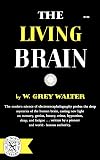
The Living Brain
by W. Grey Walter
On This Page
Description
Dr. Walter begins with a history of the evolution of the brain, and describes to us something of the meaning of "that enchanted loom where millions of flashing shuttles weave a dissolving pattern." He then tells the story of the invention and perfection of the EEG machine and its clinical use for the diagnosis of brain afflictions. He analyzes, with vivid examples, the rhythmic patterns of personality revealed in different "brain prints," and discusses what light these new electronic show more processes can throw on memory, vision, fatigue, sleep, hypnotism, genius, lunacy, sex disturbances, crime, and other problems of everyday interest. He includes descriptions, with wiring diagrams, of the various electrical toys (including the speculatrix or mechanical turtle) which he has himself invented to demonstrate his theories. With an extraordinary gift for language, a minimum of speculation and a maximum of demonstrated fact, Dr. Walter has written a truly exciting book, a landmark int he advance of human knowledge. show lessTags
Recommendations





























Member Reviews
An utterly fascinating book about brain research in the first part of the 20th century. The most engaging chapters for me were those about the Machina Speculatrix, or "turtles" that Walter designed to behave like mechanical neurons. The research and engineering that led to the development of the Speculatrix delves deep into thinking about how people and machines, motivated by goals, acquire information about the world around them and then process that information, which then feeds back into new learning and behavioral choices.
Readers will notice many connections to Cybernetics research (e.g., Wiener, Beer, Pask, Ashby) and some tasty speculation at the end of the book about the possibilities for delegating menial brain activity to show more mechanical systems, thus freeing the brain to take a leap forward in development by an order of magnitude similar to what is thought to have happened with the development of agriculture. show less
Readers will notice many connections to Cybernetics research (e.g., Wiener, Beer, Pask, Ashby) and some tasty speculation at the end of the book about the possibilities for delegating menial brain activity to show more mechanical systems, thus freeing the brain to take a leap forward in development by an order of magnitude similar to what is thought to have happened with the development of agriculture. show less
Ratings
Members
- Recently Added By
Lists

Alan Kay's Reading List
103 works; 3 members
Author Information
7+ Works 94 Members
Classifications
Statistics
- Members
- 79
- Popularity
- 401,772
- Reviews
- 1
- Rating
- (4.67)
- Languages
- English, Italian, Russian
- Media
- Paper
- ISBNs
- 1
- ASINs
- 1