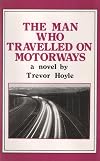
The Man Who Traveled on Motorways
by Trevor Hoyle
On This Page
Tags
Member Reviews
Being older, and a reader, you get to notice things that change slowly, but hugely, without you ever being aware of exactly when this happened.
We live now in age where books are declared to have trigger warnings, gender non-specific characters, and any possible offensive content removed (No, this is not an anti-woke rant, all of it should have happened decades ago)
As far as reading goes I've seen what I would describe as a kind of vanilla-ising of popular fiction. For me a turning point was 2 books, Gone Girl and Girl On A Train
I found them hyped well in excess of their content. Neither was offensive in any way at all and I had a distinct feeling that both books had been gone over and smoothed out by teams of PR people, Psychologists, show more Product Placement people and so on until they'd been beaten to within an inch of their lives.
By contrast
I've just finished a novel from 1979. Written by Trevor Hoyle, the man who gave us Blake's Seven
From the raw unreconstructed past.
I do not know how you'd categorise it except to say what it isn't. It is not PC or Woke in any way shape or form so some may find it a difficult read if they have never been exposed to raw works. It is a kind of inner dialog from a disturbed man and various strange scenarios which it can be difficult to work out if they are real in the literal sense or the metaphorical sense.
The book is in 3-ish parts.
The first part is raw, very raw and can be a lot to take in like a stream of uncensored inner dialogue just a gush of raw thoughts.
The second part is his life in the peak flow, he is having a good time and living life to the full. Told through a series of affairs or sexual dalliances while away from his wife and children. Characters from earlier in the book re-appear later, with the same names but as different people. Sometimes it's hard to tell if the mani character is still the main character or one of the new ones. Confusing but not perplexingly so.
The third part of the book is the most challenging. I don't know if you've ever had the chilling experience of seeing yourself as others see you? If you haven't it is one of the most sobering and potentially shattering experience you can have the misfortune to fall into. The third part of the book is a detailed, step by step account of this happening to the main character. Previous scenarios from earlier in the book are retold from the viewpoint of the other characters. In this reverse history he sees himself, probably for the first time ever. It shatters him.
I was stunned by this book as it is a far away from current trends as you can get. I didn't find it gratuitous but there are scenes that you would not find today. It put me in mind of novels of Derek Raymond, who wrote the first British Noire books in 1990 and pre-dated Tarantino for graphic detail. show less
We live now in age where books are declared to have trigger warnings, gender non-specific characters, and any possible offensive content removed (No, this is not an anti-woke rant, all of it should have happened decades ago)
As far as reading goes I've seen what I would describe as a kind of vanilla-ising of popular fiction. For me a turning point was 2 books, Gone Girl and Girl On A Train
I found them hyped well in excess of their content. Neither was offensive in any way at all and I had a distinct feeling that both books had been gone over and smoothed out by teams of PR people, Psychologists, show more Product Placement people and so on until they'd been beaten to within an inch of their lives.
By contrast
I've just finished a novel from 1979. Written by Trevor Hoyle, the man who gave us Blake's Seven
From the raw unreconstructed past.
I do not know how you'd categorise it except to say what it isn't. It is not PC or Woke in any way shape or form so some may find it a difficult read if they have never been exposed to raw works. It is a kind of inner dialog from a disturbed man and various strange scenarios which it can be difficult to work out if they are real in the literal sense or the metaphorical sense.
The book is in 3-ish parts.
The first part is raw, very raw and can be a lot to take in like a stream of uncensored inner dialogue just a gush of raw thoughts.
The second part is his life in the peak flow, he is having a good time and living life to the full. Told through a series of affairs or sexual dalliances while away from his wife and children. Characters from earlier in the book re-appear later, with the same names but as different people. Sometimes it's hard to tell if the mani character is still the main character or one of the new ones. Confusing but not perplexingly so.
The third part of the book is the most challenging. I don't know if you've ever had the chilling experience of seeing yourself as others see you? If you haven't it is one of the most sobering and potentially shattering experience you can have the misfortune to fall into. The third part of the book is a detailed, step by step account of this happening to the main character. Previous scenarios from earlier in the book are retold from the viewpoint of the other characters. In this reverse history he sees himself, probably for the first time ever. It shatters him.
I was stunned by this book as it is a far away from current trends as you can get. I didn't find it gratuitous but there are scenes that you would not find today. It put me in mind of novels of Derek Raymond, who wrote the first British Noire books in 1990 and pre-dated Tarantino for graphic detail. show less
Members
- Recently Added By
Author Information

24+ Works 881 Members
Common Knowledge
- Canonical title
- The Man Who Traveled on Motorways
Classifications
Statistics
- Members
- 7
- Popularity
- 2,745,106
- Reviews
- 1
- Rating
- (5.00)
- Languages
- English
- Media
- Paper, Ebook
- ISBNs
- 2
- ASINs
- 1