Signal to Noise
by Neil Gaiman, Dave McKean (Illustrator)
On This Page
Description
Neil Gaiman and Dave McKean present their masterpiece, Signal to Noise Somewhere in London, a film director is dying of cancer. His life's crowning achievement, his greatest film, would have told the story of a European village as the last hour of 999 AD approached - the midnight that the villagers were convinced would bring with it Armageddon. Now that story will never be told. But he's still working it out in his head, making a film that no one will ever see. No one but us.Tags
Recommendations










Member Reviews
Signal to noise
noun
• the ratio of the strength of an electrical or other signal carrying information to that of unwanted interference.
• informal a measure of how much useful information there is in a system, such as the Internet, as a proportion of the entire contents.
- Oxford Dictionary
A film director has just learned that he is dying of some unnamed disease. As he contemplates his own fate, he imagines a new movie which he knows he will never have the time to make. The movie takes place somewhere in Europe in 999AD. As the millenium approaches, people gather together convinced that it is the end of the world. Their reactions may be different, some happy, some terrified, but they all stand transfixed, staring at the clock, show more waiting for the hands to reach midnight.
The narrative shifts between the director’s thoughts, his talks with his doctor and his assistant, and his lonely moments trying to lose himself in TV. As he works out his new script, his ideas and plans are laid out for us, the audience, to see.
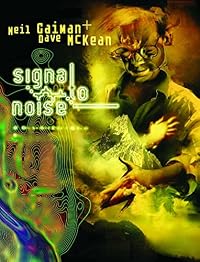
Neil Gaiman’s brilliant story telling is enhanced by the beautiful collage artwork of Dave McKean. His art adds layers and nuances to the already layered and nuanced story.
Written originally in 1989 as the world was contemplating a new millennium and apocalyptical stories were becoming more and more common and popular, Gaiman and McKean brought one of the most beautiful and thoughtful additions to the genre in this short graphic novel. The story is, perhaps, a bit slow (everything takes place inside the director’s apartment and mind) but it is intelligent and beautiful both in the tale and in the artwork. It is a perfect portrayal both in voice and sight how we can become so distracted by noise that we cannot hear the signal. I keep using the same word for this tale and I know that that is normally a bad thing but, really there is only one word to describe Signal to Noise – brilliant! show less
noun
• the ratio of the strength of an electrical or other signal carrying information to that of unwanted interference.
• informal a measure of how much useful information there is in a system, such as the Internet, as a proportion of the entire contents.
- Oxford Dictionary
A film director has just learned that he is dying of some unnamed disease. As he contemplates his own fate, he imagines a new movie which he knows he will never have the time to make. The movie takes place somewhere in Europe in 999AD. As the millenium approaches, people gather together convinced that it is the end of the world. Their reactions may be different, some happy, some terrified, but they all stand transfixed, staring at the clock, show more waiting for the hands to reach midnight.
The narrative shifts between the director’s thoughts, his talks with his doctor and his assistant, and his lonely moments trying to lose himself in TV. As he works out his new script, his ideas and plans are laid out for us, the audience, to see.
Neil Gaiman’s brilliant story telling is enhanced by the beautiful collage artwork of Dave McKean. His art adds layers and nuances to the already layered and nuanced story.
Written originally in 1989 as the world was contemplating a new millennium and apocalyptical stories were becoming more and more common and popular, Gaiman and McKean brought one of the most beautiful and thoughtful additions to the genre in this short graphic novel. The story is, perhaps, a bit slow (everything takes place inside the director’s apartment and mind) but it is intelligent and beautiful both in the tale and in the artwork. It is a perfect portrayal both in voice and sight how we can become so distracted by noise that we cannot hear the signal. I keep using the same word for this tale and I know that that is normally a bad thing but, really there is only one word to describe Signal to Noise – brilliant! show less
A must read if you're interested in communications theory or film (or just read the original version in The Face), but also if the words and pictures of a graphic novel mezmerizes you and makes you want to draw and write and mess with your own mind. Gaiman is a genious writer, and his words in this novel, coupled with McKean's haunting drawings, will make you seriously think about the small Armageddons of your life, of everyone's life. It's a very Neil Gaiman-trip this, with one world ending while others go on, possibly forever.
Neil Gaiman and Dave McKean present their masterpiece in a completely remastered and redesigned edition overflowing with bonus material! Serialized in "The Face" in 1989, expanded and revised into a graphic novel in 1992, and adapted for radio in 2000, "Signal to Noise" has never stopped evolving.
Somewhere in London, a film director is dying of cancer.
His life's crowning achievement, his greatest film, would have told the story of a European village as the last hour of 999 A.D. approached - the midnight that the villagers were convinced would bring with it Armageddon.
Now that story will never be told. But he's still working it out in his head, making a film that no one will ever see. No one but us. As the film director tried to show more convey, the end of the world is not a communal event, it does not encompass everyone--it is different for all of us. We all experience our own individual "apocalypse." I wholeheartedly agree.
Also included in this edition are three separate short stories that led to "Signal to Noise"'s publishing and creation, while a few were made during its process. All three stories deal with the themes of language and communication in terms of barriers, and breaking those barriers down. I especially loved "Vier Mauern." McKean's artwork for the Four Horsemen of the Apocalypse is superb.
Book Details:
Title Signal to Noise
Author Neil Gaiman & Dave McKean
Reviewed By Purplycookie show less
Somewhere in London, a film director is dying of cancer.
His life's crowning achievement, his greatest film, would have told the story of a European village as the last hour of 999 A.D. approached - the midnight that the villagers were convinced would bring with it Armageddon.
Now that story will never be told. But he's still working it out in his head, making a film that no one will ever see. No one but us. As the film director tried to show more convey, the end of the world is not a communal event, it does not encompass everyone--it is different for all of us. We all experience our own individual "apocalypse." I wholeheartedly agree.
Also included in this edition are three separate short stories that led to "Signal to Noise"'s publishing and creation, while a few were made during its process. All three stories deal with the themes of language and communication in terms of barriers, and breaking those barriers down. I especially loved "Vier Mauern." McKean's artwork for the Four Horsemen of the Apocalypse is superb.
Book Details:
Title Signal to Noise
Author Neil Gaiman & Dave McKean
Reviewed By Purplycookie show less
Well, that was really weird. I don't know. It wasn't *bad*, and it had quite a few really excellent lines about death and the purpose of life. But sometimes the words were a little blurry (the "noise"), and it made me blink and squint too much. The artwork was great, especially when it was the "signal" part. I don't think I understood all the "noise" parts. Maybe I need to get a little more art-literate to enjoy this fully, but I think I'll stick with normal print books and easier to understand graphic novels for now.
Somewhere in London, a film director is dying of cancer. His life's crowning achievement, his greatest film, would have told the story of a European village as the last hour of 999 A.D. approached - the midnight that the villagers were convinced would bring with it Armageddon. Now that story will never be told. But he's still working it out in his head, making a film that no one will ever see. No one but us.
Serialized in The Face in 1989, expanded and revised into a graphic novel in 1992, and adapted for radio in 2000, Signal to Noise has never stopped evolving. The bonus material in this first-time hardcover edition captures every leg of the journey, including three related short stories unseen in nearly two decades, an additional show more chapter created for the CD release of the radio drama, and a new introduction by Dave McKean along with the original by Jonathan Carrol and the radio drama introduction by Neil Gaiman
Received in ebook format from www.netgalley.com. Due to size etc, only able to view on laptop, and using the dreaded ADE which makes it clunky to navigate trough and difficult to read the text.
This is one of the Gaiman/Mckean books I missed first time round and am only coming across on republication. it's a relatively short story - about a film director, who finds out that he's dying of cancer, and looks back on the research and work he's done for a film he planned to make about a village waiting for the turn of the century and millennium of 999AD. Despite being ill and feeling week, he commences his screenplay, only to never see it get made.
McKean's drawings are of his standard occasionally fuzzy style and makes use of film stills (Groucho Marx and Monroe in particular). Gaiman's narrative brings across a level of pathos of a man feeling that he has not achieved what he wanted and that his life has been wasted.
I have seen the print version of this in the local comic book store and may well pick it up to read it in all its paper glory (that I dont think I got in the digital version) show less
Serialized in The Face in 1989, expanded and revised into a graphic novel in 1992, and adapted for radio in 2000, Signal to Noise has never stopped evolving. The bonus material in this first-time hardcover edition captures every leg of the journey, including three related short stories unseen in nearly two decades, an additional show more chapter created for the CD release of the radio drama, and a new introduction by Dave McKean along with the original by Jonathan Carrol and the radio drama introduction by Neil Gaiman
Received in ebook format from www.netgalley.com. Due to size etc, only able to view on laptop, and using the dreaded ADE which makes it clunky to navigate trough and difficult to read the text.
This is one of the Gaiman/Mckean books I missed first time round and am only coming across on republication. it's a relatively short story - about a film director, who finds out that he's dying of cancer, and looks back on the research and work he's done for a film he planned to make about a village waiting for the turn of the century and millennium of 999AD. Despite being ill and feeling week, he commences his screenplay, only to never see it get made.
McKean's drawings are of his standard occasionally fuzzy style and makes use of film stills (Groucho Marx and Monroe in particular). Gaiman's narrative brings across a level of pathos of a man feeling that he has not achieved what he wanted and that his life has been wasted.
I have seen the print version of this in the local comic book store and may well pick it up to read it in all its paper glory (that I dont think I got in the digital version) show less
Signal to Noise is a story about a director who is writing a film about the apocalypse, about the end of the world at the turn of the first millenium. This is kind of fitting, since he himself is dying of a terminal disease and so it's a race against time. A race full of self-reflection and introspection, thoughts about life and death and art and human character.
Pretty good all in all, but I do regret that we don't find out a bit more about the film he's writing, as I found scenes from it - mostly about a clan of believers who sell everything and ascend to a mountain-top in wait of impending doom - to be both visually and story-wise among the most interesting things in this graphical novel.
Pretty good all in all, but I do regret that we don't find out a bit more about the film he's writing, as I found scenes from it - mostly about a clan of believers who sell everything and ascend to a mountain-top in wait of impending doom - to be both visually and story-wise among the most interesting things in this graphical novel.
Dark. A graphic novel made from a collage published in a magazine, reworked and republished and changed again. The art is unlike anything I have seen. Hypnotic, almost. The story is sad, a film director finds out he has cancer and works on his last film before he dies, which becomes this great metaphor for life, mortality and of course immortality of yourself or your ideas. It was dark, enigmatic, intense and as I said, unlike anything I read before.
Members
- Recently Added By
Lists

Best Science Fiction Comics and Graphic Novels
144 works; 11 members
Author Information

843+ Works 448,747 Members
Neil Gaiman was born in Portchester, England on November 10, 1960. He worked as a journalist and freelance writer for a time, before deciding to try his hand at comic books. Some of his work has appeared in publications such as Time Out, The Sunday Times, Punch, and The Observer. His first comic endeavor was the graphic novel series The Sandman. show more The series has won every major industry award including nine Will Eisner Comic Industry Awards, three Harvey Awards, and the 1991 World Fantasy Award for best short story, making it the first comic ever to win a literary award. He writes both children and adult books. His adult books include The Ocean at the End of the Lane, which won a British National Book Awards, and the Locus Award for Best Fantasy Novel for 2014; Stardust, which won the Mythopoeic Award as best novel for adults in 1999; American Gods, which won the Hugo, Nebula, Bram Stoker, SFX, and Locus awards; Anansi Boys; Trigger Warning: Short Fictions and Disturbances; and The View from the Cheap Seats: Selected Nonfiction, which is a New York Times Bestseller. His children's books include The Day I Swapped My Dad for Two Goldfish; Coraline, which won the Elizabeth Burr/Worzalla, the BSFA, the Hugo, the Nebula, and the Bram Stoker awards; The Wolves in the Walls; Odd and the Frost Giants; The Graveyard Book, which won the Newbery Award in 2009 and The Sandman: Overture which won the 2016 Hugo Awards Best Graphic Story. (Bowker Author Biography) show less

Dave McKean was born on December 29, 1963 in Maidenhead, England. He is an illustrator, photographer, comic book artist, filmmaker and musician. McKean is best known for his regular collaboration with Neil Gaiman. MirrorMask, McKean's first feature film as director and visual designer, premiered at the Sundance Film Festival in January 2005. The show more screenplay was written by Neil Gaiman. (Bowker Author Biography) show less
Some Editions
Awards and Honors
Awards
Series
Belongs to Publisher Series
Work Relationships
Has the adaptation
Common Knowledge
- Canonical title*
- Sinal e Ruído
- Original title
- Signal to Noise
- Original publication date
- 1989 (The Face) (The Face); 1992 (1st edition) (1st edition)
- Dedication
- Neil: This one's for Emma Bull and Will Shetterly. And Fourth Street.
Dave: To Rolie Green, for giving myself, my family, and the film director your warmth and humour. - First words
- everybody should be able to understand the moment they sit down
- Last words
- (Click to show. Warning: May contain spoilers.)Soon now the phone will ring, and he will wake, and it will start all over again.
*Some information comes from Common Knowledge in other languages. Click "Edit" for more information.
Classifications
Statistics
- Members
- 1,041
- Popularity
- 24,672
- Reviews
- 25
- Rating
- (3.68)
- Languages
- 9 — Dutch, English, French, German, Italian, Polish, Spanish, Portuguese (Portugal), Portuguese (Brazil)
- Media
- Paper, Ebook
- ISBNs
- 19
- UPCs
- 1
- ASINs
- 3