White Shroud
by Antanas Skema
On This Page
Description
Considered by many as Lithuania's most important work of modernist fiction, White Shroud draws heavily on the author's own refugee and immigrant experience to tell the story of an migr poet working as an elevator operator in a large New York hotel during the mid-1950s. Via multiple narrative voices and streams, the novel moves through sharply contrasting settings and stages in the narrator's life in Lithuania before and during WWII, returning always to New York and his struggle to adapt to a show more completely different, and indifferent, modern world. Skema uses language and allusion to destabilise, drawing the reader into an intimate, culturally and historically specific world to explore universal human themes of selfhood, alienation, creativity and cultural difference. show lessTags
Recommendations




























Member Reviews
"White Shroud" is a portrait painted with emotions in place of colors. We don't see the face all at once. Skema shows us only one small emotional area at a time. Some are beautiful, some are sad, some are painful. We start to see the whole portrait is not a single face at all. It is not one portrait but all the emotional pieces at one time.
Our narrator and main character Garsva is a man composed of all these pieces. Together the pieces make up the man. But like the pieces, this man has many rough edges. His story, like his life, comes to us in separate but indelible pieces, not to be forgotten.
"White Shroud" deserves it's reputation as a major work of art. Although the details of the Lithuanian background present a small obstacle to show more the English reader, it is a book not to be missed. The prose, the lives, and the humanity revealed are lasting gifts to the reader. show less
Our narrator and main character Garsva is a man composed of all these pieces. Together the pieces make up the man. But like the pieces, this man has many rough edges. His story, like his life, comes to us in separate but indelible pieces, not to be forgotten.
"White Shroud" deserves it's reputation as a major work of art. Although the details of the Lithuanian background present a small obstacle to show more the English reader, it is a book not to be missed. The prose, the lives, and the humanity revealed are lasting gifts to the reader. show less
This is the first full novel by a Lithuanian writer and/or writer in translation that I have read, although I do remember an anthology of translated plays Confrontations With Tyranny: Six Baltic Plays With Introductory Essays (1977) which had a theatrical work by Antanas Škėma (1910-1961) called "The Awakening." I can no longer find my own copy of it to refresh my memory, so I may have lent it out and never got it back.
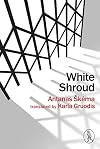
I found this first-time English translation of the Lithuanian émigré writer's best known work to be quite approachable and not far removed from my own family experience & background of post-World War II Baltic immigrants to North America. An additional quirky coincidence is that my first-ever job as a teenager was as show more an elevator operator in an era when such jobs still existed, although not for very much longer. That did make the cross-hatched pattern of the trellis on the book cover easily identifiable as that of an elevator guard rail whereas most would likely view it as that of a prison or other barrier (which it is also likely meant to suggest).
Škėma's lead character Antanas Garšva is a proxy for all émigrés and refugees who may come from skilled backgrounds and trades in their home country but who are forced to take menial work in their new homeland to survive. The sometime poet is working as an elevator operator in a huge New York City hotel while avoiding dealing with a health condition and juggling an on-again/off-again affair with another man's wife. Alternating chapters take us back and forth from this present world to his early life in Lithuania before and during the Soviet and Nazi occupations of WWII.
Although the synopsis for the book stresses its occasional stream-of-consciousness writing and somewhat experimental nature for its time of 1958, it was not at all difficult to follow in terms of its two interweaving plotlines. The very thorough background information and Lithuanian folk text translations and reference explanations in the footnotes were especially helpful in this new edition published by Scotland's Vagabond Voices who have been producing an excellent translation series with their Changelings imprint. show less
I found this first-time English translation of the Lithuanian émigré writer's best known work to be quite approachable and not far removed from my own family experience & background of post-World War II Baltic immigrants to North America. An additional quirky coincidence is that my first-ever job as a teenager was as show more an elevator operator in an era when such jobs still existed, although not for very much longer. That did make the cross-hatched pattern of the trellis on the book cover easily identifiable as that of an elevator guard rail whereas most would likely view it as that of a prison or other barrier (which it is also likely meant to suggest).
Škėma's lead character Antanas Garšva is a proxy for all émigrés and refugees who may come from skilled backgrounds and trades in their home country but who are forced to take menial work in their new homeland to survive. The sometime poet is working as an elevator operator in a huge New York City hotel while avoiding dealing with a health condition and juggling an on-again/off-again affair with another man's wife. Alternating chapters take us back and forth from this present world to his early life in Lithuania before and during the Soviet and Nazi occupations of WWII.
Although the synopsis for the book stresses its occasional stream-of-consciousness writing and somewhat experimental nature for its time of 1958, it was not at all difficult to follow in terms of its two interweaving plotlines. The very thorough background information and Lithuanian folk text translations and reference explanations in the footnotes were especially helpful in this new edition published by Scotland's Vagabond Voices who have been producing an excellent translation series with their Changelings imprint. show less
Ratings
Members
- Recently Added By
Author Information

12 Works 111 Members
Some Editions
Awards and Honors
Series
Belongs to Publisher Series
Common Knowledge
- Canonical title
- White Shroud
- Original publication date
- 1958
Classifications
- Genres
- Fiction and Literature, General Fiction
- DDC/MDS
- 891.9233 — Literature & rhetoric Asian Literature East Indo-European and Celtic literatures Baltic and other Indo-European languages Lithuanian Lithuanian fiction 1900–1990
- LCC
- PG8721 .S53 .B3 — Language and Literature Slavic languages and literatures. Baltic languages. Albanian language Slavic. Baltic. Albanian Baltic Lithuanian
- BISAC
Statistics
- Members
- 90
- Popularity
- 355,109
- Reviews
- 2
- Rating
- (4.46)
- Languages
- 6 — English, Estonian, French, German, Lithuanian, Spanish
- Media
- Paper, Ebook
- ISBNs
- 10
- ASINs
- 2