On This Page
Description
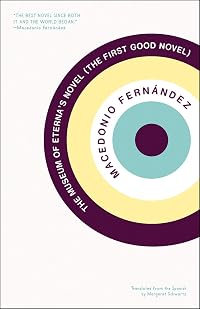
"The Museum or Eterna's Novel (The First Good Novel) is a book ahead of its time. Written during the 1930s and '40s - the heyday of Argentine literary culture - Museum is in many ways an "anti-novel: It opens with more than fifty prologues - including ones addressed "To My Authorial Persona," "To the Critics," and "To Readers Who Will Perish If They Don't Know What the Novel Is About"--That are by turns philosophical, outrageous, ponderous, and cryptic. The second half of the book is the show more novel itself, a story about a group of characters (some borrowed from other texts) who live on an estancia called "La Novelo"."--Jacket. show lessTags
Recommendations







Member Reviews
Macedonio Fernández writes:
It’s very subtle and patient work, getting quit of the self, disrupting interiors and identities. In all my writing I’ve only achieved eight or ten minutes in which two or three lines disrupted the stability, the unity of someone, even at times, I believe, disrupting the self-sameness of the reader. Nevertheless, I still believe that Literature does not exist, because it hasn’t dedicated itself solely to the Effect of dis-identification, the only thing that would justify its existence…
and:
The beauty of non-History came about; all homage to captains, generals, litigators, and governors was abolished – not a single recollection of a mother’s magnificent act, nor a childhood grace, nor the dark show more suicide of a youth overwhelmed by life; death was left to the dead and people spoke only of the living: soup, the tablecloth, the sofa, the hearth, nasty medicine, little shoes, the steps, the nest, the fig tree, the pine tree, gold, a cloud, the dog, Soon!, roses, a hat, laughter, violets, the teruteru bird (there’s nothing sweeter than to use children’s nonsense to speak of Happiness); plazas and parks that bear the names of superlative human lives, but with no last names; streets named The Bride, Remembrance, the Prince, Retirement, Hope, Silence, Peace, Life and Death, Miracles, Hours, Night, Thought, Youth, Rumor, Breasts, Happiness, Shadow, Eyes, Patience, Love, Mystery, Maternity, Soul.
All the statues that saddened the plazas were evicted, and in their place grew the best roses; the only exception was that the statue of José de San Martín was replaced by another statue symbolizing “Giving, and Leaving.” In the end, something happened to non-flowing time, like history, and there was only a fluid Present, whose only memory was of what returns to being daily, and not what simply repeats, like birthdays. That’s why the city almanac has 365 days with only one name: “Today,” and the city’s main street is also named “Today.”
Many other small things were also accomplished, whose tiny sorrows might fill a life with horror, like what was spared, for example: the half-full glass, or the little lamp with hoarded light, or the twisted tie, or artificial flowers on tombs.
I also truly love the first line of this book:
Today we release to the public the last bad novel and the first good novel.
. show less
It’s very subtle and patient work, getting quit of the self, disrupting interiors and identities. In all my writing I’ve only achieved eight or ten minutes in which two or three lines disrupted the stability, the unity of someone, even at times, I believe, disrupting the self-sameness of the reader. Nevertheless, I still believe that Literature does not exist, because it hasn’t dedicated itself solely to the Effect of dis-identification, the only thing that would justify its existence…
and:
The beauty of non-History came about; all homage to captains, generals, litigators, and governors was abolished – not a single recollection of a mother’s magnificent act, nor a childhood grace, nor the dark show more suicide of a youth overwhelmed by life; death was left to the dead and people spoke only of the living: soup, the tablecloth, the sofa, the hearth, nasty medicine, little shoes, the steps, the nest, the fig tree, the pine tree, gold, a cloud, the dog, Soon!, roses, a hat, laughter, violets, the teruteru bird (there’s nothing sweeter than to use children’s nonsense to speak of Happiness); plazas and parks that bear the names of superlative human lives, but with no last names; streets named The Bride, Remembrance, the Prince, Retirement, Hope, Silence, Peace, Life and Death, Miracles, Hours, Night, Thought, Youth, Rumor, Breasts, Happiness, Shadow, Eyes, Patience, Love, Mystery, Maternity, Soul.
All the statues that saddened the plazas were evicted, and in their place grew the best roses; the only exception was that the statue of José de San Martín was replaced by another statue symbolizing “Giving, and Leaving.” In the end, something happened to non-flowing time, like history, and there was only a fluid Present, whose only memory was of what returns to being daily, and not what simply repeats, like birthdays. That’s why the city almanac has 365 days with only one name: “Today,” and the city’s main street is also named “Today.”
Many other small things were also accomplished, whose tiny sorrows might fill a life with horror, like what was spared, for example: the half-full glass, or the little lamp with hoarded light, or the twisted tie, or artificial flowers on tombs.
I also truly love the first line of this book:
Today we release to the public the last bad novel and the first good novel.
. show less
There's no more artistic moment than the fullness of reading in the present."
This feat boasts or threatens of sporting 50 prologues, a series of checkpoints, a Gaza of apprehensions, anterior doors leading to further intermediary spaces, an endless qualification and interrogation of the novelistic enterprise, a Sorrentino sortie into narrative madness. . .or maybe it wasn't. Signature bells and whistles remind the reader incessantly -- this is a novel, nothing but. Disquisitions follow on Love and Suicide and Buenos Aires is redeemed. One can't ask for much more. (unless one prefers an arc of narrative, rounded empathetic characters and a sense of episodic closure.)
This feat boasts or threatens of sporting 50 prologues, a series of checkpoints, a Gaza of apprehensions, anterior doors leading to further intermediary spaces, an endless qualification and interrogation of the novelistic enterprise, a Sorrentino sortie into narrative madness. . .or maybe it wasn't. Signature bells and whistles remind the reader incessantly -- this is a novel, nothing but. Disquisitions follow on Love and Suicide and Buenos Aires is redeemed. One can't ask for much more. (unless one prefers an arc of narrative, rounded empathetic characters and a sense of episodic closure.)
It is amazing to “discover” such an important novel: Fernández was a friend, mentor, inspiration, and precursor to Borges. This novel, the work of over 25 years, is one of the first and still one of the most complex anti-novels ever written. I am delighted to have discovered it only 60 years late. (It was written between 1925 and 1952.)
I have found that in reading and re-reading The Museum of Eterna’s Novel (The First Good Novel) (and re-reading is the only way to read: the novel itself theorizes its possible readings extensively, inventively, repetitively, exhaustively) I find my thoughts divide into two currents. First is the mechanics and proposals of the anti-novel; then there is the psychology, the mood, or the affect that show more emerges from so many layers of anti-realism. The first develops mostly in the first half of the book, which is comprised entirely of fifty prologues to the novel. The second emerges mainly in the second half, which is the novel, and is titled “Were Those Prologues? And Is This The Novel?.”
1. The mechanics of the anti-novel.
In terms of the ways it articulates its relation to reality and fiction, this book is more sophisticated than the many that have followed it. It ends many times (there is a chapter that declares “a minute more, or a minute less” remains of the novel), and it talks continuously about itself (there are prologues that meditate on the blank pages that publishers still print before and after the text). It describes all possible sorts of readers: the one who reads straight through; the one who helps write the book itself; and the “skiparound” reader, who is both essential and wrong. (p. 119) The very idea of narrative, of plot, is theorized as a matter of memory. If something “big and new” doesn’t happen, he says, after a character “dies” (in quotation marks because characters don’t die, but move from one novel to another), then we will always see her as she was, because “without new things happening there’s no forgetting, because there’s no Time—which is nothing—outside of events, which weaken our images of the past.” Such a thing would be “a formula for unforgetfulness.” (p. 117)
There are moments when all this is fairly programmatic, and Fernández seems to be writing a fragmentary manifesto of literary modernism (“the first good novel”). “For my pages,” he says, “I want constant fantasy” in order to “avoid the hallucination of reality, which is a blemish on the face of art.” (p. 36) One of his characters, the Traveler, “functions exclusively as the extinguisher of the hallucination that menaces the story with realism.” The only “frustration or abortion of a character” in a novel is that he appears to live. (p. 35) At his least interesting, Fernández is programmatic in his anti-realism. “There is a reader with whom I cannot reconcile myself,” he says in a prologue “about the doctrine of art”: “the reader who wants what all novelists have coveted, to their shame: Hallucination.” (p. 32) Most of the time, Fernández’s paradoxes of realism and anti-realism are inventive and labyrinthine enough to keep me amused, if not really engaged. But none of this is what kept me reading and re-reading The Museum of Eterna’s Novel.
2. The mood, the feeling of the novel.
What ends up mattering is the emerging sense of Fernández himself: the kinds of moods, of feeling, that impelled him. At first it seems this may be early twentieth-century idealism and aestheticism. At the end of the book, the President speaks of “Ugliness’s long reign” in Buenos Aires, and how he wanted to “abolish civil ugliness.” (p. 236) It’s true the book bears the stamp of its time, and even—as the translator says—uses archaic language in places. But there is more to it than that. Throughout the book characters speak of their distances from one another, and the story turns on people coming together in a frail and unrepeatable gathering, and going apart again in separate journeys. The President invites each of them “to choose a path that would take them farthest from the others, so as to assure, at least, that no one had to experience in another that other farewell, death.” (p. 231) I think it is central to Fernández’s imagination that the sight of death, and ultimately everything even faintly like it, has to be kept away. Here the President is a novelist, imagining a world in which characters can be moved around in such a way that they suffer and die alone, offstage, as far away in their own worlds as possible. There is an amazing short essay on suicide, about a character named Suicide: it begins in such an abstract way that Fernández apologizes and starts again. It must have been a difficult couple of pages for him to write, because it tries so hard to think away the experience. (p. 171)
And why does Fernández want to be a character? Partly because he feels that if he has not experienced love, or when he does not experience love, his only hope of happiness is to be fictional. (p. 229) A character is not just a way of juggling the real and the imaginary, or playing with novelistic conventions. It is a way of existing as a trace, in a trance. “She is… exquisite,” he writes, “no one can tell the difference between seeing her and thinking of her.” (p. 143) A character can “feel nothing,” but be read. A reader is “moved” by such a character. (p. 130) For the character, such an existence is “enviable”: it is like living at a distance from yourself and from life. (p. 141)
Ultimately the point of the anti-novelistic experiments is to live without pain. Fernández says “each person” in the estancia was “moved by this double impression: ‘I entered La Novela, and I entered the novel.’” (p. 136) That is not a definition of the modern novel: that is the mirroring that he hopes will save him. The Museum of Eterna’s Novel (The First Good Novel) is, in the end, not a piece of experimental fiction as much as a concerted dream of a life without pain: Fernández was neurasthenic and exquisitely afraid of suffering, and he slowly dreamed his this book as an Eden, a museum, and in a perverse and impossible way, also a novel. show less
I have found that in reading and re-reading The Museum of Eterna’s Novel (The First Good Novel) (and re-reading is the only way to read: the novel itself theorizes its possible readings extensively, inventively, repetitively, exhaustively) I find my thoughts divide into two currents. First is the mechanics and proposals of the anti-novel; then there is the psychology, the mood, or the affect that show more emerges from so many layers of anti-realism. The first develops mostly in the first half of the book, which is comprised entirely of fifty prologues to the novel. The second emerges mainly in the second half, which is the novel, and is titled “Were Those Prologues? And Is This The Novel?.”
1. The mechanics of the anti-novel.
In terms of the ways it articulates its relation to reality and fiction, this book is more sophisticated than the many that have followed it. It ends many times (there is a chapter that declares “a minute more, or a minute less” remains of the novel), and it talks continuously about itself (there are prologues that meditate on the blank pages that publishers still print before and after the text). It describes all possible sorts of readers: the one who reads straight through; the one who helps write the book itself; and the “skiparound” reader, who is both essential and wrong. (p. 119) The very idea of narrative, of plot, is theorized as a matter of memory. If something “big and new” doesn’t happen, he says, after a character “dies” (in quotation marks because characters don’t die, but move from one novel to another), then we will always see her as she was, because “without new things happening there’s no forgetting, because there’s no Time—which is nothing—outside of events, which weaken our images of the past.” Such a thing would be “a formula for unforgetfulness.” (p. 117)
There are moments when all this is fairly programmatic, and Fernández seems to be writing a fragmentary manifesto of literary modernism (“the first good novel”). “For my pages,” he says, “I want constant fantasy” in order to “avoid the hallucination of reality, which is a blemish on the face of art.” (p. 36) One of his characters, the Traveler, “functions exclusively as the extinguisher of the hallucination that menaces the story with realism.” The only “frustration or abortion of a character” in a novel is that he appears to live. (p. 35) At his least interesting, Fernández is programmatic in his anti-realism. “There is a reader with whom I cannot reconcile myself,” he says in a prologue “about the doctrine of art”: “the reader who wants what all novelists have coveted, to their shame: Hallucination.” (p. 32) Most of the time, Fernández’s paradoxes of realism and anti-realism are inventive and labyrinthine enough to keep me amused, if not really engaged. But none of this is what kept me reading and re-reading The Museum of Eterna’s Novel.
2. The mood, the feeling of the novel.
What ends up mattering is the emerging sense of Fernández himself: the kinds of moods, of feeling, that impelled him. At first it seems this may be early twentieth-century idealism and aestheticism. At the end of the book, the President speaks of “Ugliness’s long reign” in Buenos Aires, and how he wanted to “abolish civil ugliness.” (p. 236) It’s true the book bears the stamp of its time, and even—as the translator says—uses archaic language in places. But there is more to it than that. Throughout the book characters speak of their distances from one another, and the story turns on people coming together in a frail and unrepeatable gathering, and going apart again in separate journeys. The President invites each of them “to choose a path that would take them farthest from the others, so as to assure, at least, that no one had to experience in another that other farewell, death.” (p. 231) I think it is central to Fernández’s imagination that the sight of death, and ultimately everything even faintly like it, has to be kept away. Here the President is a novelist, imagining a world in which characters can be moved around in such a way that they suffer and die alone, offstage, as far away in their own worlds as possible. There is an amazing short essay on suicide, about a character named Suicide: it begins in such an abstract way that Fernández apologizes and starts again. It must have been a difficult couple of pages for him to write, because it tries so hard to think away the experience. (p. 171)
And why does Fernández want to be a character? Partly because he feels that if he has not experienced love, or when he does not experience love, his only hope of happiness is to be fictional. (p. 229) A character is not just a way of juggling the real and the imaginary, or playing with novelistic conventions. It is a way of existing as a trace, in a trance. “She is… exquisite,” he writes, “no one can tell the difference between seeing her and thinking of her.” (p. 143) A character can “feel nothing,” but be read. A reader is “moved” by such a character. (p. 130) For the character, such an existence is “enviable”: it is like living at a distance from yourself and from life. (p. 141)
Ultimately the point of the anti-novelistic experiments is to live without pain. Fernández says “each person” in the estancia was “moved by this double impression: ‘I entered La Novela, and I entered the novel.’” (p. 136) That is not a definition of the modern novel: that is the mirroring that he hopes will save him. The Museum of Eterna’s Novel (The First Good Novel) is, in the end, not a piece of experimental fiction as much as a concerted dream of a life without pain: Fernández was neurasthenic and exquisitely afraid of suffering, and he slowly dreamed his this book as an Eden, a museum, and in a perverse and impossible way, also a novel. show less
This is the perfect book for the reader who loves abstract art, who trusts that meaning and beauty are in there somewhere if only one sticks with it....this is a novel about a ranch gnamed "the Novel".......this is a novel with 50+ prologues.....not a typo...50+ prologues. Thisis a novel for the reader who revels in metaphysics......the metaphysics of the written word. Did I like it? I don't know. Would I recommend it? I don't know. Was it a memorable intellectual experience? Absolutely!
O Borges disse que um bom escritor cria seus precursores. Ou recria, talvez.
É impossível ler Macedonio Fernandez sem perceber as sombras de Borges, Cortázar, Piglia.
O Museo já era legendário antes de ser publicado, porque Macedonio fez diversas referências a ele. Imagino como foi, mesmo com todas as expectativas, ler esse romance que não começa, com mais de 50 prefácios, sem falar epílogos, prólogos finais, anexos. O autor, que conhecia os diferentes tipos de leitores, dizia que era um livro para os leitores saltadores.
Talvez seja verdade que o livro é mediano, embora Macedonio tenha sido brilhante, mas é ainda interessante.
É impossível ler Macedonio Fernandez sem perceber as sombras de Borges, Cortázar, Piglia.
O Museo já era legendário antes de ser publicado, porque Macedonio fez diversas referências a ele. Imagino como foi, mesmo com todas as expectativas, ler esse romance que não começa, com mais de 50 prefácios, sem falar epílogos, prólogos finais, anexos. O autor, que conhecia os diferentes tipos de leitores, dizia que era um livro para os leitores saltadores.
Talvez seja verdade que o livro é mediano, embora Macedonio tenha sido brilhante, mas é ainda interessante.
Macedonio Fernández was of aristocratic Argentine stock, and studied law at the University of Buenos Aires. He was also interested in philosophy, and maintained an epistolary relationship with William James which he broke off due to some sort of odd impropriety on the part of the American philosopher. He set off to Paraguay in his youth to found a utopian society in the wilderness, an experience which ended in failure and a hasty retreat to Buenos Aires. He married a woman named Elena de Obieta, who died in 1920, when Macedonio was 36. He wrote a poem about her death entitled Elena Bellamuerte, investigating the relationship between life, death, love and oblivion. If a person survives in loving memory, then death is not of that person, show more death, in that it exists, is perhaps the most trivial thing that can happen to a person. He also wrote a short correlary to that poem which goes like this:
Love does not conquer all given it cannot
Break the branch with which Death reaches out.
Yet Death conquers little
If in the heart of Love its fear dies.
Yet Death conquers little, given it cannot
Enter without fear in breast bearing Love
For Death governs Life; Love governs Death.
The enduring presence of Elena in his memory, and his desire to utilize the written word to perpetuate her existence, using love and memory to conquer death, was a major motivation in Macedonio's writing. Her death also affected his personal life in a significant way: he spent the next two and a half decades without fixed residence, living in a series of pensions and cheap hotels. And, for a brief period in the 1920s, he was something of a flagbearer for the literary vanguard of Buenos Aires. It's fun to think about a young Jorge Luis Borges running around the city, planting leaflets for Macedonio's bizarre candidacy for President of the Republic of Argentina, or sitting with him late at night in a dirty, cheap pension house, eating alfajores and drinking mate while discussing metaphysics to the music of Macedonio's guitar. The influence of Macedonio on Borges was certainly fundamental to his later career as a writer, and many people go so far as to say that Jorge Luis Borges is himself nothing more than a creation of Macedonio Fernández. Here is an interesting article about the relationship between the two authors in life and literature: http://quarterlyconversation.com/macedonio-fernandez-jorge-luis-borges.
While I can say that I read all the pages of this book, written over the course of many years and published posthumously, I hardly feel that I understood even a fraction of the author's words. He has a way with words, but it's a very difficult, convoluted way. Maybe if Góngora wrote a metaphysical novel it would have been something like this. Sometimes I read ten pages and stopped to think about what had happened, realizing that I had understood nothing. After 150 pages of prolgues in which the author ponders the act of literary creation and the writer-reader relationship from many, many different perspectives, the novel begins (on page 280 of my 420-page edition of this book). By this time I was familiar with the characters that would later live on the estate, leaving one day to conquer Buenos Aires in the name of Beauty: I wanted to imagine El Presidente to be the old Macedonio, the one who lived with his wife and then mourned her death, striving to keep her memory alive through his love. I wanted Quizagenio (Maybegenius) to be Macedonio at the height of his fame, chatting with Xul Solar in neocriollo in a cafe and hovering above the Florida-Boedo literary-ideological conflict as a middle-aged eccentric who possibly was a genius. Eterna as Elena, as she lives on in El Presidente's mind, was familiar to me as a carryover of sorts from the poem, Elena Bellamuerte, that I enjoy so much. And Dulce-Persona? Well, as I was reading this and trying to make sense out of it, I came across an article explaining that, contrary to popular belief, Macedonio Fernández did have another extended relationship after Elena's death, with a woman named Consuelo Bosch. Here is an article about the "secret love" of Macedonio Fernández: http://www.lanacion.com.ar/nota.asp?nota_id=1236429 The writer of this article opines that Consuelo, not Elena, is the Eterna of this Museum of Macedonio. I, on the other hand, want to believe that Macedonio's two loves may relate to two different characters in the Museum, with Elena as Eterna and Consuelo as Dulce-Persona. There is a prologue (among so many others) that documents the only meeting between Eterna and Dulce-Persona, which contains the following paragraph:
"And also one morning Dulce-Persona tried wearing her hair in braids, which she never used, like that of Eterna, and in the end she undid them and went back to her own as she told herself with generous admiration: 'only on her do they look good, although she is 39 and I am 19. May you love her, and caress my head nothing more, but always'."
I imagine Macedonio living with and perhaps loving Consuelo, yet unwilling to forget Elena; I imagine Consuelo willing to share Macedonio with his deceased wife, in a way that she might say something like the statement above. I thought about this possible relationship between life and novel as I read, and it seemed to stand up pretty well, especially in the two female characters' connection with the two leading men, El Presidente and Quizagenio (both of whom I saw as different Macedonios). There is love expressed for both Eterna and Dulce-Persona, and I was interested to see how both of these rather abstract beings were loved by two rather abstract Macedonios. But again, so much of this book made so little sense to me, I wonder if I'd feel the same way if I read it again. No matter who these people are, there is one more relationship between life and literature that I thought about a lot as I read this: Macedonio mentions Cervantes and Don Quijote at least a half dozen times in the prologues. As I think about his life and his work as a writer, I can think of no more quixotic individual in the world of letters. His passion for his deceased wife, along with his musings on the death-defying power of love, both strike me as entirely fitting for a 20th century reincarnation of Don Quijote. This book, and Macedonio's love(s), I believe, should be read in relation to Don Quijote's wanderings and his love for Dulcinea.
While I struggled with the Museum, I had no problem understanding and enjoying the biographical information the Cátedra edition of this book provided, and I now have many more reasons to consider Macedonio Fernández one of the more fascinating authors of the past century. He's justifiably famous for his oversized influence on future generations, and while I did enjoy this book, I think that at a time when I've got a lot on my plate, I need Macedonio in smaller, more digestible segments. Reading El Museo in bits and pieces, in the evenings when I was tired after a day at work, or a chapter (or prologue) here and there, made it extremely difficult for me to feel the connection with the author that I wanted to feel. I think I'll spend some time in the library looking for some books or articles that will give me a better idea of what it was like to know Macedonio Fernández as he existed in his brief time as a godfather figure to the literary vanguard of Buenos Aires. Then, some day, when I've got a lot of time on my hands, I'll take another trip to El Museo. show less
Love does not conquer all given it cannot
Break the branch with which Death reaches out.
Yet Death conquers little
If in the heart of Love its fear dies.
Yet Death conquers little, given it cannot
Enter without fear in breast bearing Love
For Death governs Life; Love governs Death.
The enduring presence of Elena in his memory, and his desire to utilize the written word to perpetuate her existence, using love and memory to conquer death, was a major motivation in Macedonio's writing. Her death also affected his personal life in a significant way: he spent the next two and a half decades without fixed residence, living in a series of pensions and cheap hotels. And, for a brief period in the 1920s, he was something of a flagbearer for the literary vanguard of Buenos Aires. It's fun to think about a young Jorge Luis Borges running around the city, planting leaflets for Macedonio's bizarre candidacy for President of the Republic of Argentina, or sitting with him late at night in a dirty, cheap pension house, eating alfajores and drinking mate while discussing metaphysics to the music of Macedonio's guitar. The influence of Macedonio on Borges was certainly fundamental to his later career as a writer, and many people go so far as to say that Jorge Luis Borges is himself nothing more than a creation of Macedonio Fernández. Here is an interesting article about the relationship between the two authors in life and literature: http://quarterlyconversation.com/macedonio-fernandez-jorge-luis-borges.
While I can say that I read all the pages of this book, written over the course of many years and published posthumously, I hardly feel that I understood even a fraction of the author's words. He has a way with words, but it's a very difficult, convoluted way. Maybe if Góngora wrote a metaphysical novel it would have been something like this. Sometimes I read ten pages and stopped to think about what had happened, realizing that I had understood nothing. After 150 pages of prolgues in which the author ponders the act of literary creation and the writer-reader relationship from many, many different perspectives, the novel begins (on page 280 of my 420-page edition of this book). By this time I was familiar with the characters that would later live on the estate, leaving one day to conquer Buenos Aires in the name of Beauty: I wanted to imagine El Presidente to be the old Macedonio, the one who lived with his wife and then mourned her death, striving to keep her memory alive through his love. I wanted Quizagenio (Maybegenius) to be Macedonio at the height of his fame, chatting with Xul Solar in neocriollo in a cafe and hovering above the Florida-Boedo literary-ideological conflict as a middle-aged eccentric who possibly was a genius. Eterna as Elena, as she lives on in El Presidente's mind, was familiar to me as a carryover of sorts from the poem, Elena Bellamuerte, that I enjoy so much. And Dulce-Persona? Well, as I was reading this and trying to make sense out of it, I came across an article explaining that, contrary to popular belief, Macedonio Fernández did have another extended relationship after Elena's death, with a woman named Consuelo Bosch. Here is an article about the "secret love" of Macedonio Fernández: http://www.lanacion.com.ar/nota.asp?nota_id=1236429 The writer of this article opines that Consuelo, not Elena, is the Eterna of this Museum of Macedonio. I, on the other hand, want to believe that Macedonio's two loves may relate to two different characters in the Museum, with Elena as Eterna and Consuelo as Dulce-Persona. There is a prologue (among so many others) that documents the only meeting between Eterna and Dulce-Persona, which contains the following paragraph:
"And also one morning Dulce-Persona tried wearing her hair in braids, which she never used, like that of Eterna, and in the end she undid them and went back to her own as she told herself with generous admiration: 'only on her do they look good, although she is 39 and I am 19. May you love her, and caress my head nothing more, but always'."
I imagine Macedonio living with and perhaps loving Consuelo, yet unwilling to forget Elena; I imagine Consuelo willing to share Macedonio with his deceased wife, in a way that she might say something like the statement above. I thought about this possible relationship between life and novel as I read, and it seemed to stand up pretty well, especially in the two female characters' connection with the two leading men, El Presidente and Quizagenio (both of whom I saw as different Macedonios). There is love expressed for both Eterna and Dulce-Persona, and I was interested to see how both of these rather abstract beings were loved by two rather abstract Macedonios. But again, so much of this book made so little sense to me, I wonder if I'd feel the same way if I read it again. No matter who these people are, there is one more relationship between life and literature that I thought about a lot as I read this: Macedonio mentions Cervantes and Don Quijote at least a half dozen times in the prologues. As I think about his life and his work as a writer, I can think of no more quixotic individual in the world of letters. His passion for his deceased wife, along with his musings on the death-defying power of love, both strike me as entirely fitting for a 20th century reincarnation of Don Quijote. This book, and Macedonio's love(s), I believe, should be read in relation to Don Quijote's wanderings and his love for Dulcinea.
While I struggled with the Museum, I had no problem understanding and enjoying the biographical information the Cátedra edition of this book provided, and I now have many more reasons to consider Macedonio Fernández one of the more fascinating authors of the past century. He's justifiably famous for his oversized influence on future generations, and while I did enjoy this book, I think that at a time when I've got a lot on my plate, I need Macedonio in smaller, more digestible segments. Reading El Museo in bits and pieces, in the evenings when I was tired after a day at work, or a chapter (or prologue) here and there, made it extremely difficult for me to feel the connection with the author that I wanted to feel. I think I'll spend some time in the library looking for some books or articles that will give me a better idea of what it was like to know Macedonio Fernández as he existed in his brief time as a godfather figure to the literary vanguard of Buenos Aires. Then, some day, when I've got a lot of time on my hands, I'll take another trip to El Museo. show less
Members
- Recently Added By
Author Information

Awards and Honors
Series

Belongs to Publisher Series
Die Andere Bibliothek (350)
Common Knowledge
- Canonical title
- The Museum of Eterna's Novel
- Original title
- Museo de la novela de la eterna
- Original publication date
- 1967
- People/Characters
- The President; The Lover; Sweetheart; Simple; The Gentleman Who Does Not Exist; Maybegenius (show all 11); Eterna; The Traveler; The Man Who Feigned to Live; The Metaphysician; The Boy With the Long Stick
- Important places
- Buenos Aires, Argentina
- First words
- Today we release to the public the last bad novel and the first good novel.
- Quotations
- Humans, breathers, those innumerable incessantly stirring the world's air, relentlessly ordering it into your chests, elevating your eternally open mouths to an eternal heaven, beings of the heartbeat and the voice that eithe... (show all)r brightens or breaks, which perhaps every day demands alternately an end or an eternity, there's beauty to give us all understanding of the Mystery, and to stop all pain. But where is it? Is it in Art, in Conduct, in Understanding, in Passion? In Cervantes, or Beethoven, or Wagner, or in some great delirium: in adoring intonation, dazzled by Walt Whitman's Man?
- Last words
- (Click to show. Warning: May contain spoilers.)He who imagines will never know non-being.
- Original language
- Spanish
Classifications
- Genres
- Fiction and Literature, General Fiction
- DDC/MDS
- 863.62 — Literature & rhetoric Spanish Literature Spanish fiction 20th Century 1900-1945
- LCC
- PQ7797 .F312 .M813 — Language and Literature French, Italian, Spanish and Portuguese literatures Spanish literature Provincial, local, colonial, etc. Spanish America
- BISAC
Statistics
- Members
- 351
- Popularity
- 90,087
- Reviews
- 8
- Rating
- (3.61)
- Languages
- 6 — English, French, German, Italian, Portuguese, Spanish
- Media
- Paper, Ebook
- ISBNs
- 16
- ASINs
- 5