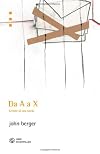
From A to X: A Story in Letters
by John Berger
On This Page
Description
"In the dusty, ramshackle town of Suse lives A'ida. Her insurgent husband Xavier has been imprisoned. Resolute, sensuous and tender, A'ida's letters to the man she loves tell of daily events in the town, and of its motley collection of inhabitants whose lives flow through hers. But Suse is under threat, and as a faceless power inexorably encroaches from outside, so the smallest details and acts of humanity -- an intimate dance, a shared meal -- assume for A'ida a life-affirming significance, show more acts of resistance against the forces that might otherwise extinguish them. From A to X is a powerful exploration of how humanity affirms itself in struggle: imagining a community which, besieged by economic and military imperialism, finds transcendent hope in the pain and fragility, vulnerability and sorrow of daily existence."--Jacket. show lessTags
Recommendations











































Member Reviews
John Berger's Booker nominated novel From A to X is designed to infuriate readers. The man is simply asking for it.
From A to X is an epistolary novel, consisting of letters sent from a woman, A'ida, to Xavier, the imprisoned man she loves. A novel made up of letters loses many readers from the get-go. The introduction explains that the letters in From A to X are not in chronological order, but in the order Xavier had put them in when they were found in his cell. To this the author has added several letters that A'ida wrote but did not send. In between each of A'ida's letters are brief passages, notations, scraps of memoir, that Xavier wrote on the backside of each letter. These are more random musing than narrative. The resulting novel show more is more puzzle than story; something a small subset of readers will enjoy. From A to X is not a book for the masses.
John Berger makes his reading audience even smaller by the content of his characters. An exchange of love letters between an imprisoned lover and a free one could make for engrossing reading, if the lover is wrongly imprisoned, even if he is rightly imprisoned but made sympathetic by circumstances or by his own remorse. Xavier, deserves to be in prison. He deserves to be there and he is not sorry either. In fact, should he get out of prison, it is clear that he would continue his life of crime. His crime, terrorism.
John Berger asks a lot from his readers. I have to give him credit for this. He is certainly willing to go far outside one's comfort zone.
I have mixed feelings about the results. The passionate love A'ida displays in her letters is as real and as moving as anything you'll find in any novel. Criminal lovers have been a staple of story-telling for some time. They've become a common feature, maybe more of movies than of books. (I suspect it's easier to identify with them over the course of a two hour film than over the length of time spent with a novel, especially if they look as good as Warren Beatty and Faye Dunaway.) But terrorists are still outside the realm of sympathetic characters for most readers. I think we've read enough, seen enough, to understand criminals who kill for money, from jealousy, or to gain position. Terrorist who coldly calculate plans to kill large numbers of innocent people to advance a political position are just not people readers can sympathize with.
Trying to come to grips with From A to X led me to look at other reviews. I found a rather loving one at The Independant which quoted a passage from the book in its conclusion:
Towards the end of the book, A'ida adopts a cat that gives her great comfort. Meanwhile, a little white kitten drops into the prison exercise yard, where Xavier and his fellow inmates quickly realise that its back is broken. They persuade the guards to take it inside, where the animal turns on her back. "With her two front paws, she wiped her face, beginning with the ears down to the white mouth, over the eyes. She wiped her eyes as if wiping away the illusions of life, and this done, she was dead... She had escaped."
If you find the above passage moving, then From A to X is the book for you. If you found yourself rolling your eyes a little, then you're probably glad From A to X did not make it to the Booker Prize short list. I'm in the latter camp. Just how does a little white kitten fall into a prison exercise yard, anyway? show less
From A to X is an epistolary novel, consisting of letters sent from a woman, A'ida, to Xavier, the imprisoned man she loves. A novel made up of letters loses many readers from the get-go. The introduction explains that the letters in From A to X are not in chronological order, but in the order Xavier had put them in when they were found in his cell. To this the author has added several letters that A'ida wrote but did not send. In between each of A'ida's letters are brief passages, notations, scraps of memoir, that Xavier wrote on the backside of each letter. These are more random musing than narrative. The resulting novel show more is more puzzle than story; something a small subset of readers will enjoy. From A to X is not a book for the masses.
John Berger makes his reading audience even smaller by the content of his characters. An exchange of love letters between an imprisoned lover and a free one could make for engrossing reading, if the lover is wrongly imprisoned, even if he is rightly imprisoned but made sympathetic by circumstances or by his own remorse. Xavier, deserves to be in prison. He deserves to be there and he is not sorry either. In fact, should he get out of prison, it is clear that he would continue his life of crime. His crime, terrorism.
John Berger asks a lot from his readers. I have to give him credit for this. He is certainly willing to go far outside one's comfort zone.
I have mixed feelings about the results. The passionate love A'ida displays in her letters is as real and as moving as anything you'll find in any novel. Criminal lovers have been a staple of story-telling for some time. They've become a common feature, maybe more of movies than of books. (I suspect it's easier to identify with them over the course of a two hour film than over the length of time spent with a novel, especially if they look as good as Warren Beatty and Faye Dunaway.) But terrorists are still outside the realm of sympathetic characters for most readers. I think we've read enough, seen enough, to understand criminals who kill for money, from jealousy, or to gain position. Terrorist who coldly calculate plans to kill large numbers of innocent people to advance a political position are just not people readers can sympathize with.
Trying to come to grips with From A to X led me to look at other reviews. I found a rather loving one at The Independant which quoted a passage from the book in its conclusion:
Towards the end of the book, A'ida adopts a cat that gives her great comfort. Meanwhile, a little white kitten drops into the prison exercise yard, where Xavier and his fellow inmates quickly realise that its back is broken. They persuade the guards to take it inside, where the animal turns on her back. "With her two front paws, she wiped her face, beginning with the ears down to the white mouth, over the eyes. She wiped her eyes as if wiping away the illusions of life, and this done, she was dead... She had escaped."
If you find the above passage moving, then From A to X is the book for you. If you found yourself rolling your eyes a little, then you're probably glad From A to X did not make it to the Booker Prize short list. I'm in the latter camp. Just how does a little white kitten fall into a prison exercise yard, anyway? show less
I loved this book, the writing was exquisite, but I needed so much more from it that ultimately it disappointed slightly.
A'ida and Xavier are lovers, but X is imprisoned on terrorist charges. Their story is teased out through some of A's letters to X in jail which were found in his cell when the new prison was built. He never replies, but sometimes writes on the back of the letters.
They live in an unnamed country where A'ida is a pharmacist. She writes about everyday life, her friends, neighbours and customers, and there are always hints of troubles and oppression in the background and it is implied that she is also an activist. She is desperate to be married to X, but the authorities won't allow it so visiting X in prison is an show more unattainable goal for her - she eventually has to be content with fantasising about him. Xavier's writing is not about A, but is often thoughts about the authorities in the outside world that he is prisoner in.
The reader is left to fill in the gaps which gives great poignancy to the texts, but I was left hungry to find out what happened to them, what X was imprisoned for, what A's role was in their struggle and other questions. Just a few answers would have satisfied, but with the exception of a brief scene-setting introduction, the author is deliberate in his intention of letting these letters speak for themselves along with the enigmatic portraits on the endpapers. show less
A'ida and Xavier are lovers, but X is imprisoned on terrorist charges. Their story is teased out through some of A's letters to X in jail which were found in his cell when the new prison was built. He never replies, but sometimes writes on the back of the letters.
They live in an unnamed country where A'ida is a pharmacist. She writes about everyday life, her friends, neighbours and customers, and there are always hints of troubles and oppression in the background and it is implied that she is also an activist. She is desperate to be married to X, but the authorities won't allow it so visiting X in prison is an show more unattainable goal for her - she eventually has to be content with fantasising about him. Xavier's writing is not about A, but is often thoughts about the authorities in the outside world that he is prisoner in.
The reader is left to fill in the gaps which gives great poignancy to the texts, but I was left hungry to find out what happened to them, what X was imprisoned for, what A's role was in their struggle and other questions. Just a few answers would have satisfied, but with the exception of a brief scene-setting introduction, the author is deliberate in his intention of letting these letters speak for themselves along with the enigmatic portraits on the endpapers. show less
This novel puports to be a collection of letters found in a jail cell of Xavier, a man convicted of being a founding member of a terrorist organization. We're told in the introduction that the letters aren't in chronological narrative and that their writer, A'ida, at times uses a code to hide her real meaning. I was psyched by the concept. However, as the book went on, it became clear that either I’m not nearly clever enough to see what’s going on, or the book is really just a series of love letters with an encoded message that was explained in the introdution. This doesn’t necessarily make it a bad book, but I was a little disappointed that the promised high-concept narrative was just a concept.
The anecdotes of daily life that show more A'ida shares are the best part of the book. Some of the stories are quite moving, and Berger’s narrative writing is great. But when A’ida gets philosophical, the book gets tedious. There’s a whole section on ligands and angels that just seemed incomprehensible. (Might there have been a code there? I sort of hope so, because otherwise, yuck!) The ending, however, is intriguing, and it is the one point in the narrative where it seems clear that A’ida (and the prisoner Xavier in his note on the final letter) is talking about something other than what is written on the page. That last letter could be read in several ways, and the ambiguity is just what I was hoping to find throughout the book.
Upon reflection on the book as a whole, my feeling of disappointment that the book failed to live up to its potential has shifted to one of outrage at being manipulated. Berger writes a story about terrorists and practically forces his readers to sympathize with them. He hides the crimes of A’ida and Xavier so deeply that we forget about them and side with them and against Xavier’s captors. Xavier’s short notes are the only hints we get at his true feeling. Note that the letters offer no real defence of their terrorist actions or try to show they aren’t guilty or that they feel sorry, any of which might be fair means for eliciting sympathy. But Berger hides their crimes in the shadows. Not fair, not fair at all.
See my complete review at my blog. show less
The anecdotes of daily life that show more A'ida shares are the best part of the book. Some of the stories are quite moving, and Berger’s narrative writing is great. But when A’ida gets philosophical, the book gets tedious. There’s a whole section on ligands and angels that just seemed incomprehensible. (Might there have been a code there? I sort of hope so, because otherwise, yuck!) The ending, however, is intriguing, and it is the one point in the narrative where it seems clear that A’ida (and the prisoner Xavier in his note on the final letter) is talking about something other than what is written on the page. That last letter could be read in several ways, and the ambiguity is just what I was hoping to find throughout the book.
Upon reflection on the book as a whole, my feeling of disappointment that the book failed to live up to its potential has shifted to one of outrage at being manipulated. Berger writes a story about terrorists and practically forces his readers to sympathize with them. He hides the crimes of A’ida and Xavier so deeply that we forget about them and side with them and against Xavier’s captors. Xavier’s short notes are the only hints we get at his true feeling. Note that the letters offer no real defence of their terrorist actions or try to show they aren’t guilty or that they feel sorry, any of which might be fair means for eliciting sympathy. But Berger hides their crimes in the shadows. Not fair, not fair at all.
See my complete review at my blog. show less
I was aware of this book because of its Booker longlisting, and I couldn't resist picking it up when I saw it in my local library. I have now read three Berger novels (the others being [b:To the Wedding|7829268|To the Wedding|John Berger|https://i.gr-assets.com/images/S/compressed.photo.goodreads.com/books/1483851964l/7829268._SY75_.jpg|450952] and his Booker winner [b:G.|15943771|G.|John Berger|https://i.gr-assets.com/images/S/compressed.photo.goodreads.com/books/1483851739l/15943771._SY75_.jpg|295874], and they are all very different. This one is perhaps the one that most reflects his interest in radical left wing politics, and consists almost entirely of letters.
The correspondence is mostly letters sent to a prisoner of conscience show more (Xavier) by his partner A'ida, hence the little, with occasional short responses. This has the effect of fracturing the narrative, and what we learn of A'ida's life has to be pieced together, but it seems clear that the setting is South American (though what place names are used seem to be borrowed from much older civilisations), that A'ida is also involved in the revolutionary struggle and that her life is a difficult one.
Quite an enjoyable and interesting book, but I think To the Wedding is a better starting point for anyone new to Berger's fiction. show less
The correspondence is mostly letters sent to a prisoner of conscience show more (Xavier) by his partner A'ida, hence the little, with occasional short responses. This has the effect of fracturing the narrative, and what we learn of A'ida's life has to be pieced together, but it seems clear that the setting is South American (though what place names are used seem to be borrowed from much older civilisations), that A'ida is also involved in the revolutionary struggle and that her life is a difficult one.
Quite an enjoyable and interesting book, but I think To the Wedding is a better starting point for anyone new to Berger's fiction. show less
From A to X is composed of A'ida's letters to her lover Xavier in prison alongside his brief notes scribbled on the backs of the pages. Although this book is classified as a novel, it's really a tone piece. There's no plot, and the few details given that hint at the story's location are contradictory. Clearly, Berger wanted to tell the story of two lovers existing outside of a particular place or time. It's the story of oppression, separation, and continuing hope in the face of it all.
A'ida's voice is sweetly poetic as she describes her days to Xavier in her letters, always focusing on the small events and details of daily life. In one letter, she describes watching a couple dance in a cafe:
"The accordionist standing, head almost show more touching the beams, a few people sitting at tables and in the centre, a couple about to dance--or, perhaps, to dance again for a third or fifth time. She couldn't have been more than seventeen. She stepped out alone, holding her arms a little apart from her body, waiting. Not for her partner who was watching her, bemused. Not for the accordionist who had begun playing. Not for another couple to join her. She was waiting to be carried away by the forces inside her. She was waiting for those forces to emerge. Calmly, her heels a little off the ground, her face open, wrists turned with their palms up, as if to see whether it was yet raining. When she felt the first drop, she would move. The drops came! She circled twice making more than twenty steps and her partner, in a leather jacket and jeans, joined her."
The unique structure of this "novel" is interesting, but the complete lack of any grounding details results in a story that feels insubstantial, like a collection of random musings rather than a cohesive whole.
This review also appears on my blog Literary License. show less
A'ida's voice is sweetly poetic as she describes her days to Xavier in her letters, always focusing on the small events and details of daily life. In one letter, she describes watching a couple dance in a cafe:
"The accordionist standing, head almost show more touching the beams, a few people sitting at tables and in the centre, a couple about to dance--or, perhaps, to dance again for a third or fifth time. She couldn't have been more than seventeen. She stepped out alone, holding her arms a little apart from her body, waiting. Not for her partner who was watching her, bemused. Not for the accordionist who had begun playing. Not for another couple to join her. She was waiting to be carried away by the forces inside her. She was waiting for those forces to emerge. Calmly, her heels a little off the ground, her face open, wrists turned with their palms up, as if to see whether it was yet raining. When she felt the first drop, she would move. The drops came! She circled twice making more than twenty steps and her partner, in a leather jacket and jeans, joined her."
The unique structure of this "novel" is interesting, but the complete lack of any grounding details results in a story that feels insubstantial, like a collection of random musings rather than a cohesive whole.
This review also appears on my blog Literary License. show less
I think I started this book twice before deciding to finish it -- I was a bit disoriented at the beginning because I had no idea where the action was taking place and it was a little off-putting. Then after I delved more deeply into the book, I realized that it could really be set in any one of many troubled places in the world where the locals face some type of military oppression, or where, as the cover blurb notes, "a faceless power inexorably encroaches from outside." Once I cleared that hurdle, the beauty of this book came shining through. It's very small, only 197 pages, but there's a lot of depth here.
The premise is that the last occupant of cell #73 in the old prison of Suse (prior to the opening of a new one) left behind some show more letters, arranged in three bundles. The prisoner, Xavier, was serving two life sentences because he was found guilty of being a "founder member of a terrorist network." The letters came from his lover, A'ida, who herself is still an activist, and are gathered in three separate bundles. Over a period of time (and we don't know what this time period is, because the letters are not in any chronological order), A'ida tries to communicate life and love onto paper and through the bars of Xavier's cell.
I have to admit to trying to figure out if she was passing along info in some kind of cryptographic way through these letters, but even that got a little old and eventually I got so caught up with A'ida and what she was saying to Xavier that I forgot all about the possibility of hidden messages and just let that all go.
This is another one of those books that really gets to you some time after you've read it. I would definitely recommend it to anyone who enjoys good literature and likes a challenge in their reading. It's not really story-ish or narrative in nature, but it is quite worth the time you put into it. It's also appropriate for the political climate of today's world.
I'm not a professional book reviewer by any means; I'm just a reader. I'm not even an English or Literature major. I don't write flowery prose in describing a book. But I do know what I like and I don't like. And I like this one. The more I think about it, the more it grows on me. I can't really do justice to this book in a review, so I'll direct you to a professional who says what I would say if I were a professional reviewer: http://living.scotsman.com/bookreviews/Book-review-From-A-to.4395414.jp show less
The premise is that the last occupant of cell #73 in the old prison of Suse (prior to the opening of a new one) left behind some show more letters, arranged in three bundles. The prisoner, Xavier, was serving two life sentences because he was found guilty of being a "founder member of a terrorist network." The letters came from his lover, A'ida, who herself is still an activist, and are gathered in three separate bundles. Over a period of time (and we don't know what this time period is, because the letters are not in any chronological order), A'ida tries to communicate life and love onto paper and through the bars of Xavier's cell.
I have to admit to trying to figure out if she was passing along info in some kind of cryptographic way through these letters, but even that got a little old and eventually I got so caught up with A'ida and what she was saying to Xavier that I forgot all about the possibility of hidden messages and just let that all go.
This is another one of those books that really gets to you some time after you've read it. I would definitely recommend it to anyone who enjoys good literature and likes a challenge in their reading. It's not really story-ish or narrative in nature, but it is quite worth the time you put into it. It's also appropriate for the political climate of today's world.
I'm not a professional book reviewer by any means; I'm just a reader. I'm not even an English or Literature major. I don't write flowery prose in describing a book. But I do know what I like and I don't like. And I like this one. The more I think about it, the more it grows on me. I can't really do justice to this book in a review, so I'll direct you to a professional who says what I would say if I were a professional reviewer: http://living.scotsman.com/bookreviews/Book-review-From-A-to.4395414.jp show less
John Berger writes gorgeous and true. That's all.
Members
- Recently Added By
Lists

Booker Prize
491 works; 62 members

Man Booker Prize Longlist 2008
13 works; 2 members
Author Information

149+ Works 17,079 Members
John Peter Berger was born in London, England on November 5, 1926. After serving in the British Army from 1944 to 1946, he enrolled in the Chelsea School of Art. He began his career as a painter and exhibited work at a number of London galleries in the late 1940s. He then worked as an art critic for The New Statesman for a decade. He wrote fiction show more and nonfiction including several volumes of art criticism. His novels include A Painter of Our Time, From A to X, and G., which won both the James Tait Black Memorial Prize and the Booker Prize in 1972. His other works include an essay collection entitled Permanent Red, Into Their Labors, and a book and television series entitled Ways of Seeing. In the 1970s, he collaborated with the director Alain Tanner on three films. He wrote or co-wrote La Salamandre, The Middle of the World, and Jonah Who Will Be 25 in the Year 2000. He died on January 1, 2017 at the age of 90. (Bowker Author Biography) show less
Awards and Honors
Awards
Distinctions
Series
Belongs to Publisher Series
Mirmanda (58)
Common Knowledge
- Original publication date
- 2008
- Quotations*
- L'espoir et l'attente sont complètement différents l'un de l'autre. Au début, je pensais que c'était une question de durée, que l'espoir, c'était attendre quelque chose qui prenait plus de temps. J'avais tort. L'attente... (show all) vient du corps, tandis que l'espoir vient de l'âme. Voilà la différence. Tous deux se parlent, s'excitent ou se consolent, mais leur rêve à chacun diffère.
Et il m'est soudain venu à l'idée qu'avec les machines faites par l'homme, il y a des circuits d'ingéniosité qui peuvent se partager d'un esprit l'autre. Comme on partage la poésie. J'ai compris ça au dos de tes mains.
A l'instant qui précède notre mort, mi Guapo, le temps fait peut-être un tête-à-queue. Peut-être qu'à ce moment-là, le fait de regarder derrière soi tient toutes les promesses de l'avenir. Peut-être que le passé se... (show all) fertilise si l'avenir est stérile !
Ce sont les petites choses qui nous effraient. Les choses énormes, celles qui nous tuent, nous rendent courageux.
L'enfer est un invention des ploutocrates ; son but premier était de détourner l'attention des pauvres de leur détresse. D'abord par la menace d'une condition plus dure encore. Et ensuite par la promesse, à condition qu'i... (show all)ls se montrent obéissants et loyaux, que, dans une autre vie, au royaume des cieux, ils jouiraient des biens que la richesse peut acquérir ici-bas, et de plus encore. (...) Les supplices actuels sont allés plus loin. Plus besoin d'évoquer un enfer dans l'au-delà. Un enfer réservé aux exclus se construit ici-bas, pour proclamer la même chose : que seule la richesse peut donner un sens à la vie.
Dans les replis obscurs du temps, il n'y a peut-être rien d'autre que le toucher muet de nos doigts. Et nos actes.
Les messages sont transmis par des ligands, qui parcourent de grandes distances, entre autre par voie sanguine. (p.169 et suivantes).
L'esprit est le résultat de la lecture constante des évènements qui surviennent dans le corps, et parmi ces évènements il y a toutes les perceptions sensorielles - ce que nous voyons, entendons, touchons, sentons, goût... (show all)ons.
*Some information comes from Common Knowledge in other languages. Click "Edit" for more information.
Classifications
Statistics
- Members
- 306
- Popularity
- 104,038
- Reviews
- 14
- Rating
- (3.62)
- Languages
- 9 — Catalan, Dutch, English, French, German, Italian, Portuguese, Spanish, Turkish
- Media
- Paper, Ebook
- ISBNs
- 16
- ASINs
- 3