
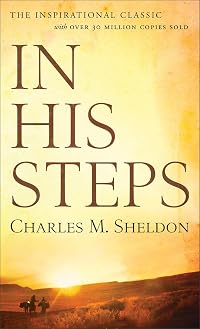
In His Steps
by Charles M. Sheldon
On This Page
Description
One hundred years ago Christians read Charles Sheldon's In His Steps with runaway enthusiasm. Sheldon's story traces the account of the fictional Reverend Maxwell who challenges himself and his congregation to constantly ask, 'What would Jesus do?' This question puts all of life's circumstances in a new light. Those characters in Sheldon's book who take the challenge of this question seriously live dramatically changed lives. But a changed life responding to Jesus' example of compassion and show more grace does not always make things easier. People in Sheldon's story learn that acting like Jesus can alienate others who prefer status quo comfort and social respectability. The real challenge of the question, 'What would Jesus do?' is not the initial fervor it evokes but the sustained devotion it can produce. show lessTags
Recommendations



































Member Reviews
This book is written in the late 19th century and is set in the US probably a town close to Chicago and involves a church community. A beggar comes into their midst and the pastor comes under conviction as to his conduct towards this beggar. He asks himself, “What would Jesus do? and he asks his congregation to take a year long pledge to live their lives by this question.
The story was entertaining, well read by the narrator but a better word would be inspirational. I was really shocked to realize that this saying “what would Jesus do” or WWJD (worn as jewelry, etc by Christians) was so old. I then proceeded to ask the question, Is this book relevant today, what is the author trying to get across through the use of this story and show more how does it fit with today's church. Essentially, this is a book about discipleship and there is a strong movement in todays church (at least the one I attend) to make disciples. The story is simple, the struggles were hinted at but nothing was developed in depth. Was this a simpler time, was it easier to be a disciple in the 19th century than it is now? How does this book fit today.
The book stated that if Christians took this to heart they would change the world. I think one of the basic premise was that government and social change could not do what the church could do for social change (help for the poor, cleaning up the tenements and ridding the environment of the saloon).
Is today’s Christian willing to give up money, position and family to do what Jesus would do or are we content to let government and organizations do the work and just give our support without getting personally involved. I hope I am very wrong, but I think that today’s average Christian is not living by this principle. We haven’t taken up our cross, we haven’t sacrificed or suffered and we are willing to let the government take care of the poor and downtrodden. Its easier to pay our taxes (and complain) that invest our time and energy and our money. show less
The story was entertaining, well read by the narrator but a better word would be inspirational. I was really shocked to realize that this saying “what would Jesus do” or WWJD (worn as jewelry, etc by Christians) was so old. I then proceeded to ask the question, Is this book relevant today, what is the author trying to get across through the use of this story and show more how does it fit with today's church. Essentially, this is a book about discipleship and there is a strong movement in todays church (at least the one I attend) to make disciples. The story is simple, the struggles were hinted at but nothing was developed in depth. Was this a simpler time, was it easier to be a disciple in the 19th century than it is now? How does this book fit today.
The book stated that if Christians took this to heart they would change the world. I think one of the basic premise was that government and social change could not do what the church could do for social change (help for the poor, cleaning up the tenements and ridding the environment of the saloon).
Is today’s Christian willing to give up money, position and family to do what Jesus would do or are we content to let government and organizations do the work and just give our support without getting personally involved. I hope I am very wrong, but I think that today’s average Christian is not living by this principle. We haven’t taken up our cross, we haven’t sacrificed or suffered and we are willing to let the government take care of the poor and downtrodden. Its easier to pay our taxes (and complain) that invest our time and energy and our money. show less
One hundred years ago Christians read Charles Sheldon's In His Steps with runaway enthusiasm. Sheldon's story traces the account of the fictional Reverend Maxwell who challenges himself and his congregation to constantly ask, "What would Jesus do?" This question puts all of life's circumstances in a new light. Those characters in Sheldon's book who take the challenge of this question seriously live dramatically changed lives. // But a changed life responding to Jesus' example of compassion and grace does not always make things easier. People in Sheldon's story learn that acting like Jesus can alienate others who prefer status quo comfort and social respectability. The real challenge of the question, "What would Jesus do?" is not the show more initial fervor it evokes but the sustained devotion it can produce. show less
I carried a lot of baggage into this book, but perhaps I'll defer that for later on. I ended up liking it fairly well.
The book arose from a series of sermons or "stories" Rev. Charles Sheldon told to his parishioners. He was pastor of a Congregational church in Topeka, Kansas, some 120 or so years ago. The weekly stories became quite popular and his church was bulging by the time he finished up.
The hook in the stories was about a preacher who decided that before he did anything, he should ask himself what Jesus would do in a given situation. He then invited those of his congregation, who were willing, to try a test. For one year they would try not do anything without first asking themselves what Jesus would do in a given situation, show more and then do that thing. One church member who signed up was a newspaper editor, so he set about changing his paper to a "Christian" paper. No more ads for liquor and tobacco, and no more idle society gossip or stories about prize fights. Another member was a beautiful young woman who sang rather stunningly. Rather than go on tour with a musical group and become rich and famous, she decided to sing at a local tent meeting, to draw in fallen souls for salvation, and to give lessons to poor people who wouldn't be able to afford lessons for themselves. A local merchant realized that he should, among other things, treat his staff as partners, not servants. And so it went with others. Some people suffered financially after their decisions, but they all felt more spiritually fulfilled, and also felt a greater sense of community and belonging with their fellow church members.
The movement spread to Chicago, where some local, well-off clergy resigned their fancy positions and set up a settlement house for less-well off people, a place where people could live decently and also become better educated so as to get jobs to support themselves. A young woman with a flair for cooking gave classes to the young women so that they'd be able to get jobs as domestics in local households. And so forth.
The movement also spawned political action. It seems that folks back in olden times believed that the major block to people's living a good life was the temptation put in front of them by the "liquor interests". Just get rid of the saloons, and people would no longer fall into sin and degradation. Something like that. When it came out, the book helped spawn a movement of Christian social action. It wasn't just about closing down the saloons, but also about feeding the hungry and caring for the sick. That stuff one reads about in Matthew 25, unless one is a modern American White Evangelical, in which case Matt. 25 has been purged from the Good Book, or at least re-interpreted out of all recognition.
So, this book really does have a good point. Those of us who aspire to live as Christians probably would be well advised to ask ourselves what Jesus would do in certain situations. Would Jesus take music lessons so as better to praise Him on Sundays and also attract new members by dint of having less dreary services, or would that money be better spent stocking the food pantry? Would Jesus work on defense-department projects so long as they were related to actual defense and not to creating ever more deadly offensive weapons, (although some would argue that the best defense is a good offense), or would one be better advised to take on more mundane work so as to avoid potential conflicts with one's conscience? Would Jesus invest his 401K in stocks in companies that invested in the Southeast Asian fishing industry where most of the workers are defacto slaves, or would he just not have a 401K and hope he died before he got too old to work? Would Jesus engage in social action and thereby try to better the lives of all, or would he be more likely not to draw people outside their comfort zones? And so forth.
But then we get to the baggage. First the more fun baggage. When I read "Topeka, Kansas", the first thing I thought about was Fred Phelps, a preacher who decided that the only thing Jesus would do is "hate fags", and hate them very publicly. That's not even remotely my idea of a Christian approach to living. I also remembered that my current Congregational church used to have a Rev. Sheldon, who was rather a polarizing figure. That was well before my time, but some 50 years after Rev. Sheldon left, some of the scars are still with us.
But then I also realized that my great grandmother was a stalwart member Women's Christian Temperance Union member in Augusta, Kansas, near Wichita. On the side, she managed to have 11 children, only one or two of whom didn't make it past 90, and all of whom seemed to have been successes in their lives. I also remembered that I'd been active in a Congregational church in Manhattan, Kansas for a time, and still think well of my experience there. So I felt somewhat better about Kansas and Congregationalists.
Unfortunately, I also began thinking about the more recent WWJD movement that rose in the 1990s. For some reason, I associate that movement with the election of George W. Bush, which is never a good association. But it's not poor Mr. Bush, it's the white Evangelical folks who took up the WWJD brand who elected them, and who have pretty much given up religion for politics, very toxic politics. They are, if nothing else, decidedly not into social justice. It rather saddens me that a century after Sheldon's book, the people who ask the same question he asked, come up with completely different answers than Sheldon's flock, answers that have done and continue to do real harm to millions of people in our world. [further pungent remarks excised for civility] show less
The book arose from a series of sermons or "stories" Rev. Charles Sheldon told to his parishioners. He was pastor of a Congregational church in Topeka, Kansas, some 120 or so years ago. The weekly stories became quite popular and his church was bulging by the time he finished up.
The hook in the stories was about a preacher who decided that before he did anything, he should ask himself what Jesus would do in a given situation. He then invited those of his congregation, who were willing, to try a test. For one year they would try not do anything without first asking themselves what Jesus would do in a given situation, show more and then do that thing. One church member who signed up was a newspaper editor, so he set about changing his paper to a "Christian" paper. No more ads for liquor and tobacco, and no more idle society gossip or stories about prize fights. Another member was a beautiful young woman who sang rather stunningly. Rather than go on tour with a musical group and become rich and famous, she decided to sing at a local tent meeting, to draw in fallen souls for salvation, and to give lessons to poor people who wouldn't be able to afford lessons for themselves. A local merchant realized that he should, among other things, treat his staff as partners, not servants. And so it went with others. Some people suffered financially after their decisions, but they all felt more spiritually fulfilled, and also felt a greater sense of community and belonging with their fellow church members.
The movement spread to Chicago, where some local, well-off clergy resigned their fancy positions and set up a settlement house for less-well off people, a place where people could live decently and also become better educated so as to get jobs to support themselves. A young woman with a flair for cooking gave classes to the young women so that they'd be able to get jobs as domestics in local households. And so forth.
The movement also spawned political action. It seems that folks back in olden times believed that the major block to people's living a good life was the temptation put in front of them by the "liquor interests". Just get rid of the saloons, and people would no longer fall into sin and degradation. Something like that. When it came out, the book helped spawn a movement of Christian social action. It wasn't just about closing down the saloons, but also about feeding the hungry and caring for the sick. That stuff one reads about in Matthew 25, unless one is a modern American White Evangelical, in which case Matt. 25 has been purged from the Good Book, or at least re-interpreted out of all recognition.
So, this book really does have a good point. Those of us who aspire to live as Christians probably would be well advised to ask ourselves what Jesus would do in certain situations. Would Jesus take music lessons so as better to praise Him on Sundays and also attract new members by dint of having less dreary services, or would that money be better spent stocking the food pantry? Would Jesus work on defense-department projects so long as they were related to actual defense and not to creating ever more deadly offensive weapons, (although some would argue that the best defense is a good offense), or would one be better advised to take on more mundane work so as to avoid potential conflicts with one's conscience? Would Jesus invest his 401K in stocks in companies that invested in the Southeast Asian fishing industry where most of the workers are defacto slaves, or would he just not have a 401K and hope he died before he got too old to work? Would Jesus engage in social action and thereby try to better the lives of all, or would he be more likely not to draw people outside their comfort zones? And so forth.
But then we get to the baggage. First the more fun baggage. When I read "Topeka, Kansas", the first thing I thought about was Fred Phelps, a preacher who decided that the only thing Jesus would do is "hate fags", and hate them very publicly. That's not even remotely my idea of a Christian approach to living. I also remembered that my current Congregational church used to have a Rev. Sheldon, who was rather a polarizing figure. That was well before my time, but some 50 years after Rev. Sheldon left, some of the scars are still with us.
But then I also realized that my great grandmother was a stalwart member Women's Christian Temperance Union member in Augusta, Kansas, near Wichita. On the side, she managed to have 11 children, only one or two of whom didn't make it past 90, and all of whom seemed to have been successes in their lives. I also remembered that I'd been active in a Congregational church in Manhattan, Kansas for a time, and still think well of my experience there. So I felt somewhat better about Kansas and Congregationalists.
Unfortunately, I also began thinking about the more recent WWJD movement that rose in the 1990s. For some reason, I associate that movement with the election of George W. Bush, which is never a good association. But it's not poor Mr. Bush, it's the white Evangelical folks who took up the WWJD brand who elected them, and who have pretty much given up religion for politics, very toxic politics. They are, if nothing else, decidedly not into social justice. It rather saddens me that a century after Sheldon's book, the people who ask the same question he asked, come up with completely different answers than Sheldon's flock, answers that have done and continue to do real harm to millions of people in our world. [further pungent remarks excised for civility] show less
After an unemployed nomad drops dead in the building, members of the First Church of Raymond take a year-long vow: to do everything asking themselves "What would Jesus do?". The "WWJD" hype of several years ago proves that this book is a classic in spite of itself.
For a hundred-year-old book, it hasn't aged well. The language is incredibly clunky. Here's one person talking to another, generally picked at random: "I do not know that I have yet been able to tell just what is the wisest and most effective kind of work that can be done in [this town]." There's not a lot of "action" in the book; anything particularly interesting that happens is almost always told as a commentary about past events. In one very strange transition, the first show more hundred or so pages are summarized as a letter from one religious letter to another.
The characters are also a bit flat. One of the main characters, the preacher that starts this pledge, does fret about how he is perceived by his congregation, but his wife -- which one would think would be one of his closest confidantes -- is barely mentioned. Some of the extra characters do "suffer" because of this pledge -- one loses his job, one loses a lot of money -- but we never get much more of the story than that. We never meet a character who tries the pledge and then fails. And then curiously, the last third of the book dumps most of these characters and starts with a new set with barely much of a transition (other than the letter mentioned above).
The problems of the day are almost laughable to us now. Closing down the town's many saloons is primary goal on the minds of many of the congregation. Keeping the newspaper free of violence and "yellow journalism" is another cross that one of our characters must bear. The characters feel suffering is a major component of following Jesus, even if it leads to financial ruin.
Perhaps the most perplexing part of this book is that the Bible isn't mentioned all that often. When the characters face an issue and ask themselves "What would Jesus do," they pray for an answer. For a religious book, it's quite surprising that Bible verses aren't used to support any decisions. On the other hand, several of the naysayers in the book (there are a few but not as many as one might expect) tend to use that in their arguments: "Jesus never said we had to close down the saloons" or "The Bible doesn't say a newspaper can't be printed on a Sunday."
This may come across as a negative review, and certainly for some reasons this book deserves negativity. And yet it reminds us that going to church and putting money in the offering plate doesn't lead to our religious salvation. More is necessary, and this book's enduring question fits as a nice corollary to the Golden Rule ("do unto others as you would have them do unto you"). show less
For a hundred-year-old book, it hasn't aged well. The language is incredibly clunky. Here's one person talking to another, generally picked at random: "I do not know that I have yet been able to tell just what is the wisest and most effective kind of work that can be done in [this town]." There's not a lot of "action" in the book; anything particularly interesting that happens is almost always told as a commentary about past events. In one very strange transition, the first show more hundred or so pages are summarized as a letter from one religious letter to another.
The characters are also a bit flat. One of the main characters, the preacher that starts this pledge, does fret about how he is perceived by his congregation, but his wife -- which one would think would be one of his closest confidantes -- is barely mentioned. Some of the extra characters do "suffer" because of this pledge -- one loses his job, one loses a lot of money -- but we never get much more of the story than that. We never meet a character who tries the pledge and then fails. And then curiously, the last third of the book dumps most of these characters and starts with a new set with barely much of a transition (other than the letter mentioned above).
The problems of the day are almost laughable to us now. Closing down the town's many saloons is primary goal on the minds of many of the congregation. Keeping the newspaper free of violence and "yellow journalism" is another cross that one of our characters must bear. The characters feel suffering is a major component of following Jesus, even if it leads to financial ruin.
Perhaps the most perplexing part of this book is that the Bible isn't mentioned all that often. When the characters face an issue and ask themselves "What would Jesus do," they pray for an answer. For a religious book, it's quite surprising that Bible verses aren't used to support any decisions. On the other hand, several of the naysayers in the book (there are a few but not as many as one might expect) tend to use that in their arguments: "Jesus never said we had to close down the saloons" or "The Bible doesn't say a newspaper can't be printed on a Sunday."
This may come across as a negative review, and certainly for some reasons this book deserves negativity. And yet it reminds us that going to church and putting money in the offering plate doesn't lead to our religious salvation. More is necessary, and this book's enduring question fits as a nice corollary to the Golden Rule ("do unto others as you would have them do unto you"). show less
Rarely have I come across a book that I am so torn over as to how to rate it. Usually a book will be obviously good or bad, making the ultimate conclusion in rating it a fairly easy process. While a good book may have some detractors, overall the good outweighs the bad, with the reverse also being true of bad books. However, I’m having a hard time making such a distinction in reviewing Charles Sheldon’s classic, In His Steps. There are many good things about the book, but there are also many not-so-good things.
The book centers primarily on a few members of the affluent First Church of Raymond in the late19th century who have been faced with the question of how Jesus would act if He were in their place. (In His Steps can be credited show more with the origin of the popularized question of “What would Jesus do?” or WWJD). A call is made for volunteers to ask the question, “What would Jesus do?” before making any decisions for one whole year. Among those who volunteer are the pastor, the local newspaper owner/editor, a gifted singer, a wealthy young woman, a writer, and an employee of the local railroad. The book follows their efforts during the course of the year as they attempt to live out their pledge of asking, “What would Jesus do?” This leads them to make decisions that aren’t the most popular or even understood by some family members and the general public. It also leads them to undertake a greater involvement in their city, both in evangelical outreaches and for the good of society in general.
For a book that was written over 100 years ago, it cuts to the heart of our current culture in the majority of the Western world of materialism and even more so among Christians. Perhaps the hardest hitting teaching comes towards the end of the book when the pastor asks a congregation, “How much is the Christianity of the age suffering for Him? Is it denying itself at the cost of ease, comfort, luxury, elegance of living? What does the age need more than personal sacrifice?....The Christianity that attempts to suffer by proxy is not the Christianity of Christ.” Here is found perhaps the main and best thrust of the entire book. The call to Christianity is a call to suffer for Christ. “If anyone would come after me, let him deny himself and take up his cross and follow me. For whoever would save his life will lose it, but whoever loses his life for my sake and the gospel’s will save it.” (Mark 8:34-35) The decision to follow Jesus, to do what He would do, is not played out in the characters’ lives as something that turns out rosy. One man loses his job and as a result, his wife becomes bitter toward him. The newspaper owner/editor watches his subscribers and advertisers leave in droves because of his decision not to allow certain kinds of content. Yet another turns down what some may consider the “opportunity of a lifetime” to serve in a more humble ministry. This is no health, wealth and prosperity gospel. Wearing a bracelet that says “WWJD?” simply won’t cut it. All through the book, the element of personal suffering and sacrifice is continually presented as the ultimate test of following Christ.
In His Steps gives an example of Christianity in action – how Christianity looks in the nitty-gritty, everyday stuff of life. The characters realize that Christianity is not simply an abstract idea, full of wise sayings and doctrines designed only to stimulate the intellect. Christianity is lived out Monday through Sunday. It’s not only making decisions based on what Jesus might do, but telling people the reasoning behind the decision. It’s getting involved in the community, reaching out to those in need, using the resources that we’ve been blessed with to help change a life. This is Christianity in action.
This brings me to the issues that have given me pause and not just a little concern. First, a few minor points. The writing style is very poor. Superlatives abound in the descriptions of the effects of various decisions. “For the first time ever…” or “he had never…” or “Nothing had ever…” or “Such a thing had never…” – these overused phrases become old and trite in their use. Additionally, the plot becomes rather predictable. However, that being said, this book is perhaps rarely read for its fictional and linguistic prowess.
While the characters in the narrative are seeking to follow Christ’s example, much of the decisions are based very much on personal interpretation with little to no Biblical basis for their reasoning. In one sense, the subjective nature of the question at hand makes the decision one that should be and can only be decided by the person ultimately responsible. In this, the author rightly puts great emphasis on prayer and the personal nature of the pledge. However, this lends somewhat of a relativistic mindset if the decision is not based on what Scripture says. For example, the newspaper editor decides that printing a Sunday edition is not what Jesus would do since Jesus would not publish something that caused a reader to read anything else but the Bible on Sunday. While to be commended for making such a difficult decision and following his conscious, this makes me wonder what in Scripture teaches such a notion that reading anything else but the Bible on Sunday is contrary to Christ’s teachings.
The biggest issue I have with the book is why the Christians go about seeking to follow Christ’s steps or do what Jesus would do. Set during the heyday of the Temperance Movement, much emphasis is placed on the poorer citizens of the city and the effect that alcohol played in many of the problems that class of society faced. Further, while there seems to be much emphasis on evangelization, the improvement of life in general for the class is seen as the ultimate end of this evangelization. Oddly enough, this message of “accept Christ and everything well get better” goes against the message for the upper class citizens that Christians must suffer. The gospel that is proclaimed in In His Steps is not a gospel that comes by means of the death, burial and resurrection of Christ. Instead, it is a gospel that points to Christ as the ultimate example of how to live and reform society, but not the source of the strength to bring about that reform. And Christ’s example in this case is to help the poor. Where a conflict arises is in dealing with the question, If helping the poor in bettering their society is what the gospel offers, how does this affect how the poor themselves live? This question is asked point blank of several of the pastors by a man out of work for many days and not one of them can provide an answer. One pastor ponders the question in his heart as
“a question that brings up the entire social problem in all its perplexing entanglement of human wrongs and its present condition contrary to every desire of God for a human being's welfare. Is there any condition more awful than for a man in good health, able and eager to work, with no means of honest livelihood unless he does work, actually unable to get anything to do, and driven to one of three things: begging or charity at the hands of friends or strangers, suicide or starvation?”
Nowhere in the book is a person’s sinful condition addressed, but only the social condition. When reform comes, it should not, it cannot come through the betterment of a person’s economic wellbeing. I’m not denying that we have a responsibility to minister to others, especially those in need. I think even my own tendency is to try to ignore others’ condition, like the condition of the man on the corner holding the sign. But in helping those in need, we should not do it simply for the sake of our own suffering nor in trying to help them make a better life for themselves. We should be pointing them to Christ, not as the example of who we are following, but as the source of the strength to do what we do, the source of the righteousness to overcome sin. Without Christ, without repentance, we can improve society to the last person but will not change the root of the problem and will find them just as bad as before. As John Owen so aptly puts it in The Mortification of Sin: “Poor soul! It is not thy sore finger but thy hectic fever that thou art to apply thyself to the consideration of. Thou settest thyself against a particular sin, and dost not consider that thou art nothing but sin.”
In His Steps is certainly a step in the right direction of encouraging believers to challenge the way we live and think and interact with the world around us. But the reader should always keep in mind that the gospel of Christ is not an example simply to be followed in order to better society, but rather the gospel is solely and completely about Christ Himself and the righteousness we have in Him. In following Him, a person’s social standing may not improve in the slightest, but his eternal standing in the sight of God will. And that’s what matters. show less
The book centers primarily on a few members of the affluent First Church of Raymond in the late19th century who have been faced with the question of how Jesus would act if He were in their place. (In His Steps can be credited show more with the origin of the popularized question of “What would Jesus do?” or WWJD). A call is made for volunteers to ask the question, “What would Jesus do?” before making any decisions for one whole year. Among those who volunteer are the pastor, the local newspaper owner/editor, a gifted singer, a wealthy young woman, a writer, and an employee of the local railroad. The book follows their efforts during the course of the year as they attempt to live out their pledge of asking, “What would Jesus do?” This leads them to make decisions that aren’t the most popular or even understood by some family members and the general public. It also leads them to undertake a greater involvement in their city, both in evangelical outreaches and for the good of society in general.
For a book that was written over 100 years ago, it cuts to the heart of our current culture in the majority of the Western world of materialism and even more so among Christians. Perhaps the hardest hitting teaching comes towards the end of the book when the pastor asks a congregation, “How much is the Christianity of the age suffering for Him? Is it denying itself at the cost of ease, comfort, luxury, elegance of living? What does the age need more than personal sacrifice?....The Christianity that attempts to suffer by proxy is not the Christianity of Christ.” Here is found perhaps the main and best thrust of the entire book. The call to Christianity is a call to suffer for Christ. “If anyone would come after me, let him deny himself and take up his cross and follow me. For whoever would save his life will lose it, but whoever loses his life for my sake and the gospel’s will save it.” (Mark 8:34-35) The decision to follow Jesus, to do what He would do, is not played out in the characters’ lives as something that turns out rosy. One man loses his job and as a result, his wife becomes bitter toward him. The newspaper owner/editor watches his subscribers and advertisers leave in droves because of his decision not to allow certain kinds of content. Yet another turns down what some may consider the “opportunity of a lifetime” to serve in a more humble ministry. This is no health, wealth and prosperity gospel. Wearing a bracelet that says “WWJD?” simply won’t cut it. All through the book, the element of personal suffering and sacrifice is continually presented as the ultimate test of following Christ.
In His Steps gives an example of Christianity in action – how Christianity looks in the nitty-gritty, everyday stuff of life. The characters realize that Christianity is not simply an abstract idea, full of wise sayings and doctrines designed only to stimulate the intellect. Christianity is lived out Monday through Sunday. It’s not only making decisions based on what Jesus might do, but telling people the reasoning behind the decision. It’s getting involved in the community, reaching out to those in need, using the resources that we’ve been blessed with to help change a life. This is Christianity in action.
This brings me to the issues that have given me pause and not just a little concern. First, a few minor points. The writing style is very poor. Superlatives abound in the descriptions of the effects of various decisions. “For the first time ever…” or “he had never…” or “Nothing had ever…” or “Such a thing had never…” – these overused phrases become old and trite in their use. Additionally, the plot becomes rather predictable. However, that being said, this book is perhaps rarely read for its fictional and linguistic prowess.
While the characters in the narrative are seeking to follow Christ’s example, much of the decisions are based very much on personal interpretation with little to no Biblical basis for their reasoning. In one sense, the subjective nature of the question at hand makes the decision one that should be and can only be decided by the person ultimately responsible. In this, the author rightly puts great emphasis on prayer and the personal nature of the pledge. However, this lends somewhat of a relativistic mindset if the decision is not based on what Scripture says. For example, the newspaper editor decides that printing a Sunday edition is not what Jesus would do since Jesus would not publish something that caused a reader to read anything else but the Bible on Sunday. While to be commended for making such a difficult decision and following his conscious, this makes me wonder what in Scripture teaches such a notion that reading anything else but the Bible on Sunday is contrary to Christ’s teachings.
The biggest issue I have with the book is why the Christians go about seeking to follow Christ’s steps or do what Jesus would do. Set during the heyday of the Temperance Movement, much emphasis is placed on the poorer citizens of the city and the effect that alcohol played in many of the problems that class of society faced. Further, while there seems to be much emphasis on evangelization, the improvement of life in general for the class is seen as the ultimate end of this evangelization. Oddly enough, this message of “accept Christ and everything well get better” goes against the message for the upper class citizens that Christians must suffer. The gospel that is proclaimed in In His Steps is not a gospel that comes by means of the death, burial and resurrection of Christ. Instead, it is a gospel that points to Christ as the ultimate example of how to live and reform society, but not the source of the strength to bring about that reform. And Christ’s example in this case is to help the poor. Where a conflict arises is in dealing with the question, If helping the poor in bettering their society is what the gospel offers, how does this affect how the poor themselves live? This question is asked point blank of several of the pastors by a man out of work for many days and not one of them can provide an answer. One pastor ponders the question in his heart as
“a question that brings up the entire social problem in all its perplexing entanglement of human wrongs and its present condition contrary to every desire of God for a human being's welfare. Is there any condition more awful than for a man in good health, able and eager to work, with no means of honest livelihood unless he does work, actually unable to get anything to do, and driven to one of three things: begging or charity at the hands of friends or strangers, suicide or starvation?”
Nowhere in the book is a person’s sinful condition addressed, but only the social condition. When reform comes, it should not, it cannot come through the betterment of a person’s economic wellbeing. I’m not denying that we have a responsibility to minister to others, especially those in need. I think even my own tendency is to try to ignore others’ condition, like the condition of the man on the corner holding the sign. But in helping those in need, we should not do it simply for the sake of our own suffering nor in trying to help them make a better life for themselves. We should be pointing them to Christ, not as the example of who we are following, but as the source of the strength to do what we do, the source of the righteousness to overcome sin. Without Christ, without repentance, we can improve society to the last person but will not change the root of the problem and will find them just as bad as before. As John Owen so aptly puts it in The Mortification of Sin: “Poor soul! It is not thy sore finger but thy hectic fever that thou art to apply thyself to the consideration of. Thou settest thyself against a particular sin, and dost not consider that thou art nothing but sin.”
In His Steps is certainly a step in the right direction of encouraging believers to challenge the way we live and think and interact with the world around us. But the reader should always keep in mind that the gospel of Christ is not an example simply to be followed in order to better society, but rather the gospel is solely and completely about Christ Himself and the righteousness we have in Him. In following Him, a person’s social standing may not improve in the slightest, but his eternal standing in the sight of God will. And that’s what matters. show less
What would Jesus do? For the first time in their lives, the Reverend Henry Maxwell and his congregation are forced to consider this question and its consequences. Deeply shaken by the appearance of a mysterious stranger in town and his impassioned pleas for the poor and downtrodden, the minister and five influential parishioners begin a year long experience in Christianity. Each has resolved to conduct his life according to the precepts of Christ, applying His behavior to their own lives.
Polemic but interesting novel, written before the turn of the last century (1900-2000), challenging smug churchgoers, with a serious pro-Prohibition angle. I don't share the philosophy, but it was a fascinating read.
Members
- Recently Added By
Lists

Favorite Childhood Books
1,646 works; 518 members

Sonlight Books
1,487 works; 25 members

CCE 1000 Good Books List
1,033 works; 12 members

Top 100 Christian Books
13 works; 3 members

Christian Classics (Old and Modern)
53 works; 3 members
Author Information

67+ Works 6,867 Members
Some Editions
Series
Belongs to Publisher Series
Work Relationships
Is contained in
Has the adaptation
Is abridged in
Has as a student's study guide
Common Knowledge
- Canonical title
- In His Steps
- Original title
- In His Steps; In His steps
- Alternate titles
- 跟隨祂的脚踪行; What would Jesus do
- Original publication date
- 1896; 1999
- People/Characters
- Henry Maxwell; Virginia Page; Rachel Winslow; Rollin Page; Edward Norman; Donald Marsh (show all 10); Jasper Chase; Rose Sterling; Felicia Sterling; Calvin Bruce
- Important places
- Town of Raymond
- Epigraph
- [None]
- Dedication
- [None]
- First words
- It was Friday morning and the Reverend Henry Maxwell was trying to finish his Sunday morning sermon.
Dit is Vrydgoggend en dr. Henry Maxwell is besig om sy preek vir Sondagoggend voor te berei. - Last words
- (Click to show. Warning: May contain spoilers.)And with a hope that walks hand in hand with faith and love Henry Maxwell, disciple of Jesus, laid him down to sleep and dreamed of the regeneration of Christendom, and saw in his dream a church of Jesus without spot or wrinkle or any such thing, following Him all the way, walking obediently in His steps.
- Original language*
- Amerikanisch
- Disambiguation notice
- Do not combine with Garrett Ward Sheldon's retelling version; different works.
*Some information comes from Common Knowledge in other languages. Click "Edit" for more information.
Classifications
Statistics
- Members
- 5,481
- Popularity
- 2,432
- Reviews
- 40
- Rating
- (3.70)
- Languages
- 12 — Afrikaans, Chinese, Danish, Dutch, English, Finnish, French, German, Korean, Norwegian (Bokmål), Spanish, Portuguese (Portugal)
- Media
- Paper, Audiobook, Ebook
- ISBNs
- 198
- UPCs
- 1
- ASINs
- 139