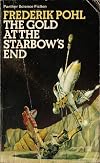
The Gold at the Starbow's End
by Frederik Pohl
On This Page
Tags
Recommendations




Member Reviews
Comprised of one novella and four short stories, The Gold at the Starbow's End is a somewhat fascinating collection. The title tale regards a group of astronauts on a very long journey to Alpha Centuari and what they do to occupy the time they spend getting there. They have been sent by a very forward-thinking man who may not really have their best interests at heart. This story was hilarious in regards to the kind of antics the astronauts got up to, and the reaction their handler has to their reports are absolutely priceless in more ways than one.
"Sad Solarian Screenwriter Sam" is one of those stories where extra-terrestrials decide to destroy the human race because we suck. Sam is their one and only test subject. He sucks. Quite a bit show more of this story is cribbed from Burroughs Martian saga. I was not amused.
"Call Me Million" is a 'what-if' kind of story that is uniquely written, but never really goes anywhere. Charley is a soul sucker. He eats people's souls and they die. There are no people left to eat except other people eaters. What now? There. You've read the story. Skip it.
After reading "Shaffery Among the Immortals" I was hoping that the final story would also feature a complete sad sack so I could say I didn't really like or identify with any of the main characters in these stories. Shaffery is a pathetic loser even compared to Sam and Charley. However, the story was worth reading for the ending. Very fitting.
Probably the best story in the book was "The Merchants of Venus." Pohl did a very good job of world-building in regards to the planet, it's atmosphere, it's previous denizens, etc. without bogging the reader down with exposition. I did not disdain the main character. I was rooting for Audee to find what he was looking for. The fact that he was destined to do so was obvious from the first, but the struggle and journey were quite enjoyable to read about.
Final take: Skip stories two and three and you have a 4 star book. show less
"Sad Solarian Screenwriter Sam" is one of those stories where extra-terrestrials decide to destroy the human race because we suck. Sam is their one and only test subject. He sucks. Quite a bit show more of this story is cribbed from Burroughs Martian saga. I was not amused.
"Call Me Million" is a 'what-if' kind of story that is uniquely written, but never really goes anywhere. Charley is a soul sucker. He eats people's souls and they die. There are no people left to eat except other people eaters. What now? There. You've read the story. Skip it.
After reading "Shaffery Among the Immortals" I was hoping that the final story would also feature a complete sad sack so I could say I didn't really like or identify with any of the main characters in these stories. Shaffery is a pathetic loser even compared to Sam and Charley. However, the story was worth reading for the ending. Very fitting.
Probably the best story in the book was "The Merchants of Venus." Pohl did a very good job of world-building in regards to the planet, it's atmosphere, it's previous denizens, etc. without bogging the reader down with exposition. I did not disdain the main character. I was rooting for Audee to find what he was looking for. The fact that he was destined to do so was obvious from the first, but the struggle and journey were quite enjoyable to read about.
Final take: Skip stories two and three and you have a 4 star book. show less
(Original Review, 1980)
It is true that Gödel numbering by itself is not an information compression technique. Its purpose is merely to represent a message as a number so that the message can be operated on with arithmetic and number theory. Gödel's original use of this device was to enable statements in number theory to talk about statements in number theory, possibly even about themselves, unambiguously. In Pohl's "The Gold at the Starbow's End", some very smart people want to send a very long message with a very small amount of energy. They Gödelized the message, and then converted it to a compact expression (perhaps by magic - these are VERY smart people) which evaluates to the original number:
354 852 2008 47 9606 88
1973 + 331 + show more 17 + 5 + 3 + 2 - 78
The recipients, although they are unable to compute the number and decrypt the message, are able to estimate the size of the message as "equal to the contents of a standard unabridged dictionary."
However, from the way Pohl described them in "The Gold at the Starbow's End" they do indeed present a way of substantially reducing the information encoded by accumulating powers, i.e. 2^X1 * 3^X2 * 5^X3 * . . . (0 show less
It is true that Gödel numbering by itself is not an information compression technique. Its purpose is merely to represent a message as a number so that the message can be operated on with arithmetic and number theory. Gödel's original use of this device was to enable statements in number theory to talk about statements in number theory, possibly even about themselves, unambiguously. In Pohl's "The Gold at the Starbow's End", some very smart people want to send a very long message with a very small amount of energy. They Gödelized the message, and then converted it to a compact expression (perhaps by magic - these are VERY smart people) which evaluates to the original number:
354 852 2008 47 9606 88
1973 + 331 + show more 17 + 5 + 3 + 2 - 78
The recipients, although they are unable to compute the number and decrypt the message, are able to estimate the size of the message as "equal to the contents of a standard unabridged dictionary."
However, from the way Pohl described them in "The Gold at the Starbow's End" they do indeed present a way of substantially reducing the information encoded by accumulating powers, i.e. 2^X1 * 3^X2 * 5^X3 * . . . (0 show less
Un gruppo di giovani americani sono stati selezionati per prendere parte al primo viaggio interstellare verso un nuovo pianeta, appena scoperto, di Alpha Centauri. Il viaggio durerà anni, e quindi il direttore del progetto, il dottor von Knefhausen, ha organizzato un complesso programma educativo allo scopo di allontanare da loro la minaccia della noia e della follia.
Potrebbe sembrare uno dei soliti romanzi sui viaggi interstellari, e invece no. Perché il grande Pohl ha qui ribaltato completamente i termini della questione. Il progetto spaziale per Alpha Centauri non è altro che una terribile beffa giocata ai danni dei giovani astronauti. Il pianeta verso cui stanno viaggiando non esiste: la loro vera destinazione è la morte. Il show more vero progetto consiste nel programma educativo: la loro astronave è un laboratorio deliberatamente isolato, in cui von Knefhausen spera di stimolare l'equipaggio verso ricerche scientifiche e scoperte impossibili sulla Terra. E il piano di von Knefhausen avrà in effetti successo; ma un successo che andrà al di là anche delle più folli aspettative e si ritorcerà contro gli autori del cinico complotto in maniera totalmente inaspettata show less
Potrebbe sembrare uno dei soliti romanzi sui viaggi interstellari, e invece no. Perché il grande Pohl ha qui ribaltato completamente i termini della questione. Il progetto spaziale per Alpha Centauri non è altro che una terribile beffa giocata ai danni dei giovani astronauti. Il pianeta verso cui stanno viaggiando non esiste: la loro vera destinazione è la morte. Il show more vero progetto consiste nel programma educativo: la loro astronave è un laboratorio deliberatamente isolato, in cui von Knefhausen spera di stimolare l'equipaggio verso ricerche scientifiche e scoperte impossibili sulla Terra. E il piano di von Knefhausen avrà in effetti successo; ma un successo che andrà al di là anche delle più folli aspettative e si ritorcerà contro gli autori del cinico complotto in maniera totalmente inaspettata show less
May 24, 2011Italian
Ratings
Members
- Recently Added By
Author Information

640+ Works 42,833 Members
Frederik Pohl was born in New York City on November 26, 1919. More interested in writing than in school, he dropped out of high school in his senior year and took a job with a publishing company. After serving as a public relations officer in the United States Army from 1943 to 1945, he returned to publishing as copywriter for Popular Science, a show more literary agent for several sci-fi writers, and the editor for the magazines Galaxy and If from 1959 until 1969, with If winning three successive Hugo awards. His first published work, a poem entitled Elegy to a Dead Satellite: Luna, was printed in Amazing Stories magazine in 1937 under the pen name Elton Andrews. His first science fiction novels were published in the mid 1960's, some written in collaboration with other writers, others created alone. During his lifetime, he won over 16 major awards for his writing (much of which was published pseudonymously) including six Hugo Awards and three Nebula Awards. His works include Gateway, which won the Campbell Memorial, Hugo, Locus SF, and Nebula Awards, Beyond the Blue Event Horizon, and Jem, which won the National Book Award in 1979. He also embraced blogging in his later years, using his online journal as an ongoing sequel to his autobiography, The Way the Future Was. He died on September 2, 2013 at the age 93. (Bowker Author Biography) show less
Some Editions
Series
Belongs to Publisher Series
Goldmann Science Fiction (0205)
Work Relationships
Common Knowledge
- Alternate titles
- Alpha Aleph (Italian title) (Italian title)
- Original publication date
- 1972-08 (Collection) (Collection); 1970 (Call Me Million) (Call Me Million); 1972 (The Gold at the Starbow's End) (The Gold at the Starbow's End); 1972 (The Merchants of Venus) (The Merchants of Venus); 1972 (Sad Solarian Screenwriter Sam) (Sad Solarian Screenwriter Sam); 1972 (Shafferty Among the Immortals) (Shafferty Among the Immortals)
- Disambiguation notice
- A collection of short stories. Do not combine with the novella with the same name.
Classifications
Statistics
- Members
- 230
- Popularity
- 141,491
- Reviews
- 3
- Rating
- (3.82)
- Languages
- English, German, Italian
- Media
- Paper, Ebook
- ISBNs
- 7
- ASINs
- 12