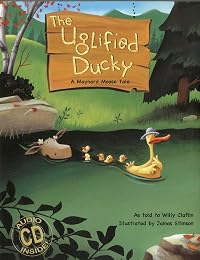
The Uglified Ducky
by Willy Claflin
On This Page
Description
Resets Hans Christian Andersen's tale, The ugly duckling, in the Northern Piney Woods of Alaska, where a baby moose is raised by a family of ducks who try to teach him to waddle, quack, and fly but cannot see his true beauty.Tags
Recommendations

Member Reviews
This picture book open with a question that is posed to the reader. The Uglified ducking attempts to connect to the reader by asking if they have ever felt like they did not belong. The story goes on to tell of how the main character is treated like all of the other ducklings and is trained in all things duck. Despite his attempts to be a duck, he fails. The beautiful part of this story is that the Uglified Ducking finds out who he truly is and joins the group of moose who welcome him and teaches him to love himself. This story would be great to teach SEL. Instructors can use this book to build confidence in students. This book can also be used to teach onomatopoeia in third grade during ELA.
I’ve always enjoyed the story of “The Ugly Duckling”, so I decided to give this version a try. I enjoyed Claflin’s version very much. The point of the story remained the same. Anyone who has ever felt out of place or ugly should know they were not ugly, but were beautiful and would one day find out where they were meant to be. I love how when you read the words you imagine a goofy moose saying them in your head (fambly for family and demember for remember). The illustrations were silly to match the tone of the story. I would definitely recommend this version of the classic tale.
This was simply adorable! A library user recommended I listen to this audio, as she and he kids giggled at the reader's performance, and she was right! It's funny and silly, without losing the Ugly Duckling story of loving who you are.
Highly recommended!
Highly recommended!
I liked this book because its big idea sent across a good message. The big idea in this book was to never let anyone tell you that you’re ugly and to be confident in your skin. They used a childish language throughout this book that young children could really relate to. For example, the author wrote the text how children sometimes say words before they learn how to say them correctly. In the text it said, ‘the first thing I notice about this ducky is it gots four foots.” “Gots” is incorrect grammar, as is “foots”, but this is how a young child speaks, so I think the author did a great job connecting to children. This books plot really helped the story flow. The uglified ducky got lost from her home, was raised by a ducky, show more and then finally found her home with the moose. The author used a progressive plot, because he introduced the characters; the uglified ducky, the mother ducky, and her babies. Also, you knew right away what the conflict was going to be, that the uglified ducky was not actually ugly, he was just in the wrong “fambly” (how the book wrote ‘family’). Then, finally the conflict was resolved and the conclusion was reached. The big idea really makes this book apply to children of all ages. This was a childish book but it has such a huge meaning behind it, and that is what I really enjoyed about this book. show less
This is a great book. It is about a moose that gets lost when he was younger and is being raised by a family of ducks. The moose goes through many trials while being raised by ducks because he can't do anything that the duckies can do. Eventually he gets to meet with his moose family and finally does not feel like an uglified ducky. This book uses great detailed words and gives the reader a true feeling of how the moose felt while being raised by duckies.
Awesome read-aloud re-telling of The Ugly Duckling with a baby moose taking the swan's place. Great illustrations and an excellent message.
This book is about a moose that is lost when he is little and is now being raised by a duck family. The moose has a very hard time because he cannot do anything the other ducks can do. He finally meets a moose family and does not feel that he is just an uglified ducky. I would use this book to teach students about onomatopoeia and to show detailing words. This would also be a great book for students that might not feel accepted to show them that moose felt the same way, but he found where he belonged.
Members
- Recently Added By
Author Information
12 Works 265 Members
Awards and Honors
Awards
Common Knowledge
- Original publication date
- 2008
Classifications
Statistics
- Members
- 207
- Popularity
- 157,856
- Reviews
- 11
- Rating
- (4.50)
- Languages
- English
- Media
- Paper, Audiobook, Ebook
- ISBNs
- 8