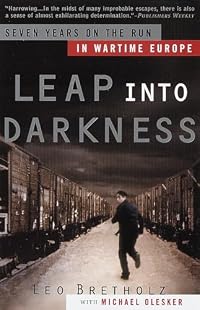
Leap into Darkness: Seven Years on the Run in Wartime Europe
by Leo Bretholz
On This Page
Description
"A harrowing, action-packed account of the author's series of audacious escapes from the Nazis' final solution--"riveting . . . a fascinating and moving piece of history" --Publisher description.Tags
Recommendations






















Member Reviews
I go back to World War Two again and again. I will go out on a (thick and secure) limb and offer that WWII was the central and essential event of the 20th century, one with which I will surely grapple for all of my days. There could be no end to what might be said about all that. It almost feels like part of me lives there, though I was born well over a decade after the fighting ended. Of course, the war never really ended for so many, and that is why I read memoirs of those years: memoirs of soldiers, of politicians, of escaped prisoners, and especially of Holocaust survivors.
Leap Into Darkness: Seven Year on the Run in Wartime Europe by Leo Bretholtz is of the last category, although the author eluded the Nazi's and the camps, though show more only barely. His story begins in 1930s Vienna, when as a seventeen year old, he leaves his mother and two sisters -- with family encouragement -- as conditions deteriorate for Austrian Jews following the Anschloss. He narrates his next seven years as a fugitive, narrowly escaping capture and death many times, and yet finding help in the midst of unimaginable cruelty. In one terrifying episode, he tells of incarceration in Drancy, the French holding area of unspeakable conditions, until he is loaded into the train to Auschwitz. In an improbable act of courage and desperation, he pries the window bars apart just enough to allow him to jump blindly as the train of the doomed rumbles on through the night, Bretholtz cheating probable death.
Holocaust memoirs are always an effort to heal, to bear witness, to speak of what was done for the millions who perished. Bretholtz' book, coauthored with Baltimore Sun columnist Michael Olesker, is also well written. It is factual and not overly sentimental, but spares no one. He particularly objects to an attitude he observes in recent years in Austrian, namely that the Austrians were Hitler's First Victims. Bretholtz insists they were his First Embracers, and his account is persuasive. If this a kind of literature that calls to you, Leap Into Darkness is a good choice. There are more erudite accounts; those of Primo Levi and Eli Weisel are well-known. And this is not a memoir of life in the concentration camps. But it is a powerful story of suffering, loss and ultimately survival. I challenge anyone to finish the last pages with a dry eye.
Edit | More show less
Leap Into Darkness: Seven Year on the Run in Wartime Europe by Leo Bretholtz is of the last category, although the author eluded the Nazi's and the camps, though show more only barely. His story begins in 1930s Vienna, when as a seventeen year old, he leaves his mother and two sisters -- with family encouragement -- as conditions deteriorate for Austrian Jews following the Anschloss. He narrates his next seven years as a fugitive, narrowly escaping capture and death many times, and yet finding help in the midst of unimaginable cruelty. In one terrifying episode, he tells of incarceration in Drancy, the French holding area of unspeakable conditions, until he is loaded into the train to Auschwitz. In an improbable act of courage and desperation, he pries the window bars apart just enough to allow him to jump blindly as the train of the doomed rumbles on through the night, Bretholtz cheating probable death.
Holocaust memoirs are always an effort to heal, to bear witness, to speak of what was done for the millions who perished. Bretholtz' book, coauthored with Baltimore Sun columnist Michael Olesker, is also well written. It is factual and not overly sentimental, but spares no one. He particularly objects to an attitude he observes in recent years in Austrian, namely that the Austrians were Hitler's First Victims. Bretholtz insists they were his First Embracers, and his account is persuasive. If this a kind of literature that calls to you, Leap Into Darkness is a good choice. There are more erudite accounts; those of Primo Levi and Eli Weisel are well-known. And this is not a memoir of life in the concentration camps. But it is a powerful story of suffering, loss and ultimately survival. I challenge anyone to finish the last pages with a dry eye.
Edit | More show less
There are two reasons why this book was such a joy to read: 1) it was extremely well written 2) I spent a week in the presence of the author and his beautiful wife, Flo, in 2005. Leo was 16 when he started fleeing the Nazi's; sometimes legally and sometimes illegally. One of his most harrowing escapes was jumping from the train that was carrying him from Drancy (France) to Auschwitz. If one can enjoy a Holocaust book; this would be it---although it doesn't lack the horrors (the author's family were all murdered), it tells of one young man's courage in the face of death and his lack of bitterness or the need for revenge.
"Mans inhumanity to man makes countless thousands mourn." Robert Burns
The author here shares his own story of being on the run as a Jew in warn torn Europe during WWII. It is a sad tale as his family disappeared and he had to escape several times from moving trains or custody. Very interesting and the author does not pull his punches as to what happened and his hurt and bewilderment to the treatment of Jews by do many people during that time. The Germans were not the only people responsible for the degradation and death of the Jews. In the end this is a tale of survival.
The author here shares his own story of being on the run as a Jew in warn torn Europe during WWII. It is a sad tale as his family disappeared and he had to escape several times from moving trains or custody. Very interesting and the author does not pull his punches as to what happened and his hurt and bewilderment to the treatment of Jews by do many people during that time. The Germans were not the only people responsible for the degradation and death of the Jews. In the end this is a tale of survival.
This is an awesome but sad book, the events that happened during the holocaust were horrific and inhumane to say the least. This bone chilling tale of survival will have you on the edge of your seat from beginning to end.
"Young Leo Bretholz survived the Holocaust by escaping from the Nazis (and others) not once, but seven times during his almost seven-year ordeal crisscrossing war-torn Europe. He leaped from trains, outran police, and hid in attics, cellars, anywhere that offered a few more seconds of safety. First he swam the River Sauer at the German-Belgian border. Later he climbed the Alps on feet so battered they froze to his socks--only to be turned back at the Swiss border. He crawled out from under the barbed wire of a French holding camp, and hid in a village in the Pyrenees while gendarmes searched it. And in the dark hours of one November morning, he escaped from a train bound for Auschwitz." from Amazon book review.
Ratings
Members
- Recently Added By
Lists

Holocaust Narratives
159 works; 3 members

THE WAR ROOM
813 works; 24 members
Author Information
1 Work 214 Members
Leo Bretholz was born in Vienna, Austria on March 6, 1921. He left Vienna at the age of 17 amid the growing menace of Nazi control. For the next seven years, he evaded Nazi concentration camps by living as a fugitive from 1938 to 1945. He assumed aliases, slept in ditches, and found sanctuary with relatives, in Jewish ghettos, and among orders of show more Roman Catholic nuns and priests. He jumped from a transport carrying him and a thousand other Jewish deportees to Auschwitz on November 5, 1942. The transport was a French train operated by the state-owned railway, the Société Nationale des Chemins de fer Français (S.N.C.F.). Toward the end of the war, he joined a Jewish resistance group known as La Sixième. He wrote about his experiences in a 1998 memoir entitled Leap Into Darkness: Seven Years on the Run in Wartime Europe. After the war he settled in Baltimore, Maryland. He found work in the textile business, then as a partner in a liquor store, then in the book selling business. Recently, when S.N.C.F. became involved in commuter rail contracts in Maryland, he became a witness at congressional hearings on the proposed Holocaust Rail Justice Act, which would allow Holocaust victims and their families to sue S.N.C.F. in the American courts. He died on March 8, 2014 at the age of 93. (Bowker Author Biography) show less
Common Knowledge
Classifications
Statistics
- Members
- 214
- Popularity
- 152,090
- Reviews
- 5
- Rating
- (4.50)
- Languages
- Dutch, English
- Media
- Paper
- ISBNs
- 4