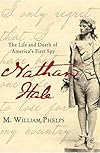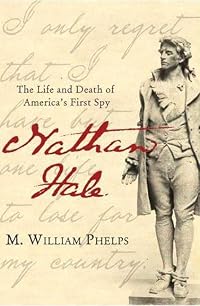
Nathan Hale: The Life and Death of America's First Spy
by M. William Phelps
On This Page
Description
Although famous for his purported last words-"I only regret that I have but one life to lose for my country"-few people know the real Nathan Hale.M. William Phelps brings into focus the life of this famed patriot and first spy of the American Revolution, charting Hale's rural childhood, his education at Yale, and his work as a schoolteacher. Like many young Americans, he was soon drawn into the colonies' war for independence and became a captain in Washington's army. When the general was in show more need of a spy, Hale willingly rose to the challenge, gathering intelligence behind British lines on Long show lessTags
Recommendations






Member Recommendations

Member Reviews
William Phelps biography of Nathan Hale is a very enjoyable read. The book is well researched, but I did find the heavy use of quotes a little distracting from the story.
 This review was written for LibraryThing Early Reviewers.
Nathan Hale: The Life and Death of America’s First Spy is somewhat of a disappointment. Not in the book itself which is well-written and provides a bird’s eye view of the revolution. It’s a disappointment because the life and death of Nathan Hale is so anti-climatic. While he was well-educated (for the times) and a patriot through to the core, his life itself is fairly unremarkable. A hard drinking student, a ladies’ man, and an excellent teacher before he volunteered to join the Connecticut forces; America’s first spy failed in his first and only mission. While he died with honor (without actually making the the often quoted last words “I regret I have but one life to give for my country.”) he appears to have been on a show more fool’s errand that would have had little effect on the war. From the perspective of understanding American history better and to rely less on legend and more on fact, this is a good place to start. show less
This review was written for LibraryThing Early Reviewers.Phelps' coverage of the "The Life and Death of America's First Spy" is insightful and enjoyable to read. What I most appreciated was how well he provided the cultural and military background as context, without delving to deep into either. He also dispels some of the previous legends that grew more from oral tradition than from historical fact. It would be hard to ready this and not have a new appreciation for the short life of Nathan Hale.
This review was written for LibraryThing Early Reviewers."I regret that I have but one life to give to my country."
Nathan Hale speaks this famous line and is then hung at the gallows by the British General Howe as a spy for the American rebellion.
I thought the legend was interesting enough that I took a review copy from publisher to learn more about America's first spy. What I learned is that the legend is much more interesting than the truth.
Hale was used a martyr for the American rebellion, becoming synonymous with patriotism, freedom, and the fight for liberty. He was a well-learned man, handsome, and good with the ladies.
As much as Mr. Phelps tries to bring Hale to life and fill in his background, there just is not much there. The book is thin and spends as much time filling in stories show more about the Revolutionary War and other people in Hale's life as it does telling Hale's life.
It turns out that Hale was not a very good spy. He was caught on first mission. It also turns out that he probably did not speak that famous line.
Maybe I'll stick with the legend. show less
Nathan Hale speaks this famous line and is then hung at the gallows by the British General Howe as a spy for the American rebellion.
I thought the legend was interesting enough that I took a review copy from publisher to learn more about America's first spy. What I learned is that the legend is much more interesting than the truth.
Hale was used a martyr for the American rebellion, becoming synonymous with patriotism, freedom, and the fight for liberty. He was a well-learned man, handsome, and good with the ladies.
As much as Mr. Phelps tries to bring Hale to life and fill in his background, there just is not much there. The book is thin and spends as much time filling in stories show more about the Revolutionary War and other people in Hale's life as it does telling Hale's life.
It turns out that Hale was not a very good spy. He was caught on first mission. It also turns out that he probably did not speak that famous line.
Maybe I'll stick with the legend. show less
This review was written for LibraryThing Early Reviewers.Anyone that has grownup in Connecticut; particularly near Coventry, the Nathan Hale homestead, has heard the story of Hale's patriotism and oft quoted final words. I count myself among one of these Connecticut Yankees. But as I started this book I realized I was ignorant of the details of Hale's life and service in the Revolutionary war. M. William Phelps fills this void in a straight forward biography of Nathan Hale from his early family life in Coventry to his death as a young man at the hands of the British army. Phelps does an excellent job bringing the many first and second hand sources together to paint a clear portrait of this larger than life figure. Where sources disagree or explanations are not plausible, Phelp's succinctly show more explains his rationale for the most likely correct fact or interpretation.
Phelps describes a young man brought up in a strict religious family in Coventry, CT; graduating Yale at age 18 and becoming a somewhat restless school teacher in Moodus and New London. Hale's strong faith led him to believe that much of your life is ( and should be) guided by God's will.
Two of the common misconceptions about Hale's spy mission that Phelps clarifies are Hale's last words and the circumstances of his detection as a spy. In the first case it widely reported that Nathan Hale's last words were "I only regret that I have but one life to lose for my country." Why a succinctly romantic statement, Phelps clarifies that these words were an invention in the Revolutionary War play Cato. His actual last words, though similar, were "I am satisfied with the cause in which I have engaged that my only regret is that I have not more lives than one to offer n its service."
In second case it was widely rumored and reported in the Essex Journal (without sources) that Hale's cousin, Sam betrayed him as a rebel spy. Phelps considers this very unlikely given that Hale's father, Richard wrote family members that he did not believe Sam was involved. Further, Sam Hale denied betraying his cousin. The more likely scenario, as described in detail by Phelps, is that Hale was betrayed by his own naivety as a spy when confronted by Robert Rogers. Robert Rogers, commander of Rogers Rangers, had been tasked by Gen Howe to scour Long Island and Connecticut for traitors (aka rebel spies etc) and became suspicious of a young asking many questions related to British army intentions. Hale's naivety is demonstrated by his traveling under his own name and carrying his Yale diploma as proof he was a school teacher looking for work!
Following his unceremonious hanging as a spy, Phelps ends his narrative with Enoch Hale's search for news of his brother and unsuccessful return of his remains for proper burial.
Nathan Hale is a well researched book with extensive reference notes and bibliography. show less
Phelps describes a young man brought up in a strict religious family in Coventry, CT; graduating Yale at age 18 and becoming a somewhat restless school teacher in Moodus and New London. Hale's strong faith led him to believe that much of your life is ( and should be) guided by God's will.
Two of the common misconceptions about Hale's spy mission that Phelps clarifies are Hale's last words and the circumstances of his detection as a spy. In the first case it widely reported that Nathan Hale's last words were "I only regret that I have but one life to lose for my country." Why a succinctly romantic statement, Phelps clarifies that these words were an invention in the Revolutionary War play Cato. His actual last words, though similar, were "I am satisfied with the cause in which I have engaged that my only regret is that I have not more lives than one to offer n its service."
In second case it was widely rumored and reported in the Essex Journal (without sources) that Hale's cousin, Sam betrayed him as a rebel spy. Phelps considers this very unlikely given that Hale's father, Richard wrote family members that he did not believe Sam was involved. Further, Sam Hale denied betraying his cousin. The more likely scenario, as described in detail by Phelps, is that Hale was betrayed by his own naivety as a spy when confronted by Robert Rogers. Robert Rogers, commander of Rogers Rangers, had been tasked by Gen Howe to scour Long Island and Connecticut for traitors (aka rebel spies etc) and became suspicious of a young asking many questions related to British army intentions. Hale's naivety is demonstrated by his traveling under his own name and carrying his Yale diploma as proof he was a school teacher looking for work!
Following his unceremonious hanging as a spy, Phelps ends his narrative with Enoch Hale's search for news of his brother and unsuccessful return of his remains for proper burial.
Nathan Hale is a well researched book with extensive reference notes and bibliography. show less
Phelps has made Nathan Hale's life and death digestible to today's average reader. It is clear that he has done extensive research on the matter, but he doesn't bog you down in details. He provides just enough to give the reader context without being overwhelming. That should make this book good for the new/reluctant reader and possibly whet their appetite to study the American Revolution in greater detail. A good starter book.
This review was written for LibraryThing Early Reviewers.After reading "Nathan Hale: The Life and Death of America's First Spy" by M. William Phelps, I've come to the conclusion that regardless of Hale's bravery, patriotism, and grace, there isn't nearly enough *personal* information about the man for a 234 page biography (306 pages, with notes, bibliography, and index). The first 70 pages are about Hale's childhood, years at college, and work as a teacher; and much of the rest of the book is concerned with general information about life in the Colonial Army and the War efforts of both George Washington and the British, with Hale seeming to be only a peripheral character. Even his mission, which proved fatal, was swathed in such secrecy that there wasn't a lot known about it - then or now. show more That section of the book was interesting and engaging, but it was a long time coming. We are told repeatedly throughout the book that Hale was bored with his life, and unfortunately, for much of the time spent reading, I was, too. To author Phelps' credit, he appears to have scoured every conceivable source for information about Hale, and has included meticulous notes and a bibliography. show less
This review was written for LibraryThing Early Reviewers.Members
- Recently Added By
Author Information

51 Works 2,272 Members
M. William Phelps is an award-winning veteran journalist and the author of twenty-six nonfiction books. He lives in-Connecticut, near the Nathan Hale Homestead.
Common Knowledge
- Original publication date
- 2008
- People/Characters
- Nathan Hale; William Howe; Enoch Hale; Richard Hale; Samuel Hale, Jr.; Stephen Hempstead (show all 9); Thomas Knowlton; Robert Rogers; Benjamin Tallmadge
- Important places
- Boston, Massachusetts, USA; New York, New York, USA; Bunker Hill, Boston, Massachusetts, USA; Fort Ticonderoga, New York, USA; Harlem Heights, New York, USA; New London, Connecticut, USA (show all 7); Yale College
- Important events
- American Revolution (1775 | 1783); Battle of Brooklyn Heights; French and Indian War
- Dedication
- For Gregg Olsen: Friend, Mentor, Colleague
- First words
- From the Western Front of the green facing Yale College's Connecticut Hall, a three-story redbrick building, one could look to the east and manage a squinted glimpse of Long Island Sound and, just over the horizon, the magni... (show all)ficent Atlantic Ocean.
- Last words
- (Click to show. Warning: May contain spoilers.)Yet he was - and could have been - all those things in life, too.
- Blurbers
- Trento, Joseph J.
Classifications
- Genres
- Nonfiction, History, Biography & Memoir, General Nonfiction
- DDC/MDS
- 973.385092 — History & geography History of North America United States Revolutionary War (1775-89) Personal narratives, vindications, secret service Secret service, spies
- LCC
- E280 .H2 .P38 — History of the United States United States The Revolution, 1775-1783
- BISAC
Statistics
- Members
- 124
- Popularity
- 262,137
- Reviews
- 14
- Rating
- (3.45)
- Languages
- English
- Media
- Paper, Audiobook, Ebook
- ISBNs
- 7
- ASINs
- 6