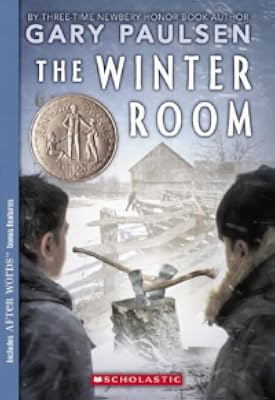
The Winter Room
by Gary Paulsen
On This Page
Description
A young boy growing up on a northern Minnesota farm describes the scenes around him and recounts his old Norwegian uncle's tales of an almost mythological logging past.Tags
Recommendations






Member Recommendations
Member Reviews
Read for Newbery Club in Children's Books, March 2023.
Reads more like a memoir than a story. Very short, doesn't waste time on explicated character growth or dramatic plots. Mostly setting and anecdotes, beautifully written and fascinating. And so specific.
For example, Thank you, Gary, for reminding me of "choppers." I knew there was a good reason my hands are so cold in the winters, even though I've moved much further south than northern WI (near to where this is set). It's because no gloves, however modern, can hold a candle to medium weight gloves with sturdy leather mittens over them. Gonna find me some choppers now. Apologies to the cows.
Which is what this book is 'about' most of all. How some have to die so others can live. No show more bloodlust, no waste, but thankfulness. In my opinion. The element that blurbs and teachers seem to hang onto is important, sure, but it's the climax of a book that is so much more than just that.
Blurbs don't prepare one for the read. It's like those who wrote the blurbs didn't understand the book. Or at least didn't appreciate it enough to talk about it appreciatively. An understanding of the climax depends on careful reading of everything that comes before - not the details of plot of course but of the atmosphere, of the details way of life. The climax is not that of plot. The brothers learn something, but not because of anything that they actually do or experience.
Anyway. Then there's other bits. Like at the beginning of the fourth chapter, "Winter," when the brothers fight about whether there are divisions between day & night, autumn & winter, etc. First of all, it's an interesting question for young readers to think about. Second, it's a quick reminder that it's silly to fight about opinions, about other points of view.
Just a lovely little book. I wish I'd read it when I was younger so I could have shared it with my sons when they were young. show less
Reads more like a memoir than a story. Very short, doesn't waste time on explicated character growth or dramatic plots. Mostly setting and anecdotes, beautifully written and fascinating. And so specific.
For example, Thank you, Gary, for reminding me of "choppers." I knew there was a good reason my hands are so cold in the winters, even though I've moved much further south than northern WI (near to where this is set). It's because no gloves, however modern, can hold a candle to medium weight gloves with sturdy leather mittens over them. Gonna find me some choppers now. Apologies to the cows.
Which is what this book is 'about' most of all. How some have to die so others can live. No show more bloodlust, no waste, but thankfulness. In my opinion. The element that blurbs and teachers seem to hang onto is important, sure, but it's the climax of a book that is so much more than just that.
Blurbs don't prepare one for the read. It's like those who wrote the blurbs didn't understand the book. Or at least didn't appreciate it enough to talk about it appreciatively. An understanding of the climax depends on careful reading of everything that comes before - not the details of plot of course but of the atmosphere, of the details way of life. The climax is not that of plot. The brothers learn something, but not because of anything that they actually do or experience.
Anyway. Then there's other bits. Like at the beginning of the fourth chapter, "Winter," when the brothers fight about whether there are divisions between day & night, autumn & winter, etc. First of all, it's an interesting question for young readers to think about. Second, it's a quick reminder that it's silly to fight about opinions, about other points of view.
Just a lovely little book. I wish I'd read it when I was younger so I could have shared it with my sons when they were young. show less
This book's strength is its descriptions - the sights and sounds and smells, often unpleasant, of a north Minnesota livestock farm. From the gory depictions of slaughter time, to the beauty of the first snow, Paulsen sends his reader to a world ruled by season and story. The young narrator and his older brother Wayne are disposed to doubt their uncle's tall tales about himself as a mighty logger, and Wayne's vicious outburst of doubt at the end of a story threatens the family peace. While the story is beautifully told, many may wish for more plot, as the story does not actually begin until the final chapter. Age ranges are inappropriate for this book - its plot and characters could be understood by anyone who can read, but the spirit of show more the book probably cannot be grasped until one has lived some more of life.
Awards: 1990 Newberry Honor show less
Awards: 1990 Newberry Honor show less
Eldon lives with his brother Wayne, Uncle David, mom, dad, Nels, and the farm. Each season brings its own personality, its own responsibilities, and its own hardships and pleasures. It is difficult to summarize the plot of this book as it is more like a series of paintings, a set designed for two purposes: to reveal the seasons and to highlight the importance of stories. The book is sectioned out: Spring, Summer, Fall, and Winter, which has its own sections as it is the time of stories from Uncle David, so each tale gets its own chapter heading. Life on the farm is described seasonally with the melty newness of Spring, the sweat and labor of Summer, the necessary but painful killing in Fall, and the stories in Winter.
The words that come show more to mind when thinking about this book are intense, mythological, and wonderfully male. In a mere 103 pages, Paulsen dramatically paints a portrait of life on a farm in the 1930s that is at once meandering and intense, with vivid descriptions of places and events. The story itself is mythological in nature with an emphasis on nature, a focus on storytelling, and mildly magical connotations. Finally, the male portion...oh, boy, how do I say this without stereotyping too dramatically.... The story is told simplistically but includes complex themes; the definition of simplistic I am going for here is writing and tone which are sparse, matter-of-fact, and to-the-point. The story revolves around horses, planting, logging, carving, wrestling, and other generally male interests and activities. It felt male in the same way smelling chopped wood does. In no way am I implying that women can't appreciate the book (obviously) - or appreciate horses, planting, logging.....
Gary Paulsen is a favorite author of mine; his ability to evoke emotion through snapshot-like descriptions of places and people is admirable and leaves me with a specific impression after reading his work. I highly recommend him for all ages. show less
The words that come show more to mind when thinking about this book are intense, mythological, and wonderfully male. In a mere 103 pages, Paulsen dramatically paints a portrait of life on a farm in the 1930s that is at once meandering and intense, with vivid descriptions of places and events. The story itself is mythological in nature with an emphasis on nature, a focus on storytelling, and mildly magical connotations. Finally, the male portion...oh, boy, how do I say this without stereotyping too dramatically.... The story is told simplistically but includes complex themes; the definition of simplistic I am going for here is writing and tone which are sparse, matter-of-fact, and to-the-point. The story revolves around horses, planting, logging, carving, wrestling, and other generally male interests and activities. It felt male in the same way smelling chopped wood does. In no way am I implying that women can't appreciate the book (obviously) - or appreciate horses, planting, logging.....
Gary Paulsen is a favorite author of mine; his ability to evoke emotion through snapshot-like descriptions of places and people is admirable and leaves me with a specific impression after reading his work. I highly recommend him for all ages. show less
The seasons of the year, as told first-person through the perspective of an eleven year old boy, living on a farm in northern Minnesota.The descriptions of what he associates with each season are not typical; several times I paused and thought over his view of what might be considered mundane tasks. Caution: he does describe the slaughter of farm animals for food in a slightly graphic manner, but did not revel in it. As tender-hearted as I am, I was able to handle it. Good read.
A chronicle of a year in the life of two young brothers growing up on a farm. They learn some hard truths about the toll country living can take, along with the value of stories blended with family history. Farm life isn't sugar-coated here, but even the slaughter of animals in the fall is treated with respect and just the right amount of delicacy. A good introduction to what's it like growing up in the country for kiddos who don't have exposure to such things, plus a nice story for good measure.
The winter room is where Eldon, his brother Wayne, old Uncle David, and the rest of the family gather on icy cold nights, sitting in front of the stove. There the boys listen eagerly to all Uncle David's tales of superheroes. Then one night Uncle David tells the story, "The Wood cutter," and what happens next is terrible, and then wonderful.
Yet again, Gary Paulsen didn't disappoint. I like how he laid out the book. He separated it into the 4 seasons, and I thought that it was perfect for this book.
Extension Idea 1: The Class Room
Have the students sit in a circle in the classroom and a time where they can tell stories.
Extension Idea 2: The Winter Room Project
Have the students design what they would want their winter room to look like.
Yet again, Gary Paulsen didn't disappoint. I like how he laid out the book. He separated it into the 4 seasons, and I thought that it was perfect for this book.
Extension Idea 1: The Class Room
Have the students sit in a circle in the classroom and a time where they can tell stories.
Extension Idea 2: The Winter Room Project
Have the students design what they would want their winter room to look like.
While there is nothing exceptional about this 1990 Newbery honor book, I enjoyed it for the slow, easy pace. I liked the clear, crisp images of a time in rural Minnesota when life consisted of a family bound together by the joint efforts of farming.
It was delightful and calming to read.
It was delightful and calming to read.
Members
- Recently Added By
Lists

Newbery Honor Books By year - II - 1981-2035
143 works; 4 members

Book Talks 9/13/17
46 works; 1 member

Books Read in 2024
4,623 works; 126 members
Author Information

235+ Works 100,324 Members
Gary Paulsen was born on May 17, 1939 in Minnesota. He was working as a satellite technician for an aerospace firm in California when he realized he wanted to be a writer. He left his job and spent the next year in Hollywood as a magazine proofreader. His first book, Special War, was published in 1966. He has written more than 175 books for young show more adults including Brian's Winter, Winterkill, Harris and Me, Woodsong, Winterdance, The Transall Saga, Soldier's Heart, This Side of Wild, and Guts: The True Stories Behind Hatchet and the Brian Books. Hatchet, Dogsong, and The Winter Room are Newbery Honor Books. He was the recipient of the 1997 Margaret A. Edwards Award for his lifetime achievement in writing for young adults. (Bowker Author Biography) show less
Awards and Honors
Awards
Distinctions
Work Relationships
Common Knowledge
- Original publication date
- 1989
- People/Characters
- Eldon; Wayne; Uncle David; Nels
- Important places
- Minnesota, USA
- Dedication
- For my father, with great love
- First words
- If books could be more, could show more, could own more, this book would have smells...
- Last words
- (Click to show. Warning: May contain spoilers.)Then he told a tale about a man who lived in the forest who was so ugly he couldn't be seen and he sent messages of love to a girl on the wing feathers of birds and Wayne listened and I listened and I knew we would listen for always.
Classifications
- Genres
- Kids, Fiction and Literature, Children's Books
- DDC/MDS
- 813.54 — Literature & rhetoric American literature in English American fiction in English 1900-1999 1945-1999
- LCC
- PZ7 .P2843 .W — Language and Literature Fiction and juvenile belles lettres Fiction and juvenile belles lettres Juvenile belles lettres
- BISAC
Statistics
- Members
- 2,376
- Popularity
- 8,245
- Reviews
- 35
- Rating
- (3.43)
- Languages
- English, German, Italian
- Media
- Paper, Audiobook, Ebook
- ISBNs
- 28
- ASINs
- 11