
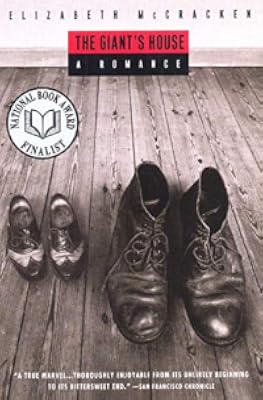
The Giant's House
by Elizabeth McCracken
On This Page
Description
"McCracken mixes the proper amount of lunacy with exactly the right amount of sorrow. The blend is reminiscent of such late-20th-century treasures as The Accidental Tourist, The World According to Garp, or A Confederacy of Dunces."--Denver Post The year is 1950, and in a small town on Cape Cod twenty-six-year-old librarian Peggy Cort feels like love and life have stood her up. Until the day James Carlson Sweatt- the "over-tall" eleven-year-old boy who's the talk of the town-walks into her show more library and changes her life forever. Two misfits whose lonely paths cross at the circulation desk, Peggy and James are odd candidates for friendship, but nevertheless they soon find their lives entwined in ways that neither one could have predicted. In James, Peggy discovers the one person who's ever really understood her, and as he grows- six foot five at age twelve, then seven feet, then eight-so does her heart and their most singular romance. Praise for The Giant's House "Remarkable . . . McCracken has wit and subtlety to burn, as well as an uncanny ability to tap into the sadness that runs through the center of her characters' worlds. This book is so lovely that, when you're reading, you'll want to sleep with it under your pillow."--Salon A true marvel . . . thoroughly enjoyable from its unlikely beginning to its bittersweet end. . . McCracken knows all kinds of subtle, enticing secrets of the heart and conveys them in silky, transparent language."--San Francisco Chronicle "Lovely . . . a tribute to the quiet passion of people trapped in isolation."--Los Angeles Times "Fascinating . . . The reader finds herself entangled, body and soul, in this tender and endlessly strange novel, which is in all senses a hymn to human growth gone haywire and to a love so big it can't hold its own magnificent limbs upright."--Elle "Such is the incantatory power of McCracken's eccentric tale that by its close we are completely in the grip of its strangely conceived ardor. . . . McCracken is as original a writer as they come. . . . I fell in love."--Daphne Merkin, The New Yorker show lessTags
Recommendations












Member Reviews
After I finished _The Giant's House_ I pulled it to my chest for a long moment. It's that kind of book.
I pulled Elizabeth McCracken's first book of my list of "Books to Read, You Know, Someday" because I was intrigued by the story and because I thought it might make a good jumping off point for a theater piece.
But a couple of chapters in I was so drawn into the emotional world of Peggy Cort, the librarian in a small Massachusetts town who tells the story. She had me at the opening lines: Part One, chapter title "See Also":
I do not love mankind.
People think they're interesting. That's their first mistake.
And then at the end of the first section of the first chapter, a paragraph someone would probably call meta-something, pointing to show more the malleability of memories-- and in this case, the fact it is fiction masquerading as memory (but all the more true for it):
My memories are not books. They are only stories that I haver been over so many times in my head that I don't know from one day to the next what's remembered and what's made up. Like when you memorize a poem and for one small unimportant part you supply your own words. The meaning's the same, the meter's identical. When you read the actual version you can never get it into you head that it's right and you're wrong.
What I give you us the day's edition. Tomorrow it may be different.
It's lovely ride for us, the bittersweet, the disillusioned romantics, the cynics with soft underbellies. Those who've ever felt on the outside of The Human Experience will identify with both Peggy and James (the "Giant" of the title) as well as several other characters in the book. But McCracken is subtle; It is not simply a tale of outsiders.
In fact, I think she may have written the most beautiful passage on loving another human I've ever read:
Now, though, my day couldn't start until I knew James was awake in his house across town. His being asleep so much of the day felt like a terrible absence to me, although weekdays I never saw him until after five anyhow. Asleep, he was not really in the world. I'd have been up since six, as always, had washed my face and dressed and neatened my apartment and walked to the library; I'd have emptied the book drop and refilled the scrap paper holders and perhaps catalogued some books; I'd have checked books in and out, dispensed advice, collected fines and kept myself busy in all the usual ways, but the day could not really begin, was not really a day, until two-thirty when James was sure to be awake and there was a possibility he was thinking of me.
At the end of the book, I had the feeling I might have walked through a museum too hastily; that I scanned the paintings too quickly missing details that could even further enrich my life. I didn't want to miss a one. She's just that good.
. show less
I pulled Elizabeth McCracken's first book of my list of "Books to Read, You Know, Someday" because I was intrigued by the story and because I thought it might make a good jumping off point for a theater piece.
But a couple of chapters in I was so drawn into the emotional world of Peggy Cort, the librarian in a small Massachusetts town who tells the story. She had me at the opening lines: Part One, chapter title "See Also":
I do not love mankind.
People think they're interesting. That's their first mistake.
And then at the end of the first section of the first chapter, a paragraph someone would probably call meta-something, pointing to show more the malleability of memories-- and in this case, the fact it is fiction masquerading as memory (but all the more true for it):
My memories are not books. They are only stories that I haver been over so many times in my head that I don't know from one day to the next what's remembered and what's made up. Like when you memorize a poem and for one small unimportant part you supply your own words. The meaning's the same, the meter's identical. When you read the actual version you can never get it into you head that it's right and you're wrong.
What I give you us the day's edition. Tomorrow it may be different.
It's lovely ride for us, the bittersweet, the disillusioned romantics, the cynics with soft underbellies. Those who've ever felt on the outside of The Human Experience will identify with both Peggy and James (the "Giant" of the title) as well as several other characters in the book. But McCracken is subtle; It is not simply a tale of outsiders.
In fact, I think she may have written the most beautiful passage on loving another human I've ever read:
Now, though, my day couldn't start until I knew James was awake in his house across town. His being asleep so much of the day felt like a terrible absence to me, although weekdays I never saw him until after five anyhow. Asleep, he was not really in the world. I'd have been up since six, as always, had washed my face and dressed and neatened my apartment and walked to the library; I'd have emptied the book drop and refilled the scrap paper holders and perhaps catalogued some books; I'd have checked books in and out, dispensed advice, collected fines and kept myself busy in all the usual ways, but the day could not really begin, was not really a day, until two-thirty when James was sure to be awake and there was a possibility he was thinking of me.
At the end of the book, I had the feeling I might have walked through a museum too hastily; that I scanned the paintings too quickly missing details that could even further enrich my life. I didn't want to miss a one. She's just that good.
. show less
This is a moving, bittersweet story about the unlikely "romance" between a spinster librarian and a young man/boy affected by gigantism. The writing is great; McCracken describes characters, scenes, and situations perfectly. The narrator, Peggy, is not particularly likable, but I found myself relating to her nonetheless. My only real problem with the book is that I was creeped out by Peggy falling in love with James, whom she first meets when he is twelve. In spite of the extraordinary circumstances of his life, and the (mostly) nonsexual nature of their relationship, I was still a little disturbed. Overall, a quick, worthwhile read, for fans of Anne Tyler and John Irving. Recommended.
“My memories are not books. They are only stories...”
Cape Cod, 1950. Peggy Cort is a librarian and she is already destined to be a spinster, at the tender age of twenty-six. One day, a boy walks into her library and a friendship develops that will alter both of their lives. James Sweatt is very tall for his age. Six-five at eleven years old and he will grow into an eight foot giant. Peggy falls in love with this special boy and becomes a surrogate parent/guardian. Their love of books, is their bond.
This is a misfit love story, which manages to avoid being overly sentimental. The writing is both strong and fluid. It is also one of the most quotable books, I've read this year:
“Library books were, I suddenly realized, promiscuous, show more ready to lie down in the arms of anyone who asked.”
I also think fans of Anne Tyler will enjoy this book. Highly recommended. show less
Cape Cod, 1950. Peggy Cort is a librarian and she is already destined to be a spinster, at the tender age of twenty-six. One day, a boy walks into her library and a friendship develops that will alter both of their lives. James Sweatt is very tall for his age. Six-five at eleven years old and he will grow into an eight foot giant. Peggy falls in love with this special boy and becomes a surrogate parent/guardian. Their love of books, is their bond.
This is a misfit love story, which manages to avoid being overly sentimental. The writing is both strong and fluid. It is also one of the most quotable books, I've read this year:
“Library books were, I suddenly realized, promiscuous, show more ready to lie down in the arms of anyone who asked.”
I also think fans of Anne Tyler will enjoy this book. Highly recommended. show less
This book has such a strange premise-- a timid and antisocial 26 year old librarian falls in love with the 11 year old boy suffering from gigantism-- which is why, of course, it caught my attention. I thought I'd struggle with accepting and believing the storyline, but I found it wasn't hard at all to believe that something like this could happen. Peggy, as a character, is fully-realized, as is James and the small town they live in. You can almost believe that this is a true story that happened somewhere once.
I really enjoyed seeing the progression of Peggy's and James's friendship, and I really felt for Peggy the whole time. Her longing seeps through the pages, and I could feel just how much she held herself back-- from love, from show more happiness, from life. She's a pretty tragic character, if you think about it. I have to admit, I was growing a bit frustrated that she wasn't doing much about her feelings, but it's understandable given the incredible age difference of the characters. However, I think it's a testament to Elizabeth McCracken's writing ability that I came to root for this odd couple, despite the taboos and moral misgivings.
McCracken also has a real ability to write about the mundane in a completely enchanting way. The Cape Cod town her characters inhabit emanates a kind of quiet and subtle magic, inviting you into the story with lovely details about its various ongoings. This was just such a wonderfully written book overall, with many quotable parts, and lots of wisdom.
I have mixed feelings about the ending.On one hand, I find it entirely appropriate and am satisfied with how things ended up. On the other hand, it was frustrating too, because I wanted Peggy to come away from the experience wanting more of out life and seeking her own happiness, instead of essentially living, existing, on the memories left. show less
I really enjoyed seeing the progression of Peggy's and James's friendship, and I really felt for Peggy the whole time. Her longing seeps through the pages, and I could feel just how much she held herself back-- from love, from show more happiness, from life. She's a pretty tragic character, if you think about it. I have to admit, I was growing a bit frustrated that she wasn't doing much about her feelings, but it's understandable given the incredible age difference of the characters. However, I think it's a testament to Elizabeth McCracken's writing ability that I came to root for this odd couple, despite the taboos and moral misgivings.
McCracken also has a real ability to write about the mundane in a completely enchanting way. The Cape Cod town her characters inhabit emanates a kind of quiet and subtle magic, inviting you into the story with lovely details about its various ongoings. This was just such a wonderfully written book overall, with many quotable parts, and lots of wisdom.
I have mixed feelings about the ending.
A quiet, achingly sad novel that describes the bonds of affection that develop between a lonely small-town librarian and her town's oddity, an extraordinarily tall young man. You can see the novel's sad final act approaching from a mile off, but McCracken's most notable achievement here is Peggy Cort, her narrator, whose punctilious, slightly repressed voice perfectly mirrors both her professional obsessions and the staid atmosphere of fifties-era America. While too many narrators these days are merely stand-ins for readers or the writers who created them, Peggy is indubitably her own woman. She's restless, prickly, analytical, and yearns for real companionship, but she isn't a fool or a dreamer. She seems resigned to the knowledge that show more she owes her carefully modulated voice and unambitious worldview to her limited social circle and the relative paucity of professional choices available to her. In this circumscribed literary environment, the losses she suffers and the small triumphs she wins seem both meaningful and significant. She's not always pleasant to be around, mind you, and there's something prim, coy quality to her narration that might frustrate some readers, but it's hard to deny that McCracken has fully explored the inner workings of a unique and believable character. Isn't that, after all, one of the most important, and one of the most difficult, things a novelist can do?
This novel is subtitled "a Romance," but I think that that might be a misnomer. While James and Peggy do grow fond of each other, McCracken's novel is more interested in asking how intractably odd characters like Peggy and her would-be paramour can fit into a society not designed to satisfy their needs. I particularly liked Peggy's attempts to describe James without drawing our attention to his prodigious height, the single attribute that makes him noteworthy to others and complicates his day-to-day existence. As the novel draws to a close, it becomes clear that Peggy and James have learned to deal with their own unhappiness by living in, and for, each other. Perhaps "The Giant's House" is a romance, after all. show less
This novel is subtitled "a Romance," but I think that that might be a misnomer. While James and Peggy do grow fond of each other, McCracken's novel is more interested in asking how intractably odd characters like Peggy and her would-be paramour can fit into a society not designed to satisfy their needs. I particularly liked Peggy's attempts to describe James without drawing our attention to his prodigious height, the single attribute that makes him noteworthy to others and complicates his day-to-day existence. As the novel draws to a close, it becomes clear that Peggy and James have learned to deal with their own unhappiness by living in, and for, each other. Perhaps "The Giant's House" is a romance, after all. show less
McCracken is a great storyteller. That might sound like an obvious statement, but IMHO many writers, even good ones, are not necessarily that. Fiction can be compelling, and beautiful, and well crafted without necessarily really telling a story at all, let alone telling a story well. McCracken gives us Peggy as our narrator, introducing her as a repressed small-town librarian who loves the books, their order and unchangeability more than she loves anything in them. As we get to know her she turns out to have unexpected depths, a dry but truly amusing sense of humor, and some inarguably creepy characteristics. This is not completely subjective -- she falls in love with James a 12 year old when she is in her mid 20's, and she clearly show more states this is not a motherly or sisterly love, this is romantic love, and it is a love that becomes the center of her life until that child dies as a young man of 20. (James' death is revealed at the beginning, I have not spoiled anything. James has a pituitary disorder and he grows to be the tallest man in the world, his body taxed beyond its capabilites fails to work in the ways it must for a happy fulfilling life, and his personal tragedies are many, but James is a generally happy boy and later a generally happy man. This attraction is not of the prurient Humbert Humbert sort. Who knows what sparks it, but I expect it has something to do with the fact that in many ways James is a very ordinary man inside the body of a freak, and Peggy is a deeply freaky woman, a woman who calls herself fundamentally unlovable, inside the most ordinary of bodies/lives.
The story of James is fascinating, even if the man is not and Peggy is as compelling a guide as one could want. that said, the story goes off is some baffling and unfulfilling directions, the story of James' mother, for one, takes up a lot of real estate it does not deserve. Also, its not clear why Peggy becomes the woman she does. It would seem that she was not so wildly in love with her own unhappiness as a college student, and we meet her in her mid-20's, but the book never tells us what happened in the 5 years to change her. I also am not sure I was wild about the rather melodramatic resolution of the story -- Peggy's choice on how to deal with the group is out of character, and the repercussions seemed both obvious and implausible, which is weird. A good read, I enjoyed it, but not what it could have been with a little more craftsmanship. show less
The story of James is fascinating, even if the man is not and Peggy is as compelling a guide as one could want. that said, the story goes off is some baffling and unfulfilling directions, the story of James' mother, for one, takes up a lot of real estate it does not deserve. Also, its not clear why Peggy becomes the woman she does. It would seem that she was not so wildly in love with her own unhappiness as a college student, and we meet her in her mid-20's, but the book never tells us what happened in the 5 years to change her. I also am not sure I was wild about the rather melodramatic resolution of the story -- Peggy's choice on how to deal with the group is out of character, and the repercussions seemed both obvious and implausible, which is weird. A good read, I enjoyed it, but not what it could have been with a little more craftsmanship. show less
This is one of the most unique voices I have ever read. Even if you're not really a romance reader, I'm pretty sure everyone would enjoy this author's work. They have perfect command of metaphor and description, and they have frequent, extremely descriptive insights on love and loneliness. I would pick up more of this author's work without question.
Members
- Recently Added By
Lists

National Book Award Finalists - Fiction
377 works; 12 members

Books Read in 2024
4,623 works; 124 members
Author Information

15+ Works 4,516 Members
Some Editions
Awards and Honors
Awards
Common Knowledge
- Canonical title
- The Giant's House
- Original publication date
- 1996-06-01
- People/Characters
- Peggy Cort; James Carlson Sweatt
- Important places
- Cape Cod, Massachusetts, USA
- Dedication
- For Robert Sidney Phelps
a giant of a friend - First words
- I do not love mankind. People think they're interesting. That's their first mistake.
- Last words
- (Click to show. Warning: May contain spoilers.)They talk about me in this town. I have passed into legend, even though I'm still around in flesh. Who would have thought? people say to each other. Now, when I walk past the windows of the library, into stores, along the beach, I am discussed. I know the sound; I heard it enough with James. See that woman? they say. I am a figure they imagine knocking on their doors, to test them. They don't know what they should do to pass the test: let me in to sit by the radiator, or send me down the sidewalk to bewitch another house. They anticipte me at any moment, thrilled with the possibilities.
- Blurbers
- Allison, Dorothy
Classifications
Statistics
- Members
- 1,691
- Popularity
- 13,137
- Reviews
- 58
- Rating
- (3.68)
- Languages
- 8 — Danish, Dutch, English, German, Italian, Norwegian (Bokmål), Spanish, Swedish
- Media
- Paper, Audiobook, Ebook
- ISBNs
- 22
- ASINs
- 14