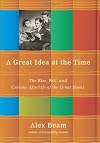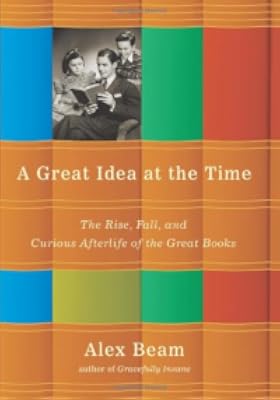
A Great Idea at the Time: The Rise, Fall, and Curious Afterlife of the Great Books
by Alex Beam
On This Page
Description
Explores the Great Books mania, in an entertaining and strangely poignant portrait of American popular culture on the threshold of the television age.Tags
Recommendations





















Member Reviews
A breezy if somewhat glib introduction to the emergence of "Great Books" courses at elite American higher education institutions like Columbia and the University of Chicago in the early twentieth century and the subsequent, dubiously successful attempts at democratising them. Alex Beam gives a decent introduction to the two curious figures who were the key drivers behind the movement: Mortimer Adler and Robert Maynard Hutchins. Sadly, Beam's failure to really grapple with the underlying issues of these Great Books courses—the assumptions about race, class, gender, and "greatness" which drove them; why it is that they seem to have flourished almost uniquely in the United States—means that this would have probably made for a better show more New Yorker article than a book in its own right.
If Beam had wanted to—and you'll forgive me, I trust—write a great book in his own right, he would have needed to double its length. Doing so would have let him really get to grips with what he (let alone Adler and Hutchins) meant by a great (or Great) book and by Western civilisation, discuss how the Great Books movement has intersected with the politicisation of education, and seriously engage with the critiques of feminists and scholars of colour (Beam pays lip service to such critiques but then often comes out with lines like "The culture wars of the 1980s effectively buried the Great Books in a blizzard of anti-Establishment, multicultural rhetoric."). It might also have given Beam more space to unpack his sneering at "middlebrow" culture and repeated, but never explained, conflation of "works produced by people who aren't white men" with "second-rate literature." show less
If Beam had wanted to—and you'll forgive me, I trust—write a great book in his own right, he would have needed to double its length. Doing so would have let him really get to grips with what he (let alone Adler and Hutchins) meant by a great (or Great) book and by Western civilisation, discuss how the Great Books movement has intersected with the politicisation of education, and seriously engage with the critiques of feminists and scholars of colour (Beam pays lip service to such critiques but then often comes out with lines like "The culture wars of the 1980s effectively buried the Great Books in a blizzard of anti-Establishment, multicultural rhetoric."). It might also have given Beam more space to unpack his sneering at "middlebrow" culture and repeated, but never explained, conflation of "works produced by people who aren't white men" with "second-rate literature." show less
A Great Idea at the Time: The Rise, Fall and Curious Afterlife of the Great Books is the perfect read for LTers. For those unfamiliar with the concept (as I was), in the 1950's Encyclopedia Brittanica took an idea from a course at the University of Chicago to educate the american public with "Great Books of the Western World". 68 volumes of double column, 9 point text of classic works including scientific texts (can you say Ptolemy's The Almagest?) sold in faux leather bindings along with a Syntopicon - a cross referencing guide of all of the great ideas and which authors commented on them - for the price of $250 (this was 1952 remember) sold by door to door salesman.
Admittedly, reading about the series I felt a little uneducated at show more times - some of the authors included in the Great Books were completely new to me (and I went to a liberal arts college) - as Beam points out, the works' obscurity and irrelevancy were part of the problem. The initial launch included NO female authors. But the idea behind the series and the business attached to it were fascinating. This book was well written, with a fair amount of humor, at no point talking down to the reader (he doesn't expect anyone to have read, or understood, Nichomachus of Gerasa's Introduction to Arithmetic (Great Books, volume 12)) and he pokes gentle fun at an interesting concept and the people and events surrounding it. Highly recommended show less
Admittedly, reading about the series I felt a little uneducated at show more times - some of the authors included in the Great Books were completely new to me (and I went to a liberal arts college) - as Beam points out, the works' obscurity and irrelevancy were part of the problem. The initial launch included NO female authors. But the idea behind the series and the business attached to it were fascinating. This book was well written, with a fair amount of humor, at no point talking down to the reader (he doesn't expect anyone to have read, or understood, Nichomachus of Gerasa's Introduction to Arithmetic (Great Books, volume 12)) and he pokes gentle fun at an interesting concept and the people and events surrounding it. Highly recommended show less
I really enjoyed this social history. The irreverent prose style of the author rendered the discussion an easy read. While I'd always heard about the Great Books (both as a commercial line, and as a pedagogical philosophy), it was intriguing to see behind the curtain.
Entertaining enough ...
but it’s not one of the Great Books. Seriously, though, this was a competent romp through the history field the Treat Books of the Western World, as a teaching paradigm and a publishing program. He makes a solid case, especially that the great scientific works do not provide a great deal of contemporary value, as science only proceeds on the theories that can be disproven but have not been, rather than a tradition. (I expected him to point out that a key tension in the modern world has been the breaking of ties with Aristotelian traditions, allowing new discoveries that were contrary to Aristotle.
However, much of the book appears opposed to the idea that there can be a canon, however opened to include women and show more minorities. Yet, we know that “classics” such as Mary Wollstonecraft’s Vindication is the Rights of Women, Shakespeare’s King Lear, and Thomas Hardy’s Return of the Native, will continue to “teach and delight” readers. From my point of view, perhaps narrow, the failure of the Great Books of the Western World as a publishing project is paradoxically in its overselling of a too-expensive series and its lack of quality control in choosing the cheapest translations and typesetting the books for value, not readability. The author does call these out, in a great deal of detail.
He could point out a more successful program, that has a similar goal: The Library of America. This program avoided several of the pitfalls of the GBWW program. It does not assume that it has a comprehensive list of the best books. Instead, it attempts to provide “America’s greatest writing in authoritative new editions.” In many cases, the best scholarship has produced definitive editions, including content previously edited out. The books have comprehensive timelines of the authors and their times, providing a context that the GBWW volumes lack. The volumes are readable, have stay open spines, and have been more inclusive of women and minorities. These editions are sold by subscription, but also, and perhaps more commonly, as individual titles. Over time, many of the individual titles have been released in paperback, and these are only sold individually, not by subscription. The Bibliothèque de la Pléiade was the inspiration for this series, envisioned by Edmund Wilson and commencing publication in 1982, ten years after Wilson’s death, this publication has been running continuously and (it appears) successfully for 37 years. show less
but it’s not one of the Great Books. Seriously, though, this was a competent romp through the history field the Treat Books of the Western World, as a teaching paradigm and a publishing program. He makes a solid case, especially that the great scientific works do not provide a great deal of contemporary value, as science only proceeds on the theories that can be disproven but have not been, rather than a tradition. (I expected him to point out that a key tension in the modern world has been the breaking of ties with Aristotelian traditions, allowing new discoveries that were contrary to Aristotle.
However, much of the book appears opposed to the idea that there can be a canon, however opened to include women and show more minorities. Yet, we know that “classics” such as Mary Wollstonecraft’s Vindication is the Rights of Women, Shakespeare’s King Lear, and Thomas Hardy’s Return of the Native, will continue to “teach and delight” readers. From my point of view, perhaps narrow, the failure of the Great Books of the Western World as a publishing project is paradoxically in its overselling of a too-expensive series and its lack of quality control in choosing the cheapest translations and typesetting the books for value, not readability. The author does call these out, in a great deal of detail.
He could point out a more successful program, that has a similar goal: The Library of America. This program avoided several of the pitfalls of the GBWW program. It does not assume that it has a comprehensive list of the best books. Instead, it attempts to provide “America’s greatest writing in authoritative new editions.” In many cases, the best scholarship has produced definitive editions, including content previously edited out. The books have comprehensive timelines of the authors and their times, providing a context that the GBWW volumes lack. The volumes are readable, have stay open spines, and have been more inclusive of women and minorities. These editions are sold by subscription, but also, and perhaps more commonly, as individual titles. Over time, many of the individual titles have been released in paperback, and these are only sold individually, not by subscription. The Bibliothèque de la Pléiade was the inspiration for this series, envisioned by Edmund Wilson and commencing publication in 1982, ten years after Wilson’s death, this publication has been running continuously and (it appears) successfully for 37 years. show less
Breezy treatment of a well-intended initiative to keep the classics alive for the middle class. A rapid read, the author doesn't have much sympathy with the actual publishing venture or those behind it, but does not speak ill of those ordinary readers who actually try to pursue the program. Good summer reading.
Although I imagined this to be a consideration of the canon in a general sense, it's actually the story behind the Great Books of the Western World collection, 54 volumes developed by a panel at the University of Chicago in the '40s.
The behind-the-scenes chatter about what should be included/excluded was my favourite part, although I think I'd've enjoyed it even more if the set had been a presence in my own life. (Or, for that matter, if I'd read more of the series' selections, as I've only read Machiavelli's The Prince, Swift's Gulliver's Travels, Montaigne's Essays, Sterne's Tristram Shandy and Tolstoy's War and Peace, and portions of other sections but not, for instance, the entirety of Shakespeare's oeuvre.)
The behind-the-scenes chatter about what should be included/excluded was my favourite part, although I think I'd've enjoyed it even more if the set had been a presence in my own life. (Or, for that matter, if I'd read more of the series' selections, as I've only read Machiavelli's The Prince, Swift's Gulliver's Travels, Montaigne's Essays, Sterne's Tristram Shandy and Tolstoy's War and Peace, and portions of other sections but not, for instance, the entirety of Shakespeare's oeuvre.)
I am really enjoying this book. The author treats the principle characters, Hutchins and Adler, with respect but a lot of irony. I had a set - which remained mostly unread but a great source of quotations - and their tiny print and double-column layout of 443 all-white-male works reinforced one quip: "The Great Books were icons of unreadability."
Nevertheless, over a million sets were sold for hundreds of dollars each, at a time when hundreds of dollars was a lot more than today. By the seventies, sales had fallen off a cliff even after an attempt to make them more "relevant" by adding some women authors.
The book has all sorts of interesting tidbit about the evo9lution of our educational system. Hutchins and Adler, along with Dewy and show more Eliot really dragged Yale and Harvard kicking and screaming out of the 17th century mold of only Latin, Greek and Rhetoric classes, by introducing -- horror -- electives.
Only St. John's College force-feeds the Great Books' through all four years of its curriculum today. James Payn, now a forgotten novelist, said of the set "Here are the most admirable and varied materials for the formation of a prig." Perfect description of William Bennett.
Hutchins, and presumably Adler, believed that metaphysics should play the most important role in undergraduate education. He wrote in his book [b:The Higher Learning in America|1759124|The Higher Learning in America (Foundations of Higher Education)|Robert Maynard Hutchins|http://photo.goodreads.com/books/1187828883s/1759124.jpg|1757028] that "the aim of higher education is wisdom. Wisdom is knowledge of principles and causes. Metaphysics deals with the highest principles and causes. Therefore metaphysics is the highest wisdom." Perhaps a weak logical string. Nevertheless, students could not gain this wisdom by sitting in class listening to teachers lecture, nor from textbooks. That became the great role for (sound the trumpets) THE GREAT BOOKS.
"Adler and Hutchins had transformed a technique of general education into a vision of salvation; they believed their Bildungsideal could save mankind and the modern world from moral decay and physical destruction.... The Great Books movement, in short, offered an intellectual surrogate for, or supplement to, attendance in church.
Interesting review in NYTimes Book Review Nov 16, 2008
Christian Science Monitor review at http://features.csmonitor.com/books/2008/11/20/a-great-idea-at-the-time/ show less
Nevertheless, over a million sets were sold for hundreds of dollars each, at a time when hundreds of dollars was a lot more than today. By the seventies, sales had fallen off a cliff even after an attempt to make them more "relevant" by adding some women authors.
The book has all sorts of interesting tidbit about the evo9lution of our educational system. Hutchins and Adler, along with Dewy and show more Eliot really dragged Yale and Harvard kicking and screaming out of the 17th century mold of only Latin, Greek and Rhetoric classes, by introducing -- horror -- electives.
Only St. John's College force-feeds the Great Books' through all four years of its curriculum today. James Payn, now a forgotten novelist, said of the set "Here are the most admirable and varied materials for the formation of a prig." Perfect description of William Bennett.
Hutchins, and presumably Adler, believed that metaphysics should play the most important role in undergraduate education. He wrote in his book [b:The Higher Learning in America|1759124|The Higher Learning in America (Foundations of Higher Education)|Robert Maynard Hutchins|http://photo.goodreads.com/books/1187828883s/1759124.jpg|1757028] that "the aim of higher education is wisdom. Wisdom is knowledge of principles and causes. Metaphysics deals with the highest principles and causes. Therefore metaphysics is the highest wisdom." Perhaps a weak logical string. Nevertheless, students could not gain this wisdom by sitting in class listening to teachers lecture, nor from textbooks. That became the great role for (sound the trumpets) THE GREAT BOOKS.
"Adler and Hutchins had transformed a technique of general education into a vision of salvation; they believed their Bildungsideal could save mankind and the modern world from moral decay and physical destruction.... The Great Books movement, in short, offered an intellectual surrogate for, or supplement to, attendance in church.
Interesting review in NYTimes Book Review Nov 16, 2008
Christian Science Monitor review at http://features.csmonitor.com/books/2008/11/20/a-great-idea-at-the-time/ show less
Members
- Recently Added By
Author Information

9 Works 1,186 Members
Alex Beam is a columnist for the Boston Globe and the author of two novels. He has also written for the Atlantic Monthly. Slate and Forbes/FYI. He lives in Newton, Massachusetts with his wife and three sons
Awards and Honors
Distinctions
Common Knowledge
- Original publication date
- 2008
- People/Characters
- Mortimer Adler; Robert Hutchins
- Dedication
- To my three great sons
- First words
- On April 15, 1952, the University of Chicago and the Encyclopedia Britannica formally launched the Great Books of the Western World.
- Last words
- (Click to show. Warning: May contain spoilers.)The Great Books are Dead. Long live the Great Books!
- Publisher's editor
- Kaufman, Lisa; Weinberg, Susan
- Blurbers
- Kinsley, Michael; O'Rourke, P.J.
Classifications
Statistics
- Members
- 338
- Popularity
- 93,491
- Reviews
- 12
- Rating
- (3.11)
- Languages
- English
- Media
- Paper, Ebook
- ISBNs
- 5
- ASINs
- 6