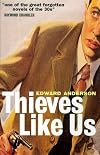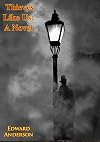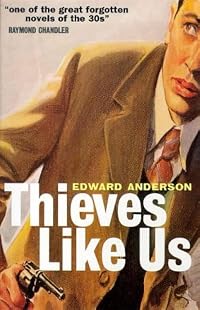
Thieves Like Us
by Edward Anderson
On This Page
Description
Fiction. Mystery. HTML:Bowie teams up with fellow thieves Chicamaw and T-Dub to rob a bank—he needs the money to hire a lawyer to prove he's innocent of murder. On the run, Bowie finds momentary peace when he elopes with a young woman. But Chicamaw and T-Dub want to reel him back in for one more job.One of the earliest American noir novels, Thieves Like Us was filmed twice, as They Live By Night in 1949, and by Robert Altman under the book's original title.
"One of the great forgotten show more novels of the 1930s"—Raymond Chandler. show less
Tags
Recommendations


















Member Reviews
Hardscrabble in West Texas, 1937
Among the most glamorized and followed criminals of the Great Depression were bank robbers. How people might have found anything admirable in these people—among them Bonnie and Clyde, John Dillinger, Pretty Boy Floyd, Machine Gun Kelly, a sprinkling of the better known bandits—should be no surprise to those who experienced the Great Recession. As Anderson’s Bowie Bowers observes, “Them capitalist fellows are thieves like us….They rob widows and orphans.” If you find yourself nodding in agreement with Bowie then you’ll want to join him, his young girlfriend Keechie and his brothers in crime T-Dub and Chicamaw as they pull off a series of successful bank robberies, battle the “Laws,” and show more traverse west Texas of the 1930s.
Like many, if not most, of noir crime fiction of the period, the nihilism of the characters and plot are nearly palpable from the first pages of Thieves Like Us. These outlaws regard themselves as a unique band of brothers, an A-team of thieves like none other. At the same time, they continually express the idea their robbery proceeds are a stake on a settled life of little care. Of course, the next job lures them, like the Sirens leading ancient sailors onto the shoals. And here the old saying, “No honor among thieves,” bears no weight as these fellows, particularly Bowie, prove themselves to be a loyal bunch to each other. Irony abounds in this notion, as loyalty leads to some pretty bad outcomes for these guys.
Within Anderson’s tale of life on adrenaline and thievery, readers will discover a love story, that between Bowie and Keechie. With Keechie beside him, Bowie manages to breakaway from the gang for a while. He and Keechie set up housekeeping in the hills of west Texas and New Orleans, fleeing when locals seem too suspicious of them, neither realizing that they are the subject of regular newspaper features, much like Bonnie and Clyde, but also because Bowie can’t help acting out his aggression in even trivial confrontations; Anderson strikes a fine balance of innocence and viciousness in his Bowie.
Naturally, in period fiction as this, and especially in one heavily intertwined with fatalism, things can’t be expected to workout for the best, at least not best for characters like Bowie and Keechie. How the wheels come off the getaway car is left for readers to discover for themselves.
Notable for the way Anderson’s story rings with veracity (he based his novel on an interview with his cousin, Roy Johnson, who was serving a life sentence for armed robbery) and the effective use of argot, now pretty much extinct, which proves transportive.
There have been a couple of film adaptations, in 1948 as They Live By Night and Robert Altman’s Thieves Like Us 1974 adaptation. show less
Among the most glamorized and followed criminals of the Great Depression were bank robbers. How people might have found anything admirable in these people—among them Bonnie and Clyde, John Dillinger, Pretty Boy Floyd, Machine Gun Kelly, a sprinkling of the better known bandits—should be no surprise to those who experienced the Great Recession. As Anderson’s Bowie Bowers observes, “Them capitalist fellows are thieves like us….They rob widows and orphans.” If you find yourself nodding in agreement with Bowie then you’ll want to join him, his young girlfriend Keechie and his brothers in crime T-Dub and Chicamaw as they pull off a series of successful bank robberies, battle the “Laws,” and show more traverse west Texas of the 1930s.
Like many, if not most, of noir crime fiction of the period, the nihilism of the characters and plot are nearly palpable from the first pages of Thieves Like Us. These outlaws regard themselves as a unique band of brothers, an A-team of thieves like none other. At the same time, they continually express the idea their robbery proceeds are a stake on a settled life of little care. Of course, the next job lures them, like the Sirens leading ancient sailors onto the shoals. And here the old saying, “No honor among thieves,” bears no weight as these fellows, particularly Bowie, prove themselves to be a loyal bunch to each other. Irony abounds in this notion, as loyalty leads to some pretty bad outcomes for these guys.
Within Anderson’s tale of life on adrenaline and thievery, readers will discover a love story, that between Bowie and Keechie. With Keechie beside him, Bowie manages to breakaway from the gang for a while. He and Keechie set up housekeeping in the hills of west Texas and New Orleans, fleeing when locals seem too suspicious of them, neither realizing that they are the subject of regular newspaper features, much like Bonnie and Clyde, but also because Bowie can’t help acting out his aggression in even trivial confrontations; Anderson strikes a fine balance of innocence and viciousness in his Bowie.
Naturally, in period fiction as this, and especially in one heavily intertwined with fatalism, things can’t be expected to workout for the best, at least not best for characters like Bowie and Keechie. How the wheels come off the getaway car is left for readers to discover for themselves.
Notable for the way Anderson’s story rings with veracity (he based his novel on an interview with his cousin, Roy Johnson, who was serving a life sentence for armed robbery) and the effective use of argot, now pretty much extinct, which proves transportive.
There have been a couple of film adaptations, in 1948 as They Live By Night and Robert Altman’s Thieves Like Us 1974 adaptation. show less
Hardscrabble in West Texas, 1937
Among the most glamorized and followed criminals of the Great Depression were bank robbers. How people might have found anything admirable in these people—among them Bonnie and Clyde, John Dillinger, Pretty Boy Floyd, Machine Gun Kelly, a sprinkling of the better known bandits—should be no surprise to those who experienced the Great Recession. As Anderson’s Bowie Bowers observes, “Them capitalist fellows are thieves like us….They rob widows and orphans.” If you find yourself nodding in agreement with Bowie then you’ll want to join him, his young girlfriend Keechie and his brothers in crime T-Dub and Chicamaw as they pull off a series of successful bank robberies, battle the “Laws,” and show more traverse west Texas of the 1930s.
Like many, if not most, of noir crime fiction of the period, the nihilism of the characters and plot are nearly palpable from the first pages of Thieves Like Us. These outlaws regard themselves as a unique band of brothers, an A-team of thieves like none other. At the same time, they continually express the idea their robbery proceeds are a stake on a settled life of little care. Of course, the next job lures them, like the Sirens leading ancient sailors onto the shoals. And here the old saying, “No honor among thieves,” bears no weight as these fellows, particularly Bowie, prove themselves to be a loyal bunch to each other. Irony abounds in this notion, as loyalty leads to some pretty bad outcomes for these guys.
Within Anderson’s tale of life on adrenaline and thievery, readers will discover a love story, that between Bowie and Keechie. With Keechie beside him, Bowie manages to breakaway from the gang for a while. He and Keechie set up housekeeping in the hills of west Texas and New Orleans, fleeing when locals seem too suspicious of them, neither realizing that they are the subject of regular newspaper features, much like Bonnie and Clyde, but also because Bowie can’t help acting out his aggression in even trivial confrontations; Anderson strikes a fine balance of innocence and viciousness in his Bowie.
Naturally, in period fiction as this, and especially in one heavily intertwined with fatalism, things can’t be expected to workout for the best, at least not best for characters like Bowie and Keechie. How the wheels come off the getaway car is left for readers to discover for themselves.
Notable for the way Anderson’s story rings with veracity (he based his novel on an interview with his cousin, Roy Johnson, who was serving a life sentence for armed robbery) and the effective use of argot, now pretty much extinct, which proves transportive.
There have been a couple of film adaptations, in 1948 as They Live By Night and Robert Altman’s Thieves Like Us 1974 adaptation. show less
Among the most glamorized and followed criminals of the Great Depression were bank robbers. How people might have found anything admirable in these people—among them Bonnie and Clyde, John Dillinger, Pretty Boy Floyd, Machine Gun Kelly, a sprinkling of the better known bandits—should be no surprise to those who experienced the Great Recession. As Anderson’s Bowie Bowers observes, “Them capitalist fellows are thieves like us….They rob widows and orphans.” If you find yourself nodding in agreement with Bowie then you’ll want to join him, his young girlfriend Keechie and his brothers in crime T-Dub and Chicamaw as they pull off a series of successful bank robberies, battle the “Laws,” and show more traverse west Texas of the 1930s.
Like many, if not most, of noir crime fiction of the period, the nihilism of the characters and plot are nearly palpable from the first pages of Thieves Like Us. These outlaws regard themselves as a unique band of brothers, an A-team of thieves like none other. At the same time, they continually express the idea their robbery proceeds are a stake on a settled life of little care. Of course, the next job lures them, like the Sirens leading ancient sailors onto the shoals. And here the old saying, “No honor among thieves,” bears no weight as these fellows, particularly Bowie, prove themselves to be a loyal bunch to each other. Irony abounds in this notion, as loyalty leads to some pretty bad outcomes for these guys.
Within Anderson’s tale of life on adrenaline and thievery, readers will discover a love story, that between Bowie and Keechie. With Keechie beside him, Bowie manages to breakaway from the gang for a while. He and Keechie set up housekeeping in the hills of west Texas and New Orleans, fleeing when locals seem too suspicious of them, neither realizing that they are the subject of regular newspaper features, much like Bonnie and Clyde, but also because Bowie can’t help acting out his aggression in even trivial confrontations; Anderson strikes a fine balance of innocence and viciousness in his Bowie.
Naturally, in period fiction as this, and especially in one heavily intertwined with fatalism, things can’t be expected to workout for the best, at least not best for characters like Bowie and Keechie. How the wheels come off the getaway car is left for readers to discover for themselves.
Notable for the way Anderson’s story rings with veracity (he based his novel on an interview with his cousin, Roy Johnson, who was serving a life sentence for armed robbery) and the effective use of argot, now pretty much extinct, which proves transportive.
There have been a couple of film adaptations, in 1948 as They Live By Night and Robert Altman’s Thieves Like Us 1974 adaptation. show less
I'm not sure why more people don't rate this book higher. It's a great gritty noir novel masquerading as a crime novel. You feel the humanity and nobility of the characters, how they are not that far from us, even while you realize these are kidnappers, murderers, and thieves. It perfectly captures the '30s Great Depression era feel and the Robin Hood aura that surrounded many of the serial bank robbers of the time.
Very compelling story of a group of bank robbers and murderers who escape from an Oklahoma prison and what happens to them afterward as they start a new crime spree across the Southwest during the Depression. Especially effective when the focus shifts to the youngest and smartest, Bowie, as he tries but fails to put the past behind him with his new love, Keetchie. Inevitably sad and bittersweet, Anderson tells the story simply and totally effectively, so that it will linger in your mind long after you turn the last page.
Certainly has its relevance in these times, as well.Thieves Like Us, indeed.
Certainly has its relevance in these times, as well.Thieves Like Us, indeed.
Thieves Like Us by Edward Anderson was originally published in 1937 and is about three small-time gangsters who break out of prison and immediately fall back into robbing banks. T-Dub, Chicamaw and Bowie cut a swath across Oklahoma and Western Texas. While holed up in a small town, the youngest, Bowie meets and falls in love with Keechie, a cousin of Chicamaw. After a robbery goes bad, Bowie and Keechie strike out on their own, and the story becomes a tale of love on the run with no where to hide.
The novel paints a realistic picture of life in the dust-bowl of the 1930s. One gets a feeling that the author based his story on the real lives of Bonnie and Clyde. As they drive back and forth on the dusty roads the reader can sense that time show more for these two is running out, that sooner or later they are heading for a confrontation with the police.
Thieves Like Us is a gripping, well written story that brings this lost era to life. There is an overwhelming sense of doom that clings to these tough, violent men, and even as they dream of a better life in Mexico, it is clear that fate has other plans for them. I note that this novel is considered an excellent example of the noir style of American crime stories. show less
The novel paints a realistic picture of life in the dust-bowl of the 1930s. One gets a feeling that the author based his story on the real lives of Bonnie and Clyde. As they drive back and forth on the dusty roads the reader can sense that time show more for these two is running out, that sooner or later they are heading for a confrontation with the police.
Thieves Like Us is a gripping, well written story that brings this lost era to life. There is an overwhelming sense of doom that clings to these tough, violent men, and even as they dream of a better life in Mexico, it is clear that fate has other plans for them. I note that this novel is considered an excellent example of the noir style of American crime stories. show less
My original Thieves Like Us audiobook review and many others can be found at Audiobook Reviewer.
Thieves Like Us was originally published in 1937 and is part of the American Noir of the 1930s and 40s collection. It provided the basis for two films: They Live By Night (1949) and Thieves Like Us (1974).
The story focuses on Bowie, Chicamaw, and T-Dub. Bowie, the youngest of them, killed a guy when he was 16. Chicamaw and T-Dub are convicted bank robbers. Following their escape from a chain gang, they continue robbing banks in order to get smart clothes, fast cars, and more guns. Bowie becomes romantically involved with Keechie, a young girl who is related to Chicamaw and who works at a gas station where they hide out. Set in the 1930s in show more Texas, Mississippi, and Oklahoma, this is a Depression-era story with a good bit of social commentary, with bankers referred to as "thieves like us" and politicians who “use their damned tongues instead of a gun.”
I found the story slow to start with, as there was a lot of conversation between the three men that I didn't find particularly engrossing. Once the plot started to focus on Bowie and Keechie, I found myself a lot more engaged. But action-packed, this isn't. In fact, a lot of the action, such as the bank robberies, chases etc, is described retrospectively via newspaper articles. I thought that was quite a good narrative device as the media account of the "dangerous" criminals didn't tally at all with their rather dull lives of hiding out, reading the paper and discussing ball games.
There was a feeling of unease right from the start which turned to unavoidable doom at the latest by the time Bowie and Keechie set off road tripping and 'Bonnie and Clyde' automatically came to mind. This is hard-boiled crime fiction, but quite moving in parts. Bowie was a really interesting character, extremely loyal and also generous, defiantly proclaiming “I never robbed nothin’ that couldn’t stand being robbed.” However, when he reminisced about Keechie, he sometimes came across as a total psychopath thinking "I can snap her little body. I can break her little body in my grip." Their relationship was difficult to believe at times.
The narration by Mike Dennis was first-class. His voice suited the protagonists, the pacing was excellent and his delivery really captured the setting. You felt transported back to that period in time and the story came to life.
This is classic noir, and if you appreciate stories of inevitable self-destruction, then this is an appealing listen that perfectly captures the 30s Depression era.
Audiobook was provided for review by the publisher. show less
Thieves Like Us was originally published in 1937 and is part of the American Noir of the 1930s and 40s collection. It provided the basis for two films: They Live By Night (1949) and Thieves Like Us (1974).
The story focuses on Bowie, Chicamaw, and T-Dub. Bowie, the youngest of them, killed a guy when he was 16. Chicamaw and T-Dub are convicted bank robbers. Following their escape from a chain gang, they continue robbing banks in order to get smart clothes, fast cars, and more guns. Bowie becomes romantically involved with Keechie, a young girl who is related to Chicamaw and who works at a gas station where they hide out. Set in the 1930s in show more Texas, Mississippi, and Oklahoma, this is a Depression-era story with a good bit of social commentary, with bankers referred to as "thieves like us" and politicians who “use their damned tongues instead of a gun.”
I found the story slow to start with, as there was a lot of conversation between the three men that I didn't find particularly engrossing. Once the plot started to focus on Bowie and Keechie, I found myself a lot more engaged. But action-packed, this isn't. In fact, a lot of the action, such as the bank robberies, chases etc, is described retrospectively via newspaper articles. I thought that was quite a good narrative device as the media account of the "dangerous" criminals didn't tally at all with their rather dull lives of hiding out, reading the paper and discussing ball games.
There was a feeling of unease right from the start which turned to unavoidable doom at the latest by the time Bowie and Keechie set off road tripping and 'Bonnie and Clyde' automatically came to mind. This is hard-boiled crime fiction, but quite moving in parts. Bowie was a really interesting character, extremely loyal and also generous, defiantly proclaiming “I never robbed nothin’ that couldn’t stand being robbed.” However, when he reminisced about Keechie, he sometimes came across as a total psychopath thinking "I can snap her little body. I can break her little body in my grip." Their relationship was difficult to believe at times.
The narration by Mike Dennis was first-class. His voice suited the protagonists, the pacing was excellent and his delivery really captured the setting. You felt transported back to that period in time and the story came to life.
This is classic noir, and if you appreciate stories of inevitable self-destruction, then this is an appealing listen that perfectly captures the 30s Depression era.
Audiobook was provided for review by the publisher. show less
Like the work of Dashiell Hammett, this stunning 1935 character-driven noir novel bears the minimalist stamp of a true Hemingway disciple. More about how criminals live between their acts of violence and theft, the novel is a clear precursor to modern literary crime noir like Barry Gifford's "Wild at Heart." Maybe best of all, Anderson here did a phenomenal job of capturing the sights, sounds and idioms of 1930s. - Adam
Members
- Recently Added By
Lists

Books That Inspired American Film Noir
7 works; 1 member
Author Information
2+ Works 204 Members
Series
Belongs to Publisher Series
Work Relationships
Is contained in
Has the adaptation
Common Knowledge
- Canonical title*
- Son Ladrones Como Nosotros
- Original title
- Thieves Like Us
- Original publication date
- 1937
- People/Characters
- Bowie; Keechie; T-Dub; Chicamaw
- Important places
- Texas, USA
- Important events
- Great Depression
- Related movies
- Thieves Like Us (1974 | IMDb); They Live by Night (1948 | IMDb)
- Epigraph
- "Men do not despise a thief, if he steal to satisfy his soul when he is hungry; but if he be found, he shall restore sevenfold; he shall give all substance of his house."
--------Proverbs of Solomon - Dedication
- To
My cousin and my wife
Because there I was with an empty gun
and you, Roy, supplied the ammunition
and you, Anne , directed my aim - First words
- There was no doubt about it this time: over yonder behind the rise of scrub-oak, the automobile had left the highway and was laboring in low gear over the rutted road to where they waited. Like a saliva-wettened finger scorch... (show all)ing across a hot iron, Bowie's insides spitted. He looked at Chicamaw.
- Last words
- (Click to show. Warning: May contain spoilers.)"Bowers was a ruthless, cunning criminal," Warden Howard declared, "and we had to exert every resource to bring himdown."
- Original language
- English
*Some information comes from Common Knowledge in other languages. Click "Edit" for more information.
Classifications
Statistics
- Members
- 165
- Popularity
- 198,710
- Reviews
- 12
- Rating
- (3.65)
- Languages
- 5 — Catalan, Danish, English, Italian, Spanish
- Media
- Paper, Audiobook, Ebook
- ISBNs
- 16
- ASINs
- 6