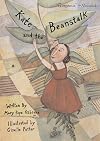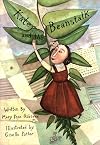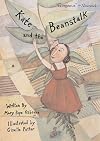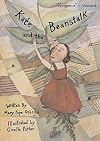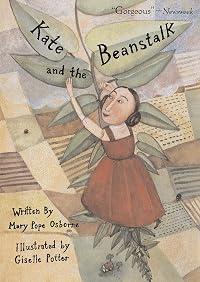
Kate and the Beanstalk
by Mary Pope Osborne
On This Page
Description
In this version of the classic tale, a girl climbs to the top of a giant beanstalk, where she uses her quick wits to outsmart a giant and make her and her mother's fortune.Tags
Recommendations



Member Reviews
I had high hopes for this book as a take on the classic Jack and the Beanstalk with a female heroine. However, other than changing the gender of some of the characters, this book didn't offer a fresh take on this fairy tale, it mostly rehashed the old version. There was nothing wrong with this version and I would potentially choose it over the original, but on an updated version, I'd like to see more updated details, humor, a different setting, something fresh. I did love the illustrations though and the visual use of varying fonts and how the text was arranged on the page. I also love a female heroine showing bravery, intelligence, and grit which this story does.
This book switches up the story a bit in that the hero is a heroine! Jack is replaced by Kate! A refreshing take on a familiar old tale. This is a good choice for those of us looking to add diversity to our class library.
Kate and the Beanstalk is a recreation of the classic “Jack and the Beanstalk” tale. The central message of this book is knowledge over strength and courage. As Kate faces the giant, she used her wittiness to defeat him.
I liked this book because rather than it being “Jack”, the main character is a female named Kate. This will allow some students to better relate to the character. Another reason I liked this book is because of the illustrations. The illustrator, Giselle Potter, created unique and colorful visuals to go with the text. Another part of the book that was great is how Mary Pope Osbourne used dialogue to tell the story. She also used rhyme and repetition of “Fee, Fi, Fo, Fum’un, I smell the blood of an show more Englishwoman. Be she alive or be she dead, I’ll grind her bones to make my bread.” These kept readers engaged and is an example of predictable text. show less
I liked this book because rather than it being “Jack”, the main character is a female named Kate. This will allow some students to better relate to the character. Another reason I liked this book is because of the illustrations. The illustrator, Giselle Potter, created unique and colorful visuals to go with the text. Another part of the book that was great is how Mary Pope Osbourne used dialogue to tell the story. She also used rhyme and repetition of “Fee, Fi, Fo, Fum’un, I smell the blood of an show more Englishwoman. Be she alive or be she dead, I’ll grind her bones to make my bread.” These kept readers engaged and is an example of predictable text. show less
Kate and the Beanstalk is a creative and fresh retelling of the traditional Jack and the Beanstalk and is based on Andrew Lang's work from "The Read Fairy Book," published in 1890. Kate and her mother are impoverished with nothing to eat, and it seems that their only salvation is to sell their cow. However, Kate encounters a beggar and trades the family cow for a bag of "magic beans." Thinking they were extraordinary, she completes the transaction without thinking and rushes home to her mother - to her surprise her mother becomes highly upset and disappointed, and her mother tosses the beans out the window.
To Kate's surprise, she discovers later that night that the beans have grown into a stalk that reaches the skies. Out of curiosity show more she climbs and climbs the beanstalk until she reaches the top and finds a beautiful countryside with a mighty castle overlooking the land. Kate meets an old woman from whom she learns that the castle and its treasures - a hen that lays golden eggs, a bag filled with coins, and a magical harp - were all stolen from a noble knight and his fair wife by a monstrous giant. The giant has killed the knight, and fortunately the wife and their baby were in the valley. However, the widow was afraid to return home and remained below to raise her child. The old woman suggests that Kate is could be the hero to return the castle and treasure to its rightful owners.
Kate accomplishes the daunting task of retrieving each treasure, climbing down the stalk to hide them in the bush, and outwitting the giant and his wife by wearing disguises. However, Kate is almost caught when she gets the magic harp - the giant wakes up, chases Kate, and in the nick of time she is able to get down from the stalk and chop it down, bringing the giant to his death.
Kate's mother recognizes the giant as the one who killed her father, and the Queen of the Fairies arrives to reveal that she had disguised herself as the old woman near the castle to test Kate and see if Kate could avenge her father's death. The Queen of the Fairies takes Kate and her Mother to the castle, and they reclaim the home and riches that is rightly theirs.
This heroine story effectively conveys the message that risk and reward exists with every choice - the magic beans are initially disappointing, yet lead Kate and her mother to their rightful home and property. The tale also suggests that with confidence, quick thinking, and action, one can overcome the biggest of challenges.
The illustrations are rendered in pencil, ink, gouache, gesso, and watercolor bringing rich color and texture to the characters and setting. The illustrations closely follow the plot and action, and the creative text placement, i.e., "Down and down and down..." is placed alongside the beanstalk drawing to convey Kate going down the stalk is a great signal for the reader to read with anticipation as Kate makes her escape.
Engaging book to read aloud for children ages 5-9, and great to read along with the original Jack and the Beanstalk for an interesting class discussion. show less
To Kate's surprise, she discovers later that night that the beans have grown into a stalk that reaches the skies. Out of curiosity show more she climbs and climbs the beanstalk until she reaches the top and finds a beautiful countryside with a mighty castle overlooking the land. Kate meets an old woman from whom she learns that the castle and its treasures - a hen that lays golden eggs, a bag filled with coins, and a magical harp - were all stolen from a noble knight and his fair wife by a monstrous giant. The giant has killed the knight, and fortunately the wife and their baby were in the valley. However, the widow was afraid to return home and remained below to raise her child. The old woman suggests that Kate is could be the hero to return the castle and treasure to its rightful owners.
Kate accomplishes the daunting task of retrieving each treasure, climbing down the stalk to hide them in the bush, and outwitting the giant and his wife by wearing disguises. However, Kate is almost caught when she gets the magic harp - the giant wakes up, chases Kate, and in the nick of time she is able to get down from the stalk and chop it down, bringing the giant to his death.
Kate's mother recognizes the giant as the one who killed her father, and the Queen of the Fairies arrives to reveal that she had disguised herself as the old woman near the castle to test Kate and see if Kate could avenge her father's death. The Queen of the Fairies takes Kate and her Mother to the castle, and they reclaim the home and riches that is rightly theirs.
This heroine story effectively conveys the message that risk and reward exists with every choice - the magic beans are initially disappointing, yet lead Kate and her mother to their rightful home and property. The tale also suggests that with confidence, quick thinking, and action, one can overcome the biggest of challenges.
The illustrations are rendered in pencil, ink, gouache, gesso, and watercolor bringing rich color and texture to the characters and setting. The illustrations closely follow the plot and action, and the creative text placement, i.e., "Down and down and down..." is placed alongside the beanstalk drawing to convey Kate going down the stalk is a great signal for the reader to read with anticipation as Kate makes her escape.
Engaging book to read aloud for children ages 5-9, and great to read along with the original Jack and the Beanstalk for an interesting class discussion. show less
I enjoyed reading this book for a multitude of reasons. I liked the author’s use of varying font sizes. The variation in font sizes helped to emphasize important words and phrases and catch the readers’ attention. For example the phrase “… up and up and up” was next to an illustration of a beanstalk and each word in the phrase increased in font size along with the growing beanstalk. Another highlight of the book was the descriptive language and word choice. The language in the book helped to create strong imagery. Some of these words included “astonishing”, “misty haze”, and “forlorn.” However children may need some of the more advanced vocabulary defined. Although I enjoyed this book, I do have one reservation show more about it. I believe this book should not be read to younger children (such as preschool aged children) because it contains some graphic themes. For example the giant in the story wants to eat Kate and repeats the phrase, “I’ll grind her bones to make my bread.” I feel that this graphic phrase is not age appropriate for younger children. show less
I liked this book for three reasons. I like how it was similar but different from Jack and the Beanstalk. It is similar because Kate meets and beggar and exchanges the cow for magic beans. It is also similar because each time Kate climbs the beanstalk, she has to hide from the giant and then steals his things. It is different because there is a fairy who tells Kate the story of the giant who killed the knight and left the knight’s wife and daughter poor and hungry. It is also different because Kate helps the giant’s wife prepare him food. I also like this book because it allows females to be heroes as well. Finally, I like that the illustrations follow the words of the book. For example, when the author says that Kate climbs up, up, show more up the beanstalk, the words also climb up the beanstalk. show less
I liked this book for three reasons. I like how it was similar but different from Jack and the Beanstalk. It is similar because Kate meets and beggar and exchanges the cow for magic beans. It is also similar because each time Kate climbs the beanstalk, she has to hide from the giant and then steals his things. It is different because there is a fairy who tells Kate the story of the giant who killed the knight and left the knight’s wife and daughter poor and hungry. It is also different because Kate helps the giant’s wife prepare him food. I also like this book because it allows females to be heroes as well. Finally, I like that the illustrations follow the words of the book. For example, when the author says that Kate climbs up, up, show more up the beanstalk, the words also climb up the beanstalk. show less
Members
- Recently Added By
Author Information

482+ Works 370,796 Members
Mary Pope Osborne was born in Fort Sill, Oklahoma on May 20, 1949. She grew up in a military family, and by the time she was 15 she had lived in Oklahoma, Austria, Florida, and four different army posts in Virginia and North Carolina. She attended the University of North Carolina at Chapel Hill where she majored in religion. After graduation, she show more traveled around Europe and Asia. Before becoming an author, she worked as a window dresser, a medical assistant, a Russian travel consultant, a waitress, an acting teacher, a bartender, and an assistant editor for a children's magazine. Her first book, Run, Run as Fast as You Can, was published in 1982. She is the author of the Magic Tree House series and the Merlin Missions series. Her husband, actor Will Osborne, helps her write the nonfiction companion series, Magic Tree House Research Guides. Her other books include The Deadly Power of Medusa, Jason and the Argonauts, Haunted Waters, and Moonhorse. (Bowker Author Biography) show less
All Editions
Awards and Honors
Common Knowledge
- Canonical title
- Kate and the Beanstalk
- Original publication date
- 2000
- Quotations
- Greetings, brave Kate,...as Queen of the Fairies, I have long wanted to avenge the treachery done to the good knight. But first I needed to know if his daughter was worthy of her inheritance. So I disguised myself as both the... (show all) beggar and the old woman and sent you on your quest to your father's castle.
Classifications
Statistics
- Members
- 581
- Popularity
- 50,686
- Reviews
- 26
- Rating
- (3.79)
- Languages
- English
- Media
- Paper, Ebook
- ISBNs
- 11
- ASINs
- 5