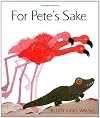
For Pete's Sake Grade 2, Level Library: Harcourt School Publishers Collections
by Ellen Stoll Walsh
On This Page
Description
Pete, an alligator who thinks that he is a flamingo, worries when he begins to notice the differences between him and his flamingo friends.Tags
Recommendations



















Member Reviews
This is a wonderful book about acceptance. I love the idea of an alligator who thinks he is a flamingo and I love the way the flamingos fully accept him as he is. At the end of the story the flamingos acknowledge that they have known Pete is different all along but they fully accepted him long ago. His differences seem inconsequential to them, never raising the issue themselves but providing comforting (amusing!) explanations when Pete becomes aware his differences. The flamingos just want to get on with playing.
Oh, if only people could be like this!
This simple book is truly a gem.
Oh, if only people could be like this!
This simple book is truly a gem.
"For Pete's Sake," by Ellen Stoll Walsh was about an alligator thinking he was a flamingo, because he was always around them. He thought he was a flamingo just like them, he just wasn't quite grown up like them yet. One day, he sees more alligators like himself and thinks they are flamingos too, and he also thinks they just aren't quite grown yet. This book shows diversity, being that not everyone or everything has to be alike. There are always going to be differences in your surroundings. Pete notices, he is different, but the same. This gives students a good perspective of what they need to understand in such a diverse world.
Pete is sure he's a flamingo, but doesn't quite fit in with his flamingo friends. He's green, has four feet, and doesn't have feathers like everyone else. As Pete points out all of his differences, his friends try to reassure him that being different is ok. One day, Pete meets a group of flamingos (alligators) that look just like him and realizes that even though he's different, he's still the same.
Just as she does in many of her other books, Ellen Stoll Walsh uses many adjectives in "For Pete's Sake." This is especially prevalent as she is describing the main character, Pete. Walsh alternates the dialogue throughout the book between Pete describing how he is different, and his friends trying to cheer him up. There is also one use of show more ellipsis as Pete is walking home to emphasize how slow he is walking. show less
Just as she does in many of her other books, Ellen Stoll Walsh uses many adjectives in "For Pete's Sake." This is especially prevalent as she is describing the main character, Pete. Walsh alternates the dialogue throughout the book between Pete describing how he is different, and his friends trying to cheer him up. There is also one use of show more ellipsis as Pete is walking home to emphasize how slow he is walking. show less
For Pete's Sake by Ellen Stoll Walsh tells the story of Pete, who is actually an alligator, who thinks he is a flamingo. act time Pete realizes a difference between him and his flamingo friends, his flamingo friends tell Pete something to make him feel better. When Pete realizes he xdoesznt have any feathers, his flamingo friends tell him "The best feathers take the longest to grow." AT the end of the story Pete meets other alligators who look just like him. Pete realizes he is different, but is also the same, like his flamingo friends had been trying to tell him.
The author writes in a way that each two page spread acknowledged another difference between Pete and his flamingo friends. However, each time the flamingo's respond in a way show more to tell Pete he is not so different. Also, in one part of the story the author skips a page to show how slow Pete walked and how long it took Pete to walk home on his four, little legs.
The illustrations are made out of cut outs. Different types of textured paper were used to make the shapes of Pete, the flamingos, and the sand. show less
The author writes in a way that each two page spread acknowledged another difference between Pete and his flamingo friends. However, each time the flamingo's respond in a way show more to tell Pete he is not so different. Also, in one part of the story the author skips a page to show how slow Pete walked and how long it took Pete to walk home on his four, little legs.
The illustrations are made out of cut outs. Different types of textured paper were used to make the shapes of Pete, the flamingos, and the sand. show less
Pete is a green crocodile who wants to be pink like his flamingo friends. They tell him he is probably just unripe. He points out he has four legs and they have two. They tell him he's probably just lucky. He then notices he doesn't have feathers. They say feathers grow slowly. He's slow, they're fast. All of which is making Pete very unhappy. But then one day strangers arrive -- other green strangers with four legs and no feathers. Ends with: "I'm different but the same," he told the others. "Well for Peter's sake, Pete," they said. You always have been."
Genre: Through the fantasy of this book, the reader is able to hear the life of the flamingo. This fantasy is displayed through the communication of the flamingo's and the crocodile.
Media: college
Use: lesson on differences in people, lesson on observation
Media: college
Use: lesson on differences in people, lesson on observation
Ratings
Members
- Recently Added By
Author Information

23+ Works 10,321 Members
Awards and Honors
Classifications
Statistics
- Members
- 404
- Popularity
- 76,752
- Reviews
- 6
- Rating
- (4.18)
- Languages
- English
- Media
- Paper
- ISBNs
- 5
- ASINs
- 1