On This Page
Description
Leo, a young tiger, finally blooms under the anxious eyes of his parents.Tags
Recommendations





















Member Recommendations

Member Reviews
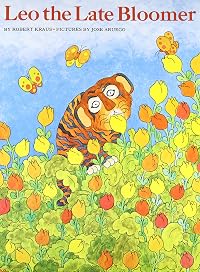
Leo the tiger was a late bloomer. He didn't learn to read and write when the other baby animals did, and he couldn't draw, eat neatly, or speak when they could. His father wondered aloud what the problem was, but his mother counseled patience, declaring that he would bloom when it was his time. After much worried watching, his father eventually let him be, and then... Leo bloomed!
Originally published in 1971, this classic picture-book addresses a common childhood (and parent) concern: the feeling that one's development, either overall or in some specific area, is delayed, because it doesn't happen at exactly the same time as it does with one's peers. The simple story here gently drives home the point that everyone is on their own show more schedule, and that it shouldn't be a cause of undue concern when one child develops a skill at a different time than another. I found Robert Kraus's text quite humorous, especially the depiction of Leo's father and his worried watching, and thought the illustrations by José Aruego, whose artwork I am familiar with from various folkloric retellings he has been involved in, were colorful and appealing. Recommended to anyone, parent or child, worried about development schedules. show less
Originally published in 1971, this classic picture-book addresses a common childhood (and parent) concern: the feeling that one's development, either overall or in some specific area, is delayed, because it doesn't happen at exactly the same time as it does with one's peers. The simple story here gently drives home the point that everyone is on their own show more schedule, and that it shouldn't be a cause of undue concern when one child develops a skill at a different time than another. I found Robert Kraus's text quite humorous, especially the depiction of Leo's father and his worried watching, and thought the illustrations by José Aruego, whose artwork I am familiar with from various folkloric retellings he has been involved in, were colorful and appealing. Recommended to anyone, parent or child, worried about development schedules. show less
First sentence: Leo couldn't do anything right. He couldn't read. He couldn't write. He couldn't draw. He was a sloppy eater. And, he never said a word.
Premise/plot: Much of Leo the Late Bloomer covers conversations between a mother and father as they discuss their late bloomer, Leo. The father worries that Leo will never, ever bloom. His mother is confident that Leo will bloom. Seasons come and go but Leo hasn't bloomed. Then one day, he does. And Leo's "first word" isn't a first word, but a sentence: "I made it!"
My thoughts: I did not grow up with this one. In fact, I didn't meet Leo until I was in college. But I definitely connected with him once I met him. I liked the optimism of the mother tiger. I could understand, in part, the show more frustration of the father. And I cheered the happy, happy ending. Overall, I'm not sure that it's perfectly-perfect in terms of modeling what to do if your child has learning difficulties. But I'm not convinced that it has to be. This isn't a how-to book for children or parents.
Text: 5 out of 5
Illustrations: 4 out of 5
Total: 9 out of 10 show less
Premise/plot: Much of Leo the Late Bloomer covers conversations between a mother and father as they discuss their late bloomer, Leo. The father worries that Leo will never, ever bloom. His mother is confident that Leo will bloom. Seasons come and go but Leo hasn't bloomed. Then one day, he does. And Leo's "first word" isn't a first word, but a sentence: "I made it!"
My thoughts: I did not grow up with this one. In fact, I didn't meet Leo until I was in college. But I definitely connected with him once I met him. I liked the optimism of the mother tiger. I could understand, in part, the show more frustration of the father. And I cheered the happy, happy ending. Overall, I'm not sure that it's perfectly-perfect in terms of modeling what to do if your child has learning difficulties. But I'm not convinced that it has to be. This isn't a how-to book for children or parents.
Text: 5 out of 5
Illustrations: 4 out of 5
Total: 9 out of 10 show less
There are 2 reasons why I like this book. The first reason is that the language is clear and concise, but uses vivid words and some figurative language to create a playful tone. As a young tiger, Leo was a late bloomer and did not grow at the same rate as his other friends. When his other friends were talking, Leo did not speak. The author playfully used onomatopoeia to show what each animal was "saying". For example, the elephant would say, "Brrrpht" (p. 8).The concise language helps to show the audience the idea that his peers were communicating, while Leo was not saying anything. As the story goes on, Leo's mother is patient with his development, reassuring everyone that he was a late bloomer and he would soon develop. Leo's mother show more tells her husand to "Be patient, he is a late bloomer". Another reason that I like this book are that the characters are believable and have common human emotions that students can relate to. The book uses words to describe emotions such as frustrated and patient, which young students are learning about. When the father is described as frustrated, he must learn patience and know that Leo will soon speak, write, and read just like the others his age. The overall message in this book is that everyone grows at different rates and it is okay to be slower than others. It helps students learn about patience and understand that everyone is different. show less
Leo the tiger simply cannot comprehend why he cannot complete tasks in a timely manner. He cannot write; He cannot draw. He cannot write; He cannot even eat without making a sloppy mess. His father is very concerned and wonders outloud what is wrong with Leo?
A loving mother notes that Leo is fine, he is simply a late bloomer. While Leo's father is frustrated, it is Leo who is most anxious. And, then one magical day, Leo bloomed "in his own good time," as the author notes!
And, when he blooms, he draws inside the lines. He can read lots of books, Finally, he made it!
What a wonderful book to read to a child who is struggling, confused and anxious. Leo's mother was his advocate. She knew he would bloom, but not at the same time of others, show more and not at the misunderstanding of his father! show less
A loving mother notes that Leo is fine, he is simply a late bloomer. While Leo's father is frustrated, it is Leo who is most anxious. And, then one magical day, Leo bloomed "in his own good time," as the author notes!
And, when he blooms, he draws inside the lines. He can read lots of books, Finally, he made it!
What a wonderful book to read to a child who is struggling, confused and anxious. Leo's mother was his advocate. She knew he would bloom, but not at the same time of others, show more and not at the misunderstanding of his father! show less
Poor Leo can’t seem to do anything right . . . he can’t read, he can’t write, he can’t draw. He’s a sloppy eater, and he doesn’t speak. What is the matter with Leo?
“Nothing,” says Leo’s mother. “Leo is just a late bloomer.”
But will Leo ever bloom?
Charming illustrations accompany the simply narrative that helps young readers learn that everyone blooms in their own good time. A delightful tale for parents and children to enjoy together.
Highly recommended.
“Nothing,” says Leo’s mother. “Leo is just a late bloomer.”
But will Leo ever bloom?
Charming illustrations accompany the simply narrative that helps young readers learn that everyone blooms in their own good time. A delightful tale for parents and children to enjoy together.
Highly recommended.
I'm completely enthralled by this book. It's endearing, it is funny, and it is motivational and inspiring. I'm really having a hard time letting go of it, since I borrowed it at the library. I was first taken in by the illustrations which are splashing in color and humorously portray by facial expressions Leo's backwardness/awkwardness, father's anxiety/impatience and mother's gentle love and warm confidence in her offspring.
The story tells our children not to worry about not growing up fast enough, because they all will get there on their own time, and it teaches parents to relax and hold back on the motherly worries and the fatherly ambitions. The illustrations are hilarious at times, Leo's skills (or lack thereof) are compared to show more five very capable animal friends, and while they each do things their own way they admittedly have a big lead on Leo. And while father tries to hide his concern it only keeps growing, while Leo looks ever so baffled and out of place.
The illustrations are credited to two artists: [a:José Aruego|5480|José Aruego|http://www.goodreads.com/assets/nophoto/nophoto-U-50x66.jpg] who draws and [a:Ariane Dewey|5479|Ariane Dewey|http://www.goodreads.com/assets/nophoto/nophoto-U-50x66.jpg] who adds the color. I swept up everything I could find with this winning team at the library. This included the mouse series: [b:Whose Mouse Are You?|197438|Whose Mouse Are You?|Robert Kraus|http://photo.goodreads.com/books/1172606057s/197438.jpg|1517345], [b:Where Are You Going, Little Mouse?|252602|Where Are You Going, Little Mouse?|Robert Kraus|http://photo.goodreads.com/books/1173155878s/252602.jpg|244778] and [b:Come Out and Play, Little Mouse|7406265|Come Out and Play, Little Mouse|Robert Kraus|http://photo.goodreads.com/books/1267453625s/7406265.jpg|9317543], but the illustrations in these books, while easily recognizable, are a little more subdued and less playful. The tone of the books is also somewhat cynical and sometimes a little too mean for my taste. The following books however are very much in the spirit of Leo and I would heartily recommend them: [b:Milton The Early Riser|1269316|Milton The Early Riser (Stories To Go!)|Robert Kraus|http://photo.goodreads.com/books/1182386427s/1269316.jpg|1258234], [b:Herman the Helper|829396|Herman the Helper|Robert Kraus|http://photo.goodreads.com/books/1178739384s/829396.jpg|403503], [b:Owliver|384481|Owliver|Robert Kraus|http://photo.goodreads.com/books/1174348621s/384481.jpg|1957174] and [b:Little Louie the Baby Bloomer|414288|Little Louie the Baby Bloomer|Robert Kraus|http://photo.goodreads.com/books/1174529808s/414288.jpg|403509]. show less
The story tells our children not to worry about not growing up fast enough, because they all will get there on their own time, and it teaches parents to relax and hold back on the motherly worries and the fatherly ambitions. The illustrations are hilarious at times, Leo's skills (or lack thereof) are compared to show more five very capable animal friends, and while they each do things their own way they admittedly have a big lead on Leo. And while father tries to hide his concern it only keeps growing, while Leo looks ever so baffled and out of place.
The illustrations are credited to two artists: [a:José Aruego|5480|José Aruego|http://www.goodreads.com/assets/nophoto/nophoto-U-50x66.jpg] who draws and [a:Ariane Dewey|5479|Ariane Dewey|http://www.goodreads.com/assets/nophoto/nophoto-U-50x66.jpg] who adds the color. I swept up everything I could find with this winning team at the library. This included the mouse series: [b:Whose Mouse Are You?|197438|Whose Mouse Are You?|Robert Kraus|http://photo.goodreads.com/books/1172606057s/197438.jpg|1517345], [b:Where Are You Going, Little Mouse?|252602|Where Are You Going, Little Mouse?|Robert Kraus|http://photo.goodreads.com/books/1173155878s/252602.jpg|244778] and [b:Come Out and Play, Little Mouse|7406265|Come Out and Play, Little Mouse|Robert Kraus|http://photo.goodreads.com/books/1267453625s/7406265.jpg|9317543], but the illustrations in these books, while easily recognizable, are a little more subdued and less playful. The tone of the books is also somewhat cynical and sometimes a little too mean for my taste. The following books however are very much in the spirit of Leo and I would heartily recommend them: [b:Milton The Early Riser|1269316|Milton The Early Riser (Stories To Go!)|Robert Kraus|http://photo.goodreads.com/books/1182386427s/1269316.jpg|1258234], [b:Herman the Helper|829396|Herman the Helper|Robert Kraus|http://photo.goodreads.com/books/1178739384s/829396.jpg|403503], [b:Owliver|384481|Owliver|Robert Kraus|http://photo.goodreads.com/books/1174348621s/384481.jpg|1957174] and [b:Little Louie the Baby Bloomer|414288|Little Louie the Baby Bloomer|Robert Kraus|http://photo.goodreads.com/books/1174529808s/414288.jpg|403509]. show less
I liked this book for two reasons. One reason I liked this book was because of the main character. I felt that Leo was a very relatable character. He struggled with being on the "same level" as his other animal friends. I think that this is very relatable for children because they may feel like they are also falling behind in certain aspects that their peers may be excelling at. Another reason I liked this book was for the plot. In the beginning of the book, it talked about all the things that his animal friends could do that he couldn't do. Even his parents began to worry. But, then at the end, he finally bloomed in his own time. I thought that the plot portrayed a very powerful message, and that is what made this story great. Overall, show more I think that the big message of this book was that everyone grows up in their own time and in their own way. show less
Members
- Recently Added By
Lists

Mensa for Kids Excellence in Reading Award Program (Grades K-3)
64 works; 6 members

Childhood Favorites
427 works; 23 members

my children books reading list-from 100 great books
101 works; 7 members

CCE 1000 Good Books List
1,033 works; 12 members

Sonlight Books
1,487 works; 25 members

Early Picture Books
467 works; 9 members

Recommended Reading List
219 works; 1 member

Children's Picture Books
188 works; 1 member

BOOKS READ IN 1980's and 1990's
52 works; 4 members
Author Information

118+ Works 11,895 Members
Robert Kraus was born in Milwaukee, Wisconsin on June 21, 1925. When he was 10-years-old, he won a cartoon contest staged by the Milwaukee Journal. He received a plaque and had his cartoon printed in the paper. Two years later, the newspaper hired him to produce a weekly cartoon called Public Nuisances. By the time he was 16-years-old, he was show more selling cartoons to magazines like Esquire and the Saturday Evening Post. He studied at Milwaukee's Layton Art School and the Art Students' League in New York. After selling a few cartoons to The New Yorker, he was hired by the magazine as a contract artist. He worked there for 15 years and created 21 covers. While there, he started writing and illustrating children's books. His books included All the Mice Came, Leo the Late Bloomer, and Whose Mouse Are You? He left The New Yorker in 1966 and founded Windmill Books. Within a year, the house had won a prestigious Caldecott Medal. After 20 years, he sold Windmill to Simon and Schuster. In 1983, he began a syndicated Sunday comic feature, called Zap! The Video Chap. He died of congestive heart failure on August 7, 2001 at the age of 76. (Bowker Author Biography) show less
All Editions
Awards and Honors
Series

Work Relationships
Common Knowledge
- Canonical title
- Leo the Late Bloomer
- Original publication date
- 1971
- Related movies
- Leo the Late Bloomer (1999 | IMDb)
- Original language
- English
Classifications
Statistics
- Members
- 4,647
- Popularity
- 3,111
- Reviews
- 48
- Rating
- (3.96)
- Languages
- 7 — Chinese, English, French, Hmong, Italian, Russian, Spanish
- Media
- Paper, Audiobook, Ebook
- ISBNs
- 66
- UPCs
- 1
- ASINs
- 21