Rip van Winkle [short story]
by Washington Irving
On This Page
Description
A man who sleeps for twenty years in the Catskill Mountains wakes to a much-changed world.Tags
Recommendations

















Member Reviews
Last night at supper we were talking about the various kinds of fey characters of human folklore, and the Spouse said Rip had spent his twenty years (relative) among hairy gnomes. I didn't remember that at all, so it seemed I'd have to read the story again. At thirty years remove from the original reading, all I could recall was the simplest plot: that Rip drinks among the fey, comes back to town 20 years later.
I'm glad I re-read it, because there's much more to the Irving telling. Kind of horrifically so, because the whole point of the story is that Van Winkle's wife is horrible. Really horrible. Such a shrew. I had no recollection of the fact that Rip was running away from her. Nor did I recall that the men he went among were so very show more hairy, nor that they were supposed to be Hendrick Hudson and crew. Nor did I notice the time the story was set: before and after the Revolutionary War, with the heroism of his former friends recounted.
The Spouse complained that Irving took a traditional story and nailed it to a specific time and place and made it such a very Catskill story. That didn't bother me, but oh, that wife! I feel suitably chastened on behalf of all my gender. The nerve of that woman, trying to make her husband provide for the family. She deserves the harshest punishment imaginableand stroking out while yelling at a peddler is pretty harsh . show less
I'm glad I re-read it, because there's much more to the Irving telling. Kind of horrifically so, because the whole point of the story is that Van Winkle's wife is horrible. Really horrible. Such a shrew. I had no recollection of the fact that Rip was running away from her. Nor did I recall that the men he went among were so very show more hairy, nor that they were supposed to be Hendrick Hudson and crew. Nor did I notice the time the story was set: before and after the Revolutionary War, with the heroism of his former friends recounted.
The Spouse complained that Irving took a traditional story and nailed it to a specific time and place and made it such a very Catskill story. That didn't bother me, but oh, that wife! I feel suitably chastened on behalf of all my gender. The nerve of that woman, trying to make her husband provide for the family. She deserves the harshest punishment imaginable
Last night at supper we were talking about the various kinds of fey characters of human folklore, and the Spouse said Rip had spent his twenty years (relative) among hairy gnomes. I didn't remember that at all, so it seemed I'd have to read the story again. At thirty years remove from the original reading, all I could recall was the simplest plot: that Rip drinks among the fey, comes back to town 20 years later.
I'm glad I re-read it, because there's much more to the Irving telling. Kind of horrifically so, because the whole point of the story is that Van Winkle's wife is horrible. Really horrible. Such a shrew. I had no recollection of the fact that Rip was running away from her. Nor did I recall that the men he went among were so very show more hairy, nor that they were supposed to be Hendrick Hudson and crew. Nor did I notice the time the story was set: before and after the Revolutionary War, with the heroism of his former friends recounted.
The Spouse complained that Irving took a traditional story and nailed it to a specific time and place and made it such a very Catskill story. That didn't bother me, but oh, that wife! I feel suitably chastened on behalf of all my gender. The nerve of that woman, trying to make her husband provide for the family. She deserves the harshest punishment imaginableand stroking out while yelling at a peddler is pretty harsh . show less
I'm glad I re-read it, because there's much more to the Irving telling. Kind of horrifically so, because the whole point of the story is that Van Winkle's wife is horrible. Really horrible. Such a shrew. I had no recollection of the fact that Rip was running away from her. Nor did I recall that the men he went among were so very show more hairy, nor that they were supposed to be Hendrick Hudson and crew. Nor did I notice the time the story was set: before and after the Revolutionary War, with the heroism of his former friends recounted.
The Spouse complained that Irving took a traditional story and nailed it to a specific time and place and made it such a very Catskill story. That didn't bother me, but oh, that wife! I feel suitably chastened on behalf of all my gender. The nerve of that woman, trying to make her husband provide for the family. She deserves the harshest punishment imaginable
Wonderfully vivid tale of a man who loses 20 years of his life overnight in the Catskill Mountains. Irving is a delightful narrator, who employs some irony and humor along with his powerful sense of place, to enthrall his reader.
I had, of course, read this long ago in my youth. I found it was a bit different than I had remembered and well worth taking the time to read again.
I had, of course, read this long ago in my youth. I found it was a bit different than I had remembered and well worth taking the time to read again.
I thought the descriptive prose captivating, the story not altogether dissimilar to the watered down version I remember reading/listening to as a child. If you want to read a really excellent review, read Margaret's review here.
Margaret got me thinking about the author and his MC's excessively derisive opinion of his wife, in particular, and with far more subtlety, toward the women in his town, in general. Most of my comments appear in our brief discussion in her review. It seems that the 24 year-old Irving fell in love with and became engaged to the fifteen year-old Matilda Hoffman who was the essence of purity (blablabla) and when she died of consumption at the age of 17, he was bereft (for close to 50 years!?!) and never married, show more dying in his bachelor solitude at the age of 77. This left me with some speculation regarding his general attitude toward women and whether they posed a subjective threat to his emotional equilibrium.... I'm such a cynic! No one will ever accuse me of being a hopeless romantic....lol
For the sake of good order, and in case there is a reader in the universe who is unfamiliar with at least a version of the story:
Rip is an amiable, lazy, self absorbed character who gets his kicks scorning and criticizing his wife, who he believes henpecks him (if that is an accurate definition of demanding that he shoulder some of the responsibility in providing for his family). I can only assume it to be spite that motivates him to spend time with everyone else's kids in the town, instead of his own (at least I hope it was only spite), help out all of his neighbors with their farm chores, instead of doing his own, or carry out the errands and duties shirked by the husbands of all the other wives in town (ahem!), instead of doing so for his own. He also enjoys a nip, imbibing every now and now....
As the story goes, Rip grabs his hunting rifle and together with his trusty dog heads for the mountains to escape his wife's sharp tongue. When he sees a funny man struggling to carry a large heavy keg, he (naturally) helps out and is rewarded with an evening of drink and camaraderie. He falls asleep and wakes two hundred years later. In the meantime revolution and wars have been fought, governments formed,.... Upon his return home, everything/everyone he knew has gone. He becomes the object of curiosity to the townsfolk, who most likely would have sent him off to the funny farm, if not for his daughter (who must have been at least 210-years-old (?!?)). She recognizes him and takes him in. End of Story.
In the public domain and available everywhere on the internet or here
Also, a pleasant audio available here
… A termagant wife may, therefore, in some respects, be considered a tolerable blessing; and if so, Rip Van Winkle was thrice blessed.
…the women of the village, too, used to employ him to run their errands, and to do such little odd jobs as their less obliging husbands would not do for them… (hmmm…odd jobs…less obliging husbands?...come on in....) show less
Margaret got me thinking about the author and his MC's excessively derisive opinion of his wife, in particular, and with far more subtlety, toward the women in his town, in general. Most of my comments appear in our brief discussion in her review. It seems that the 24 year-old Irving fell in love with and became engaged to the fifteen year-old Matilda Hoffman who was the essence of purity (blablabla) and when she died of consumption at the age of 17, he was bereft (for close to 50 years!?!) and never married, show more dying in his bachelor solitude at the age of 77. This left me with some speculation regarding his general attitude toward women and whether they posed a subjective threat to his emotional equilibrium.... I'm such a cynic! No one will ever accuse me of being a hopeless romantic....lol
For the sake of good order, and in case there is a reader in the universe who is unfamiliar with at least a version of the story:
Rip is an amiable, lazy, self absorbed character who gets his kicks scorning and criticizing his wife, who he believes henpecks him (if that is an accurate definition of demanding that he shoulder some of the responsibility in providing for his family). I can only assume it to be spite that motivates him to spend time with everyone else's kids in the town, instead of his own (at least I hope it was only spite), help out all of his neighbors with their farm chores, instead of doing his own, or carry out the errands and duties shirked by the husbands of all the other wives in town (ahem!), instead of doing so for his own. He also enjoys a nip, imbibing every now and now....
As the story goes, Rip grabs his hunting rifle and together with his trusty dog heads for the mountains to escape his wife's sharp tongue. When he sees a funny man struggling to carry a large heavy keg, he (naturally) helps out and is rewarded with an evening of drink and camaraderie. He falls asleep and wakes two hundred years later. In the meantime revolution and wars have been fought, governments formed,.... Upon his return home, everything/everyone he knew has gone. He becomes the object of curiosity to the townsfolk, who most likely would have sent him off to the funny farm, if not for his daughter (who must have been at least 210-years-old (?!?)). She recognizes him and takes him in. End of Story.
In the public domain and available everywhere on the internet or here
Also, a pleasant audio available here
… A termagant wife may, therefore, in some respects, be considered a tolerable blessing; and if so, Rip Van Winkle was thrice blessed.
…the women of the village, too, used to employ him to run their errands, and to do such little odd jobs as their less obliging husbands would not do for them… (hmmm…odd jobs…less obliging husbands?...come on in....) show less
I knew of Rip Van Winkle, but had never read it. The fact it is by a US author, and set in the US was a surprise, as was the fact Rip slept for only 20 years. It purports to have been found in the papers of an amateur historian, Diedrich Knickerbocker, who was especially interested in the legends of the Kaatskill [sic] mountains, along the Hudson. The story itself mentions the “magical hues” of “these fairy mountains” at the start.
But the mood switches to folklore, more than magic. Rip lives in a village of Dutch settlers and their descendants: everyone loves him - except his wife, who nags and complains (not without some justification, as he’s too busy helping others to support his family).
“Morning, noon, and night, her show more tongue was incessantly going, and everything he said or did was sure to produce a torrent of household eloquence.”
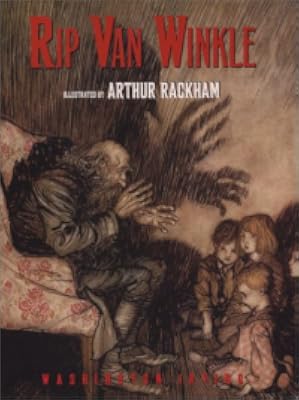
Image: “His children were as ragged and wild as if they belonged to nobody.” - illustration by Arthur Rackham (Source)
He goes to shoot squirrels, and sees a strange gathering:
Image: “A company of odd-looking persons playing at ninepins.” - illustration by Arthur Rackham (Source)
When he awakes from slumber and returns to the village, he doesn’t initially realise how long he slept. He’s puzzled and alarmed at how the village has changed and that he can’t recognise anyone. It turns out, he missed the whole American Revolution (against the British King), and he doesn’t understand people talking about things like citizen rights, elections, and Congress.
Image: “A troop of strange children ran at his heels, hooting after him and pointing at his grey beard..” - illustration by Arthur Rackham (Source)
Outwardly, this is quite funny, but it’s existential terror, too. Seeing his now adult son:
“He doubted his own identity… ‘I’m not myself - I’m somebody else.’”
But it then wraps up very neatly, happily, and far too quickly.
Plagiarism?
This is very similar to a German story, Peter Klaus published in 1800, nineteen years before Irving’s. Was it a conscious appropriation, and does it matter?
Short story club
I read this with The Short Story Club, which you can join here.
You can read this story HERE, with over 30 of Arthur Rackham’s ethereal illustrations. show less
But the mood switches to folklore, more than magic. Rip lives in a village of Dutch settlers and their descendants: everyone loves him - except his wife, who nags and complains (not without some justification, as he’s too busy helping others to support his family).
“Morning, noon, and night, her show more tongue was incessantly going, and everything he said or did was sure to produce a torrent of household eloquence.”
Image: “His children were as ragged and wild as if they belonged to nobody.” - illustration by Arthur Rackham (Source)
He goes to shoot squirrels, and sees a strange gathering:
Image: “A company of odd-looking persons playing at ninepins.” - illustration by Arthur Rackham (Source)
When he awakes from slumber and returns to the village, he doesn’t initially realise how long he slept. He’s puzzled and alarmed at how the village has changed and that he can’t recognise anyone. It turns out, he missed the whole American Revolution (against the British King), and he doesn’t understand people talking about things like citizen rights, elections, and Congress.
Image: “A troop of strange children ran at his heels, hooting after him and pointing at his grey beard..” - illustration by Arthur Rackham (Source)
Outwardly, this is quite funny, but it’s existential terror, too. Seeing his now adult son:
“He doubted his own identity… ‘I’m not myself - I’m somebody else.’”
But it then wraps up very neatly, happily, and far too quickly.
Plagiarism?
This is very similar to a German story, Peter Klaus published in 1800, nineteen years before Irving’s. Was it a conscious appropriation, and does it matter?
Short story club
I read this with The Short Story Club, which you can join here.
You can read this story HERE, with over 30 of Arthur Rackham’s ethereal illustrations. show less
The Rip Van WInkle is better known by name than actuality. To avoid confusion let me advise that Van WInkle sleeps only twenty years not a hundred and time goes by in the usual way. Crucially he misses the American Revolution and so when he sleeps, George III is King and when he awakes the American Republlic has come into existence. It is a well told story, a little old fashioned and mysogynistic in its view of marriage, perhaps. It is chiefly good fun. Three other short stories here too.
Rip Van Winkle is a laid back man with an overbearing wife in America that is currently controlled by Great Britain. He goes up into a mountain to escape his wife and falls asleep. He wakes up twenty years later, but he does not realize that it is 20 years later. He comes to his home town and everything seems very different to him. He is questioned about his reasons for being at the town and is asked who he supports. Not knowing of the Revolutionary War he tells everyone that he supports the King of England. Rip then asks the crowd if they knew anything about Rip Van Winkle and eventually his daughter takes him in. Now, Rip Van Winkle is still laid back and can now enjoy his passiveness without his overbearing wife.
I can see the humor show more of a man looking to escape his overbearing wife. I think it is even funnier that he just went up the mountain to escape her for the moment, but to wake up and come back 20 years later and realize that she is no longer around. I just enjoy the humor of an extremely passive man pretty much getting a happy ending, because he falls asleep. I also liked when Rip yelled long live the king when being questioned about who he supports. You can’t help, but shake your head at his ignorance due to not being around during the revolution. show less
I can see the humor show more of a man looking to escape his overbearing wife. I think it is even funnier that he just went up the mountain to escape her for the moment, but to wake up and come back 20 years later and realize that she is no longer around. I just enjoy the humor of an extremely passive man pretty much getting a happy ending, because he falls asleep. I also liked when Rip yelled long live the king when being questioned about who he supports. You can’t help, but shake your head at his ignorance due to not being around during the revolution. show less
Members
- Recently Added By
Lists

Picture Book Library
49 works; 7 members

Mensa for Kids Excellence in Reading Award Program (Grades 7-8)
62 works; 3 members

Reading List: Books for Insomniacs
17 works; 4 members

Books Set in New York State
65 works; 11 members

Western World's Greatest Books - Project Gutenberg
295 works; 15 members

Favourite Short Stories
153 works; 9 members
Newark Public Library's 1904 List of a Thousand of the Best Novels
95 works; 5 members

Mensa for Kids Excellence in Reading Award Program (Grades 7-8)
62 works; 1 member
Books I read in high school
52 works; 1 member

Books Read in 2023
5,547 works; 145 members

1970s
657 works; 23 members

Works in the game of Authors
44 works; 2 members

Recommended Reading : 600 Classics Reviewed, Editors of Salem Press, 2015
634 works; 6 members

Ambleside Online Year 4
46 works; 1 member
Author Information

Washington Irving, one of the first Americans to achieve international recognition as an author, was born in New York City in 1783. His A History of New York, published in 1809 under the name of Diedrich Knickerbocker, was a satirical history of New York that spanned the years from 1609 to 1664. Under another pseudonym, Geoffrey Crayon, he wrote show more The Sketch-book, which included essays about English folk customs, essays about the American Indian, and the two American stories for which he is most renowned--"The Legend of Sleepy Hollow" and "Rip Van Winkle." Irving served as a member of the U.S. legation in Spain from 1826 to 1829 and as minister to Spain from 1842 to 1846. Following his return to the U.S. in 1846, he began work on a five-volume biography of Washington that was published from 1855-1859. Washington Irving died in 1859 in New York. show less
Some Editions
Awards and Honors
Series
Belongs to Publisher Series
Work Relationships
Is contained in
The sketch-book of Geoffrey Crayon,: Gent. [pseud.] together with Abbotsford and other selections from the writings of Washington Irving by Washington Irving (indirect)
The Works of Washington Irving: (Vol. 5) The voyages of the companions of Columbus/Sketch Book (New Hudson Ed.) by Washington Irving (indirect)
The Complete Works of Washington Irving Sketch Book Crayon Papers No 65 of 1000 copies by Washington Irving (indirect)
The works of Washington Irving containing The sketch book, Knickerbocker's history of New York, Bracebridge Hall, Tales of a traveller, A chronicle of the conquest of Granada, The Alhambra by Washington Irving (indirect)
Washington Irving: A Treasury: Rip Van Winkle, The Legend of Sleepy Hollow, Old Christmas by Washington Irving
La Leyenda De Sleepy Hollow / Little Britain (COLECCIÓN LIBROS BILINGÜES CLARÍN) by Washington Irving
Three Stories By Washington Irving, Vols. I - III: Rip Van Winkle; The Legend of Sleepy Hollow; The Great Mississippi Bubble by Washington Irving
Rip van Winkle [and] The adventure of the German student [and] The spectre bridegroom by Washington Irving
Rip Van Winkle,: And other American essays from The sketch-book, (The Riverside literature series) by Washington Irving
Is retold in
Has the adaptation
Is abridged in
Common Knowledge
- Canonical title
- Rip van Winkle [short story]
- Original title
- Rip van Winkle
- Alternate titles
- Der dicke Herr
- Original publication date
- 1820; 1914; 1819
- People/Characters
- Rip van Winkle; Diedrich Knickerbocker; Dame van Winkle; Derrick Van Bummel; Nicholas Vedder; Judith Cardenier (show all 7); Peter Vanderdonk
- Important places
- Hudson River, USA; Kaatskill Mountains
- Related movies
- Wishbone" Digging Up the Past (1995 | IMDb); Rip Van Winkle (1978 | IMDb)
- Epigraph
- By Woden, God of Saxons, Frem whence comes Wensday, that is Wodensday, Truth is a thing that ever I will keep Unto thylke day in whilch I creep into My sepulchre - Cartwright
- First words
- [The following Tale was found among the papers of the late Diedrich Knickerbocker, an old gentleman of New York, who was curious in the Dutch history of the province, and the manners of the descendants from its primitive sett... (show all)lers. His historical researches, however, did not lie so much among books as among men; for the former are lamentably scanty on his favorite topics; whereas he found the old burghers, and still more their wives, rich in that legendary lore, so invaluable to true history. . . .]
The following Tale was found among the papers of the late Diedrich Knickerbocker, an old gentleman of New York, who vas very curious in the Dutch history of the province and the manners of the descendants from its primitive s... (show all)ettlers. - Last words
- (Click to show. Warning: May contain spoilers.)The story, therefore, is beynd the possibility of doubt.
- Original language
- English
- Canonical DDC/MDS
- 813.2
- Disambiguation notice
- Note: Name Difference & ISBN before combining
Classifications
- Genres
- Fiction and Literature, Children's Books
- DDC/MDS
- 813.2 — Literature & rhetoric American literature in English American fiction in English Post-Revolutionary 1776-1830
- LCC
- PZ7 .I68 .R — Language and Literature Fiction and juvenile belles lettres Fiction and juvenile belles lettres Juvenile belles lettres
- BISAC
Statistics
- Members
- 1,568
- Popularity
- 14,536
- Reviews
- 26
- Rating
- (3.64)
- Languages
- 10 — Danish, Dutch, English, French, German, Italian, Portuguese, Spanish, Swedish, Turkish
- Media
- Paper, Audiobook, Ebook
- ISBNs
- 143
- UPCs
- 5
- ASINs
- 94