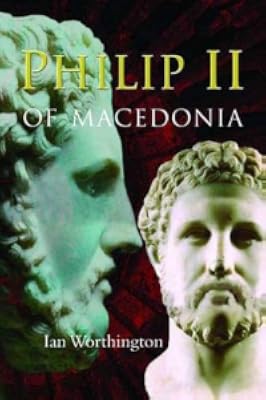
Philip II of Macedonia
by Ian Worthington
On This Page
Description
Alexander the Great is remembered as a brilliant conqueror, but his father's achievements as a leader were greater still Alexander the Great is probably the most famous ruler of antiquity, and his spectacular conquests are recounted often in books and films. But what of his father, Philip II, who united Macedonia, created the best army in the world at the time, and conquered and annexed Greece? This landmark biography is the first to bring Philip to life, exploring the details of his life show more and legacy and demonstrating that his achievements were so remarkable that it can be argued they outshone those of his more famous son. Without Philip, Greek history would have been entirely different. Taking into account recent archaeological discoveries and reinterpreting ancient literary records, Ian Worthington brings to light Philip's political, economic, military, social, and cultural accomplishments. He reveals the full repertoire of the king's tactics, including several polygamous diplomatic marriages, deceit, bribery, military force, and a knack for playing off enemies against one another. The author also inquires into the king's influences, motives, and aims, and in particular his turbulent, unraveling relationship with Alexander, which may have ended in murder. Philip became in many ways the first modern regent of the ancient world, and this book places him where he properly belongs: firmly at the center stage of Greek history. show lessTags
Recommendations










Member Reviews
I have yet to read the bulk of this, having started with the appendices. (Method and some issues of detail interest me more in this case.) Worthington is an impeccable scholar, of course. His review of the sources is quite good.
For what it's worth, however, I object to his short essay on the ethnicity of the Macedonians. It's not that he isn't right in at least the way he intends to mean it, but that, like many, he takes a naive approach to what "right" means. That the ancient Macedonians spoke Greek and were ethnically ancient Greeks—to the extent that statements like that can have meaning—is well established. But we don't have an accurate picture of what ancient ethnicity translates into on a biological level, and less as to what show more that means 2,400 years later. Any intelligent person would suspect it means nothing at all.
But these aren't questions of biology. Ethnic politics in the Balkans is a dangerous, high-stakes affair. Greece and its neighbors have frequently sought to deport or strip the culture from citizens who don't fit the official ideology of a ethnically and linguistically pure state. Wars have been fought over this stuff, always with high levels of historical justification in the rhetoric that leads to and sustains the war. Balkan nationalism loves "Who is an X?" questions, and not because they're intellectually stimulating. Worthington and other classics scholars who think it's just a scholarly game, and they are defending accuracy on a scholarly topic, should step back and think about how their scholarly conclusions about people 2,400 years ago will be used in the streets, at the tip of an official's pen—or at the end of a gun. show less
For what it's worth, however, I object to his short essay on the ethnicity of the Macedonians. It's not that he isn't right in at least the way he intends to mean it, but that, like many, he takes a naive approach to what "right" means. That the ancient Macedonians spoke Greek and were ethnically ancient Greeks—to the extent that statements like that can have meaning—is well established. But we don't have an accurate picture of what ancient ethnicity translates into on a biological level, and less as to what show more that means 2,400 years later. Any intelligent person would suspect it means nothing at all.
But these aren't questions of biology. Ethnic politics in the Balkans is a dangerous, high-stakes affair. Greece and its neighbors have frequently sought to deport or strip the culture from citizens who don't fit the official ideology of a ethnically and linguistically pure state. Wars have been fought over this stuff, always with high levels of historical justification in the rhetoric that leads to and sustains the war. Balkan nationalism loves "Who is an X?" questions, and not because they're intellectually stimulating. Worthington and other classics scholars who think it's just a scholarly game, and they are defending accuracy on a scholarly topic, should step back and think about how their scholarly conclusions about people 2,400 years ago will be used in the streets, at the tip of an official's pen—or at the end of a gun. show less
Was looking for a book on Phillip as it always seemed to me that what he accomplished was in many ways more impressive and complex than his more famous son. This book does a great job of telling that story in an easy to read narrative form, while giving you a great understanding of the source material.
Ratings
Members
- Recently Added By
Published Reviews
ThingScore 100
Now, thanks to Ian Worthington’s lively new biography, readers can more fully understand the circumstances and origins of the world-changing transformation of the ancient Mediterranean initiated by Philip, who as Worthington writes, “deserves to live beyond the shadow of his more famous son.”
Worthington is a professor of history at the University of Missouri and the author of several show more first-rate studies of the fourth century and Alexander. This familiarity with the sources and scholarship of that complex century is indispensable for making sense of a seemingly endless parade of inter-city feuds, full-scale wars, and intra-city political wrangling, all spread over the equally complex geography, states, and peoples of northern and central Greece. show less
Worthington is a professor of history at the University of Missouri and the author of several show more first-rate studies of the fourth century and Alexander. This familiarity with the sources and scholarship of that complex century is indispensable for making sense of a seemingly endless parade of inter-city feuds, full-scale wars, and intra-city political wrangling, all spread over the equally complex geography, states, and peoples of northern and central Greece. show less
added by TomVeal
Lists

Kindle Non-Fiction
221 works; 1 member
Author Information

23+ Works 572 Members
Ian Worthington is Curators' Professor of History and Adjunct Professor of Classical Studies at the University of Missouri. He is the author of numerous books about ancient Greece, including, most recently, Demosthenes of Athens and the Fall of Classical Greece and Ptolemy I: King and Pharaoh of Egypt.
Common Knowledge
- People/Characters
- Philip II of Macedon
- Important places
- Macedonia
Classifications
- Genres
- History, Nonfiction, Biography & Memoir
- DDC/MDS
- 938.07092 — History & geography History of ancient world (to ca. 499) Greece to 323 Greece to 323 Macedonian Supremacy (362-323 BC)
- LCC
- DF233.8 .P59 .W67 — History of Europe, Asia, Africa and Oceania Greece History of Greece History By period Macedonian epoch. Age of Philip. 359-336 B.C.
- BISAC
Statistics
- Members
- 46
- Popularity
- 648,514
- Reviews
- 2
- Rating
- (4.00)
- Languages
- English
- Media
- Paper
- ISBNs
- 2