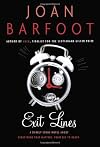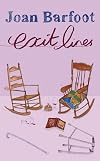
Exit Lines
by Joan Barfoot
On This Page
Description
At three o'clock in the morning, that defenceless hour when anything feels possible, the Idyll Inn's only sounds are the low hum and thrum a building makes to keep itself going. An uneasy hour, it is also the most discreet time for unsavoury acts. If all goes well, there will be no repercussions. At three o'clock in the morning, four people convene in one room to do the unthinkable. All four harbour secrets - of betrayal, sex, fear, and guilt - but all four are united in their loathing of show more the director of the Inn. Fuelled by Sylvia's secret wine stash, they begin to confess to past demeanours, to abandonment and hope, to questions of love and loyalty. But then one of them asks a question that no one is prepared for... EXIT LINES is a wry, funny but also terribly poignant novel about life's turning points and about how we adapt and change. It is about growing old disgracefully and tackles the 'Big Questions' with a refreshing lightness of touch. show lessTags
Recommendations
















Member Reviews
This novel concerns the relationships among four new residents of the recently opened Idyll Inn for Senior Living. Sylvia, who suffers from arthritis, checked herself in after a recent fall. She is acerbic and suffers no fools. (She reminded me of Maude on the tv shows Maude and Golden Girls). George is a stroke survivor and feels he has been unfairly parked at the Inn by his daughter. Although the stroke has left him wheelchair bound and with verbal difficulties, his mind is still all there. Greta came to this country as a young woman, but still retains many of her emigrant ways. She suffers from a vague heart condition, and she is proud of her daughters for funding the expense of the Idyll Inn. Ruth is a retired social worker who also show more suffers from arthritis. She is recently widowed and is childless.
These four come together as a group. Some of them have had relationships in the past, and they learn new secrets about each other as they adjust to life in the Idyll Inn. Then one of the four asks the others to participate in his/her assisted suicide.
This book seems to fairly depict the mental and physical issues that accompany aging. The central conflict it raises--whether and when to end one's life voluntarily--is an important one, but one which the author handles with humor and warmth. Ultimately, the book considers what makes life worth living in a manner that is gentle rather than pedantic, and without ever forgetting that there are real people involved. Recommended. show less
These four come together as a group. Some of them have had relationships in the past, and they learn new secrets about each other as they adjust to life in the Idyll Inn. Then one of the four asks the others to participate in his/her assisted suicide.
This book seems to fairly depict the mental and physical issues that accompany aging. The central conflict it raises--whether and when to end one's life voluntarily--is an important one, but one which the author handles with humor and warmth. Ultimately, the book considers what makes life worth living in a manner that is gentle rather than pedantic, and without ever forgetting that there are real people involved. Recommended. show less
A quartet of seniors living in a local retirement residence become confidantes, discussing and collaborating on several important issues, some carefully below the radar of the wily Idyll Inn administrator. In the wryly funny and wholly compassionate Exit Lines , acclaimed author Joan Barfoot once again treats her readers to an intimate encounter with some fascinating characters engaged in the fight of their lives. Sylvia, George, Greta and Ruth are at times tender, angry, hilarious and deeply flawed, but always utterly and captivatingly human. How do we treat the elderly in our lives? How do we intend to grow old ourselves? Will we ever come to the end of longing? Exit Lines brings to the surface these and other fundamental questions show more about the nature of life. Summary BPL
Ms Barfoot’s dark comedy casts a cold yet humorous eye on the geriatric service industry while focusing the reader’s attention on the rise and fall of four unique life stories—marriage, careers, infidelities, independence and ultimately “retirement”. A deceptive word—retirement—that can be defined not only as “Withdrawal from one’s occupation, business, or office” but also (often forced) withdrawal from one’s independence and life. Ms Barfoot’s sharp dialogue cuts away the brochure euphemisms and lays bare the selfish motives and cruel “kindness” in our treatment of our elders.
8 out of 10 Highly recommended to all! show less
Ms Barfoot’s dark comedy casts a cold yet humorous eye on the geriatric service industry while focusing the reader’s attention on the rise and fall of four unique life stories—marriage, careers, infidelities, independence and ultimately “retirement”. A deceptive word—retirement—that can be defined not only as “Withdrawal from one’s occupation, business, or office” but also (often forced) withdrawal from one’s independence and life. Ms Barfoot’s sharp dialogue cuts away the brochure euphemisms and lays bare the selfish motives and cruel “kindness” in our treatment of our elders.
8 out of 10 Highly recommended to all! show less
The main character says:
"All my work is done, and there's nothing more to be loved, and even if there were, I can't feel any love in me to give. So I'm finished. But what I do have is the luxury of my own choice."
That's a pretty good summary of this really good book. It explores a theme which is prominent in my mind, namely, what is the meaning of *later* life? This is especially concentrating the mind of the main character who has seen her partner have an unhappy pre-death experience, and who doesn't have children to distract her. Joan Barfoot takes on another substantial set of issues here (my last Barfoot was "Critical Injuries" - an exploration of forgiveness) and she makes a reasonable job of it. It's certainly a very readable show more book, and this is her great skill, I think. She combines meaty issues with readable stories, without trivializing the issue. This one will stay in my thoughts for quite a while. show less
"All my work is done, and there's nothing more to be loved, and even if there were, I can't feel any love in me to give. So I'm finished. But what I do have is the luxury of my own choice."
That's a pretty good summary of this really good book. It explores a theme which is prominent in my mind, namely, what is the meaning of *later* life? This is especially concentrating the mind of the main character who has seen her partner have an unhappy pre-death experience, and who doesn't have children to distract her. Joan Barfoot takes on another substantial set of issues here (my last Barfoot was "Critical Injuries" - an exploration of forgiveness) and she makes a reasonable job of it. It's certainly a very readable show more book, and this is her great skill, I think. She combines meaty issues with readable stories, without trivializing the issue. This one will stay in my thoughts for quite a while. show less
Sylvia, Ruth, Greta and George move into a retirement complex because they have lost their independence because of the ravages of aging. Arthritis, heart attack, stroke have limited their abilities to care for themselves. Each one of them is facing death and does so in the unique way that they lived their lives. We learn of their lives and of their developing friendships in a way that reveals history, personality, intelligence and determination to live. The student interview scene echoes Hemingway's comment from the short story "A Clean Well Lighted Place".
This was an enjoyable book to read. It's about four elderly people in a retirement home who become friends. They all have secrets, and they eventually share their life histories with each other. One of the four asks the others to end her life on her 75th birthday! Pretty humorous. I heard the author read an excerpt from the book at Word on the Street in Toronto.
Exit Lines by Joan Barfoot is different from most books I read. This book makes you sit back and think about your future and where will you be when you hit retirement age.
The novel focuses on four seniors: Sylvia, Greta, Ruth and George who have come to stay at the Idyll Inn-a retirement home. They're not really happy about it but they've come to that age and among health concerns and other things it's easier for them to move into this home where if they need it, care is available. They aren't ready to give up on their lives yet even if their children might be-well maybe, one of them is. The four meet when they first move in and I think even to their surprise forge a friendship. They bond in a strong way, to the point that they will do show more almost anything for each other.
I think this novel really shows us how sometimes-well probably a lot more than sometimes-the old are forgotten and that is very sad to me. There is one quote from Ruth that really tugged my heart...
'The old, as they might remember from their own youth, are like a separate species: more or less useless, even repellent, and certainly irrelevant. It may even be, Ruth supposes, that they are all those things, and that's just one way the world propels itself onward, and the best trick the old can perform involves acquiesing to the harsh rule of becoming unseen'. ---pg. 81
The elderly have such a beautiful story to tell as this book shows us. Sylvia, Greta, Ruth and George tell us in their own way about the lives they've lived, the mistakes they've made, the hopes and dreams that kept them going and ultimately the losses they've suffered. It shows us at any age we can make special and life friendships that are loyal and amazing. In this novel, the author gives a voice and a story to the old-those who are often forgotten in our society today in a beautifully written way.
Just because people get old and we all will, that does not mean life is over-unless you want it that way. Moving into a retirement home does not mean life is over, you can still meet new people and learn new things. I think this novel is an inspiration to someone like me, who at 42, is eventually heading in that direction. It shows me that you need to live your and live it as fully as you can-enjoy every minute because as this quote shows...
'But some other things are sharp and true: that life comes and goes in a minute of time.' ---pg 316
...You have to grab onto life, take advantage of all it has to offer. Make friends and do new things.
This novel was released in hardcover by Random House on August 12, 2008. You can read more about it and purchase it here.
http://peekingbetweenthepages.blogspot.com/2008/11/book-review-exit-lines-by-joa... show less
The novel focuses on four seniors: Sylvia, Greta, Ruth and George who have come to stay at the Idyll Inn-a retirement home. They're not really happy about it but they've come to that age and among health concerns and other things it's easier for them to move into this home where if they need it, care is available. They aren't ready to give up on their lives yet even if their children might be-well maybe, one of them is. The four meet when they first move in and I think even to their surprise forge a friendship. They bond in a strong way, to the point that they will do show more almost anything for each other.
I think this novel really shows us how sometimes-well probably a lot more than sometimes-the old are forgotten and that is very sad to me. There is one quote from Ruth that really tugged my heart...
'The old, as they might remember from their own youth, are like a separate species: more or less useless, even repellent, and certainly irrelevant. It may even be, Ruth supposes, that they are all those things, and that's just one way the world propels itself onward, and the best trick the old can perform involves acquiesing to the harsh rule of becoming unseen'. ---pg. 81
The elderly have such a beautiful story to tell as this book shows us. Sylvia, Greta, Ruth and George tell us in their own way about the lives they've lived, the mistakes they've made, the hopes and dreams that kept them going and ultimately the losses they've suffered. It shows us at any age we can make special and life friendships that are loyal and amazing. In this novel, the author gives a voice and a story to the old-those who are often forgotten in our society today in a beautifully written way.
Just because people get old and we all will, that does not mean life is over-unless you want it that way. Moving into a retirement home does not mean life is over, you can still meet new people and learn new things. I think this novel is an inspiration to someone like me, who at 42, is eventually heading in that direction. It shows me that you need to live your and live it as fully as you can-enjoy every minute because as this quote shows...
'But some other things are sharp and true: that life comes and goes in a minute of time.' ---pg 316
...You have to grab onto life, take advantage of all it has to offer. Make friends and do new things.
This novel was released in hardcover by Random House on August 12, 2008. You can read more about it and purchase it here.
http://peekingbetweenthepages.blogspot.com/2008/11/book-review-exit-lines-by-joa... show less
This novel is set in a seniors home. It is a thoughtful, honest book about human inter-connectivity and longevity. I really enjoyed the story and the characters Barfoot created.
Members
- Recently Added By
Published Reviews
ThingScore 50
While the novel has plenty of bite, the writing falters at times....But this is a poignant read that unsettles, haunts and disturbs with the best literary sensibility.
added by kathrynnd
Lists

Fiction Featuring Cranky, Eccentric Old Folks
80 works; 35 members
Author Information

11 Works 774 Members
Joan Barfoot was born on May 17, 1946, in Ontario, Canada. After graduating from the University of Western Ontario in 1969, she worked as a reporter for several newspapers. She first garnered attention in 1978 with Abra, a book about a woman who leaves her life behind to search for her true self. Barfoot received the Books in Canada First Novel show more Award for this title. Barfoot has continued publishing fiction, largely about the emotions, needs, and rediscovery of the self for women. Other titles include Dancing in the Dark, Plain Jane, and Duet for Three. She has also been the recipient of the Women of Distinction London Award YM-YMCA for 1985 and the Marian Engel Award in 1992. Barfoot makes her home in London, Ontario. (Bowker Author Biography) show less
Awards and Honors
Awards
Common Knowledge
- Original publication date
- 2008-08-12
- People/Characters
- Syliva Lodge; George Hammond; Greta Bauer; Ruth Friedman; Annabel Walker
- Important places
- Idyll Inn
- First words
- At three o'clock in the morning, that defenceless hour when anything feels possible and nothing human or inhuman out of the question, the Idyll Inn's only sounds are the low hum and thrum a complicated building makes to keep ... (show all)itself going.
- Last words
- (Click to show. Warning: May contain spoilers.)"Look at us go," Sylvia says, and they're off.
Classifications
Statistics
- Members
- 93
- Popularity
- 345,293
- Reviews
- 7
- Rating
- (3.63)
- Languages
- English
- Media
- Paper, Ebook
- ISBNs
- 7
- ASINs
- 1