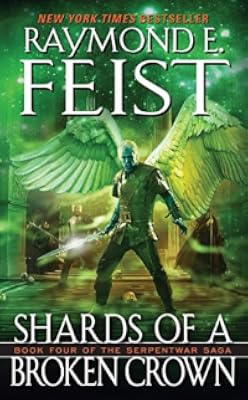
Shards of a Broken Crown
by Raymond E. Feist
Serpentwar Saga (4), The Riftwar Cycle: Publication (Series Name) (The Serpentwar Saga, 4), The Riftwar Cycle, Alternative Reading Order (12 (Serpentwar Saga 04)), The Riftwar Cycle: Publication (Series Blocks) (15), The Riftwar Cycle: Chronological (19 (Serpentwar Saga 04))
On This Page
Description
The terrible Emerald Queen is vanquished...but the war in Midkemia is not yet won, as the remarkable Raymond E. Feist concludes his magnificent Serpentwar Saga with Shards of a Broken Crown-a spellbinding tale of magic, conflict, and treachery that sees the rise of a new threat from the ashes of defeat, an evil poised to strike mercilessly at realm triumphant but weakened by war. This is epic fantasy adventure at its finest-a classic that stands tall alongside the best works of Terry show more Goodkind, George R. R. Martin, Terry Brooks and other acclaimed fantasists. Feist once again works his breathtaking magic in Shards of a Broken Crown. show lessTags
Recommendations




Member Reviews
Essentially a book-length epilogue to the epic confrontation in "Rage of a Demon King", this book bothered me more the more I thought about it. While not overtly unpleasant to read, everything about it is disappointing.
It had the potential to be really interesting: a story of trying to rebuild a devastated land in the midst of a three-way war. Feist could have combined the military story of Erik von Darkmoor, the economic story of Roo Avery and the political story of Krondor's ruling nobility into a story of the compromises and struggles needed to restore peace and prosperity.
Instead, it was a largely pointless exercise in box-checking, in which the main characters are largely passive. The economic and political recovery of the Western show more Realm just sort of happens on its own, with protagonists only supporting characters. Most of the book is taken up with desperate struggles, but all of them are rendered moot in the end when a group of demigods finally decide to get off their asses and resolve everything in a massive deus ex machina.
Feist kills off characters repeatedly, but their deaths seldom have meaning. Instead, they only serve to remove from the table characters who were just beginning to become interesting, and who matter mostly in their absence. Instead, the surviving characters are largely reactive. The most dynamic character in the series, Roo, is left on the sidelines except for one brief episode mid-book.
The villains remain as off-screen and flat as they were in "Rage of a Demon King," but this fault is more egregious since the demonic-control justification for that struggle had already been removed in the prior book. But instead of letting the former invaders struggle with the enormity of the crimes they were forced to commit as they try to establish a home for themselves in the new land they've partially conquered, Feist just reestablishes new mystical command, sort of a junior varsity army of darkness. The evil plot comes largely out of nowhere in the final act of the book, and is resolved almost as quickly as it's introduced with little help from the characters we've spent most of the book following.
As for the political plotline of the invasion from Kesh, we're treated to some second-rate skullduggery and lots of hamhanded blustering from the mouth of Patrick, the new Prince of Krondor, who is uniformly dismissed as incompetent and over his head (if generally decent). General Duko had the potential to be fascinating, an invader who cuts a deal with his enemies and has to balance his own interests against his new masters, his old masters and Kesh in a delicate power play. Instead he's instantly identified as trustworthy, and never gives anyone any reason to doubt this assessment.
Largely this book exists to wrap up loose ends from the first three books in the Serpentwar series, and to lay the groundwork for the series to follow, about which Feist seems indefinitely more interested than he does in the bland plot points he has to tick off in this book to get there.
If you've read the first three books in the series, you might as well read this one, but it's a letdown through and through. show less
It had the potential to be really interesting: a story of trying to rebuild a devastated land in the midst of a three-way war. Feist could have combined the military story of Erik von Darkmoor, the economic story of Roo Avery and the political story of Krondor's ruling nobility into a story of the compromises and struggles needed to restore peace and prosperity.
Instead, it was a largely pointless exercise in box-checking, in which the main characters are largely passive. The economic and political recovery of the Western show more Realm just sort of happens on its own, with protagonists only supporting characters. Most of the book is taken up with desperate struggles, but all of them are rendered moot in the end when a group of demigods finally decide to get off their asses and resolve everything in a massive deus ex machina.
Feist kills off characters repeatedly, but their deaths seldom have meaning. Instead, they only serve to remove from the table characters who were just beginning to become interesting, and who matter mostly in their absence. Instead, the surviving characters are largely reactive. The most dynamic character in the series, Roo, is left on the sidelines except for one brief episode mid-book.
The villains remain as off-screen and flat as they were in "Rage of a Demon King," but this fault is more egregious since the demonic-control justification for that struggle had already been removed in the prior book. But instead of letting the former invaders struggle with the enormity of the crimes they were forced to commit as they try to establish a home for themselves in the new land they've partially conquered, Feist just reestablishes new mystical command, sort of a junior varsity army of darkness. The evil plot comes largely out of nowhere in the final act of the book, and is resolved almost as quickly as it's introduced with little help from the characters we've spent most of the book following.
As for the political plotline of the invasion from Kesh, we're treated to some second-rate skullduggery and lots of hamhanded blustering from the mouth of Patrick, the new Prince of Krondor, who is uniformly dismissed as incompetent and over his head (if generally decent). General Duko had the potential to be fascinating, an invader who cuts a deal with his enemies and has to balance his own interests against his new masters, his old masters and Kesh in a delicate power play. Instead he's instantly identified as trustworthy, and never gives anyone any reason to doubt this assessment.
Largely this book exists to wrap up loose ends from the first three books in the Serpentwar series, and to lay the groundwork for the series to follow, about which Feist seems indefinitely more interested than he does in the bland plot points he has to tick off in this book to get there.
If you've read the first three books in the series, you might as well read this one, but it's a letdown through and through. show less
These last two Feist novels have been rather wonderful, a return to the grand epic-style stakes and battles that drew me to the writer in the beginning. The aftermath of the Serpentwar mainly focused on the fate of the survivors from all over the place scrambling to take control of the rubble and while we follow some rather sympathetic characters in this, INCLUDING a ton of Pug, I found a ton action and intrigue to love.
But more importantly, and other than the big battles, I particularly loved the reveals about the gods. And the results of our long-lived characters' choices. This kind of thing is both very satisfying and sets up the rest of the series for some really spectacular blowouts.
Mad gods, sleeping gods, new avatars, new show more religions... it's all great. But I particularly love how lawless this place has become. And Pug's final decision. And I agree with him. Screw them all. :) Not worth it. :)
It's going to be a wild time in the rebuilding. :) show less
But more importantly, and other than the big battles, I particularly loved the reveals about the gods. And the results of our long-lived characters' choices. This kind of thing is both very satisfying and sets up the rest of the series for some really spectacular blowouts.
Mad gods, sleeping gods, new avatars, new show more religions... it's all great. But I particularly love how lawless this place has become. And Pug's final decision. And I agree with him. Screw them all. :) Not worth it. :)
It's going to be a wild time in the rebuilding. :) show less
This was the fourth and final book in the Serpentwar Saga, one subseries in the middle of Feist’s very large Riftwar Cycle. I think I enjoyed this one the best out of the books in this subseries. This is an ensemble book, but the two grandsons of Jimmy the Hand get a large chunk of the page time and I really enjoyed them, both separately and together.
The story held my attention well, although I think that was as much because I was invested in the characters as it was because of the story. There’s a pattern to these books that causes me to roll my eyes a little bit more in each book. I enjoy the writing and the characters and the stories, but I’m also hoping Feist will find some new types of stories to tell in the later books or I show more can imagine reaching a point where I get tired of it.
I have some notes on the reading order in the unlikely event that somebody who’s trying to decide how to read this series happens to randomly run across this review for a book right smack in the middle of the entire series. This book was published in early 1998, before Krondor: The Betrayal, the first book in the next subseries, which was published later that same year. Sounds logical so far, right? However, this book takes place later chronologically then Krondor: The Betrayal. Ok, well, sometimes authors do that, so what? Well, Krondor: The Betrayal is based on a video game that was released in 1993. This book therefore has several references to and spoilers for the events in Krondor: The Betrayal, because that story already existed in a video game format when this book was written, even though that story hadn’t yet been published as a book. This whole mishmash is further complicated by the author’s revised edition of Prince of the Blook from the subseries before this one. That book was originally published before even the game, but it now makes references to events in that game due to being revised at a later date. If I were ever to read through this series again, I think I would do it in chronological order instead. The first time I read these books, I did read them in chronological order based on some random list I had found on the internet and I think the story flowed better that way.
I have a couple other things to discuss inside the spoiler tags…
Regarding the repetitive plot elements, this seems to be the basic story that is repeated throughout the books: The Kingdom, or at least the Western portion of it, is threatened by a big, bad, overwhelming enemy. There’s a major bloodbath as the sides clash. There are also inevitably a few deaths of critical secondary characters for emotional impact. Nevertheless, the Kingdom manages to just barely stay ahead of total destruction thanks to courageous and clever leaders. Meanwhile, the powerful magicians are either missing or unwilling to help for one reason or another, but they manage to show up in time to fight the big, bad supernatural creature that’s the source of all the trouble. This serves to end the fighting and/or they might get involved to help end the remaining petty squabbles before gathering together for a final companionable chat.
I had somewhat mixed feelings about Dash becoming the Upright Man at the end, but I think I liked it overall. My main worry is that this will lead to conflict between Dash and his brother Jimmy who has chosen to continue serving the crown. I’m guessing Dash probably won’t tell Jimmy, but it may come out sooner or later. The camaraderie between the two is one of the things I really enjoyed in this book, and I’ve never particularly liked seeing a good fictional friendship become estranged or develop tension. I haven’t yet read any of the books that are set chronologically after this one, so I’m curious to find out where things go with that storyline in the future. I think the next 7 books were all set prior to this subseries though, so it may be a while before I get there.
One more thing: Prince Patrick is annoying! I miss Prince Arutha. show less
The story held my attention well, although I think that was as much because I was invested in the characters as it was because of the story. There’s a pattern to these books that causes me to roll my eyes a little bit more in each book. I enjoy the writing and the characters and the stories, but I’m also hoping Feist will find some new types of stories to tell in the later books or I show more can imagine reaching a point where I get tired of it.
I have some notes on the reading order in the unlikely event that somebody who’s trying to decide how to read this series happens to randomly run across this review for a book right smack in the middle of the entire series. This book was published in early 1998, before Krondor: The Betrayal, the first book in the next subseries, which was published later that same year. Sounds logical so far, right? However, this book takes place later chronologically then Krondor: The Betrayal. Ok, well, sometimes authors do that, so what? Well, Krondor: The Betrayal is based on a video game that was released in 1993. This book therefore has several references to and spoilers for the events in Krondor: The Betrayal, because that story already existed in a video game format when this book was written, even though that story hadn’t yet been published as a book. This whole mishmash is further complicated by the author’s revised edition of Prince of the Blook from the subseries before this one. That book was originally published before even the game, but it now makes references to events in that game due to being revised at a later date. If I were ever to read through this series again, I think I would do it in chronological order instead. The first time I read these books, I did read them in chronological order based on some random list I had found on the internet and I think the story flowed better that way.
I have a couple other things to discuss inside the spoiler tags…
I had somewhat mixed feelings about Dash becoming the Upright Man at the end, but I think I liked it overall. My main worry is that this will lead to conflict between Dash and his brother Jimmy who has chosen to continue serving the crown. I’m guessing Dash probably won’t tell Jimmy, but it may come out sooner or later. The camaraderie between the two is one of the things I really enjoyed in this book, and I’ve never particularly liked seeing a good fictional friendship become estranged or develop tension. I haven’t yet read any of the books that are set chronologically after this one, so I’m curious to find out where things go with that storyline in the future. I think the next 7 books were all set prior to this subseries though, so it may be a while before I get there.
One more thing: Prince Patrick is annoying! I miss Prince Arutha.
The invasion is over and the demon lord has been banished but not all is roses for the Kingdom, especially for the Western Kingdom. Although the Commander in Chief may be gone in a puff of sulphurous smoke the invading General is still alive and is now working for himself. And, of course, Krondor itself is wrecked and under enemy occupation. Jimmy and Dash, grandsons of the now late James Duke of Krondor find that they have to live up to their great grandfather's reputation. Another person feeling the weight of history is Prince Patrick, a young man in his own right, with limited forces to hold off all the potential opponents.
This isn't quite as bloody as the earlier books in the series, focussing on the political manoeuvrings of the show more various sides as much as outright combats but that makes it better in its way especially as Patrick tries to be an autocrat without the experience or the power to pull it off. show less
This isn't quite as bloody as the earlier books in the series, focussing on the political manoeuvrings of the show more various sides as much as outright combats but that makes it better in its way especially as Patrick tries to be an autocrat without the experience or the power to pull it off. show less
Het einde van de Slangenoorlog. Weer een geweldig boek van Feist. Ondanks dat de grote slag al in het vorige boek (De macht van een koopmansprins) plaats vond, genoeg actie ook in dit verhaal
Wou datFeist een beetje creatiever was met namen. Ik weet dat hij vroegere karakters probeert te eren, maar voor het grootste deel van het boek raakte ik in de war als hij het had over een actueel personage in de verhaallijn of een verhaal uit vorige verhaallijnen. Dit leidde ook tot verwarring over de relaties - als je vader dezelfde naam heeft als je zoon en je het over beide hebt in dezelfde discussie. . .
De focus lag voornamelijk op de broer Jimmy(James) en Dash(el).
Na de dood van de Smaragden Koningin zou je denken dat er tijd was om het land show more weer op te bouwen, maar niet dus. Kesh probeert om land te bezetten dat zij als de hunne beschouwen. Een generaal onder de Smaragden Koningin roept zichzelf uit tot Koning van de Bitterzee en zoekt naar manieren om zijn claim uit te breiden.
Omdat vele in de oorlog zijn gesneuveld, ligt het lot van koninkrijk op de schouders van Eric van Zwartheide en de broers Jimmy en Dash.
Nu mag ik eindelijk weer verder in de Krondor-reeks, met Het verraad, waar ik eerder mee gestopt ben omdat het chronologisch een beetje vreemd zat. show less
Wou datFeist een beetje creatiever was met namen. Ik weet dat hij vroegere karakters probeert te eren, maar voor het grootste deel van het boek raakte ik in de war als hij het had over een actueel personage in de verhaallijn of een verhaal uit vorige verhaallijnen. Dit leidde ook tot verwarring over de relaties - als je vader dezelfde naam heeft als je zoon en je het over beide hebt in dezelfde discussie. . .
De focus lag voornamelijk op de broer Jimmy(James) en Dash(el).
Na de dood van de Smaragden Koningin zou je denken dat er tijd was om het land show more weer op te bouwen, maar niet dus. Kesh probeert om land te bezetten dat zij als de hunne beschouwen. Een generaal onder de Smaragden Koningin roept zichzelf uit tot Koning van de Bitterzee en zoekt naar manieren om zijn claim uit te breiden.
Omdat vele in de oorlog zijn gesneuveld, ligt het lot van koninkrijk op de schouders van Eric van Zwartheide en de broers Jimmy en Dash.
Nu mag ik eindelijk weer verder in de Krondor-reeks, met Het verraad, waar ik eerder mee gestopt ben omdat het chronologisch een beetje vreemd zat. show less
A satisfactory end to the series, using 4-5 POVs, constant warfare across the western realm, battles with dark magic, and two young prince's fighting for their cities and their lives., all leading to major changes at the end.
A great ending to the Serpentwar Saga. Stop here. The stories continue, but they go downhill.
Members
- Recently Added By
Lists

Best Fantasy Novels
821 works; 361 members
Favourite High Fantasy Books
113 works; 22 members
Author Information

155+ Works 97,086 Members
Fantasy writer Raymond E. Feist was born in Southern California. He received a B.A. in Communication Arts with honors from the University of California at San Diego in 1977. His first novel, Magician, published in 1982 is the first book of The Riftwar Saga. His other series include The Serpentwar Saga, The Empire Trilogy, The Riftwar Legacy, show more Krondor's Sons, Legends of the Riftwar, Conclave of Shadows, Darkwar Saga, Chaoswar Saga, Demonwar Saga, and The Firemane Saga. Feist's work appears regularly on the bestseller lists of The New York Times and The Times of London. He has also worked with Sierra Studios and PyroTechnix to produce a role-playing game. (Bowker Author Biography) show less
Some Editions
Series

Serpentwar Saga
4 works (4)

The Riftwar Cycle: Publication (Series Name)
31 works (The Serpentwar Saga, 4)

The Riftwar Cycle, Alternative Reading Order
33 works (12 (Serpentwar Saga 04))

The Riftwar Cycle: Publication (Series Blocks)
30 works (15)

The Riftwar Cycle: Chronological
32 works (19 (Serpentwar Saga 04))
Work Relationships
Is contained in
Common Knowledge
- Canonical title
- Shards of a Broken Crown
- Original title
- Shards of a Broken Crown
- Original publication date
- 1998-04
- People/Characters
- Aglaranna; Pug; Miranda; Nakor; Jimmy Jamison; Dashell Jamison (show all 9); Trina; Talwin; Patrick ConDoin
- Important places
- Midkemia; Krondor, Kingdom of the Isles, Midkemia
- Epigraph
- Duty cannot exist without faith. -Benjamin Disraeli, Earl of Beaconsfield, Tancred, Bk. II, Ch. 1
- Dedication
- To Jon and Anita Everson, who were with me from the start.
- First words
- The General knocked.
- Last words
- (Click to show. Warning: May contain spoilers.)He nodded to Nakor and Gathis, and led his followers out of the cave, down the path to their home.
- Original language*
- Englisch
*Some information comes from Common Knowledge in other languages. Click "Edit" for more information.
Classifications
Statistics
- Members
- 3,149
- Popularity
- 5,583
- Reviews
- 19
- Rating
- (3.67)
- Languages
- 8 — Dutch, English, Finnish, French, German, Hungarian, Polish, Swedish
- Media
- Paper, Audiobook, Ebook
- ISBNs
- 36
- ASINs
- 15