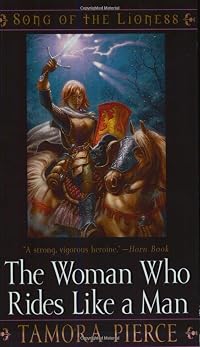
The Woman Who Rides Like a Man
by Tamora Pierce
Song of the Lioness Quartet (3), Tortall Universe (06 (Song of the Lioness 03))
On This Page
Description
On her first tour as a knight errant, Alanna assumes a position of influence with a fierce desert tribe, makes some changes in the role of women in the society, and continues her own emotional development.Tags
Recommendations











Member Reviews
A bit dated -- which makes it an interesting read in itself. On the one-hand, the depiction of Bashir culture is a little too tribes=primitive. On the other, Alanna approaches Bashir society with respect and genuine interest in their culture. I don't love the white savior trope; I do like the strategic partnership that the Bashir gain by pulling Jonathan into their culture. I very much like that Alanna is developing her own mind and opinions about romance, and that she travels that journey with courage and confidence, even when it is hard. I think this is a book that still has a lot to offer young readers.
Alanna spends most of her first year as a knight amongst the Bhazir in the southern deserts, where she becomes more involved than she planned. Plus her entanglements with Prince Jonathan and with George Cooper, King of the Rogues, continue to tie her up in knots no matter how close or far she might be from the two men.
Happily, this third book in the series returns the excellent writing quality of the first. The plot is well done, Alanna continues to grow as a person in interesting ways, and the expansion of the world is fascinating. And if I could turn off the critical part of my brain that would be it. But instead, I ended up having squidgy feelings about the book because it's (unintentionally?) a white saviour narrative. Sigh. I'll be show more finishing the quartet because I want to know how things end up for Alanna but I also don't think I'll be revisiting these books. show less
Happily, this third book in the series returns the excellent writing quality of the first. The plot is well done, Alanna continues to grow as a person in interesting ways, and the expansion of the world is fascinating. And if I could turn off the critical part of my brain that would be it. But instead, I ended up having squidgy feelings about the book because it's (unintentionally?) a white saviour narrative. Sigh. I'll be show more finishing the quartet because I want to know how things end up for Alanna but I also don't think I'll be revisiting these books. show less
I’m getting it out of the way up front: this is my least favorite installment in the Song of the Lioness quartet. 'This is some colonialist bullshit’ passed through my head a few dozen times in reading The Woman Who Rides Like a Man. Despite its more problematic aspects, I do like the novel, but if it was my entree to the series I would’ve bounced and never read the others.
The main issues lie in the treatment of the Bazhir, whose problematic portrayal I briefly touched on in my review of [b:Alanna The First Adventure|13831|Alanna The First Adventure (Song of the Lioness, #1)|Tamora Pierce|https://d.gr-assets.com/books/1388206270s/13831.jpg|1936544]. The Bazhir are a largely nomadic people (the only explicitly stated PoCs in the show more series, at this point) nominally living under the reign of Tortall (they’ve been ‘conquered,’ but frequent border skirmishes take lives on both sides) while remaining true to the governor of the Bazhir’s lone city, Persopolis (Ali Mukhtab, the Voice of the Tribes, the religious/governmental/magical leader of the Bazhir).
The Bazhir are highly patriarchal, and for pretty unspecified magical/religious/cultural reasons the women of the tribes wear veils and aren’t allowed to hold positions of power. This is where we get into some troublesome white savior territory. Alanna, through some crazy random happenstance, winds up as a member of one of the Bazhir tribes, The Bloody Hawk. She’s forced to kill their shaman because of Evil Magical Sword (made by now-deceased Evil Cousin Roger™, ‘cause we just can’t escape the shadow of that asshole) reasons. Then she can’t leave until she’s trained a replacement.
Luckily enough, the last shaman was too incompetent/greedy/what-have-you to train the three young people in the tribe who’ve demonstrated evidence of the Gift. Alanna has never wanted to use her Gift and is, understandably, hesitant to be in charge of teaching young people to handle theirs. To complicate things, two of her three charges are girls, and from a cultural perspective having a woman shaman is NOT DONE. This is pretty easily handwaved away by saying ‘well, the Woman Who Rides Like a Man, Alanna, is already serving as the shaman. It’s a ridiculously easy change considering the generations of cultural stigma stacked up against the change. Her male student, Ishak, is an obnoxious young man who longs for power beyond his reach and is ultimately killed trying to get it. The entire apprentice/cultural change situation comes across like a weird feminist morality play.
Another issue in the narrative's treatment of the Bazhir is the choice of successor to Ali Mukhtab, the Voice of the Tribes. The Voice is a cultural, religious, and governmental leader. The position is traditionally passed down to a younger tribesman who's trained for years to take over the position. When the current Voice realizes he is dying (the Voice always gets to know when they’re going to die because reasons) he tells Alanna that Jonathan must come and learn the laws of the tribes so the Bazhir can finally be truly united with Tortall and, you know, peace and stuff. It all smacks of The White Man Shall Save Us from Ourselves and the way that Jonathan behaves when he arrives doesn’t help to remedy my feelings about the situation.
Prince Jonathan and Sir Myles aren’t easily welcomed by the Bazhir. Jonathan is forced to undertake the same wrestling challenge Alanna passed to become part of the tribe. Then Jonathan spends several weeks studying with Ali Mukhtab and doing his best to understand and bond with the other Bazhir. Behind the scenes, he’s behaving like a bit of a prat. He proposes to Alanna and when she tells him she has to think about it he assumes she’s being coy, despite the fact that it would be completely out of character for her to behave so. He spends his free time whining to Alanna about all the work he has to do, even though Ali Mukhtab is torturing himself and Alanna is exhausting herself keeping him alive long enough for Jonathan to learn Bazhir laws.
Jonathan also makes a lot of offhand comments and actions that are alarming: of course Alanna will no longer where her charm against pregnancy when they’re wed, he’s fully in his rights to order others to pack her things without her say so, Alanna’s well-meaning advice that certain people are trying to stir up trouble is treated with disdain. They part on bad terms. Alanna says she’s not ready and not what he needs in a queen. Jonathan spitefully brings up the way George looks at her (which leads to Alanna spitefully pointing out his affairs with court ladies) and her lack of femininity. He leaves in the night without saying goodbye and takes up with the next lady his parents parade before him without much thought for Alanna’s or Princess Josiane’s feelings.
On the brighter side, we get some lovely scenes between Alanna and both Myles and George. Myles, who accompanied Jonathan to the Great Southern Desert, formally adopts Alanna. She finally gets a father who loves and understands her, and she’ll have the means to support herself in her journeys without worrying about Thom or Trebond. After the desert, Alanna and Coram head to Port Caynn, where George is rooting out trouble amongst some of his thieves. Once there, Alanna and George come to an understanding in one of the most poignant scenes in the book.
“There’s plenty more fish in the sea than Prince Jonathan,” he told her softly. “And this particular fish loves you with all his crooked heart.”
Alanna snuggled close, lifting her face to his again. “I’m glad,” she said honestly. “I need to be loved right now. Kiss me again, please.”
“Oh no,” George said, drawing in a ragged breath. “If I kiss you again now, one thing will lead to another, and this isn’t the proper place for that sort of carryin’-on.”
“Then take me to a place that is,” she suggested. When he hesitated, she added, “I know what I’m doing, George. And it’s not just because Jon found someone else. This should’ve happened between us a long time ago.”
*cue millions of fangirl tears*
Despite how much I love the George/Alanna and Myles & Alanna portions of the book, the rest falls to mid-series syndrome.
There are half a dozen open-ended storylines (what the hell is Thom doing sapping people’s magic without consent? who’s the mysterious thief/possibly former noble trying to take George’s ‘throne’? is someone trying to raise Roger from the dead? what’s Jonathan doing with Princess Rando? where will Alanna go now? will the Bazhir actually be at peace with Tortall and follow Jonathan?) at the novel’s close. This could be more easily overcome if I wasn’t already put off by basically everything involved in the Bazhir storyline (racial, cultural, religious, and political differences aren’t easily dismissed or fixed by the appearance of a Strong White Female and her White Knight boyfriend) and Jonathan behaving like an ass for the entirety of the book.
Would recommend to: young readers new to or looking to expand their fantasy reading, fans of Tamora Pierce, readers who like sword and sorcery settings, and readers who like kickass heroines.
Would not recommend to: readers specifically looking for diversity, readers who prefer 1st person POV, readers who aren’t fans of fantasy, readers who are sensitive to haphazard portrayals of religious/racial/cultural groups, readers who can’t stand White Savior narratives, and readers who don’t like open-ended books. show less
The main issues lie in the treatment of the Bazhir, whose problematic portrayal I briefly touched on in my review of [b:Alanna The First Adventure|13831|Alanna The First Adventure (Song of the Lioness, #1)|Tamora Pierce|https://d.gr-assets.com/books/1388206270s/13831.jpg|1936544]. The Bazhir are a largely nomadic people (the only explicitly stated PoCs in the show more series, at this point) nominally living under the reign of Tortall (they’ve been ‘conquered,’ but frequent border skirmishes take lives on both sides) while remaining true to the governor of the Bazhir’s lone city, Persopolis (Ali Mukhtab, the Voice of the Tribes, the religious/governmental/magical leader of the Bazhir).
The Bazhir are highly patriarchal, and for pretty unspecified magical/religious/cultural reasons the women of the tribes wear veils and aren’t allowed to hold positions of power. This is where we get into some troublesome white savior territory. Alanna, through some crazy random happenstance, winds up as a member of one of the Bazhir tribes, The Bloody Hawk. She’s forced to kill their shaman because of Evil Magical Sword (made by now-deceased Evil Cousin Roger™, ‘cause we just can’t escape the shadow of that asshole) reasons. Then she can’t leave until she’s trained a replacement.
Luckily enough, the last shaman was too incompetent/greedy/what-have-you to train the three young people in the tribe who’ve demonstrated evidence of the Gift. Alanna has never wanted to use her Gift and is, understandably, hesitant to be in charge of teaching young people to handle theirs. To complicate things, two of her three charges are girls, and from a cultural perspective having a woman shaman is NOT DONE. This is pretty easily handwaved away by saying ‘well, the Woman Who Rides Like a Man, Alanna, is already serving as the shaman. It’s a ridiculously easy change considering the generations of cultural stigma stacked up against the change. Her male student, Ishak, is an obnoxious young man who longs for power beyond his reach and is ultimately killed trying to get it. The entire apprentice/cultural change situation comes across like a weird feminist morality play.
Another issue in the narrative's treatment of the Bazhir is the choice of successor to Ali Mukhtab, the Voice of the Tribes. The Voice is a cultural, religious, and governmental leader. The position is traditionally passed down to a younger tribesman who's trained for years to take over the position. When the current Voice realizes he is dying (the Voice always gets to know when they’re going to die because reasons) he tells Alanna that Jonathan must come and learn the laws of the tribes so the Bazhir can finally be truly united with Tortall and, you know, peace and stuff. It all smacks of The White Man Shall Save Us from Ourselves and the way that Jonathan behaves when he arrives doesn’t help to remedy my feelings about the situation.
Prince Jonathan and Sir Myles aren’t easily welcomed by the Bazhir. Jonathan is forced to undertake the same wrestling challenge Alanna passed to become part of the tribe. Then Jonathan spends several weeks studying with Ali Mukhtab and doing his best to understand and bond with the other Bazhir. Behind the scenes, he’s behaving like a bit of a prat. He proposes to Alanna and when she tells him she has to think about it he assumes she’s being coy, despite the fact that it would be completely out of character for her to behave so. He spends his free time whining to Alanna about all the work he has to do, even though Ali Mukhtab is torturing himself and Alanna is exhausting herself keeping him alive long enough for Jonathan to learn Bazhir laws.
Jonathan also makes a lot of offhand comments and actions that are alarming: of course Alanna will no longer where her charm against pregnancy when they’re wed, he’s fully in his rights to order others to pack her things without her say so, Alanna’s well-meaning advice that certain people are trying to stir up trouble is treated with disdain. They part on bad terms. Alanna says she’s not ready and not what he needs in a queen. Jonathan spitefully brings up the way George looks at her (which leads to Alanna spitefully pointing out his affairs with court ladies) and her lack of femininity. He leaves in the night without saying goodbye and takes up with the next lady his parents parade before him without much thought for Alanna’s or Princess Josiane’s feelings.
On the brighter side, we get some lovely scenes between Alanna and both Myles and George. Myles, who accompanied Jonathan to the Great Southern Desert, formally adopts Alanna. She finally gets a father who loves and understands her, and she’ll have the means to support herself in her journeys without worrying about Thom or Trebond. After the desert, Alanna and Coram head to Port Caynn, where George is rooting out trouble amongst some of his thieves. Once there, Alanna and George come to an understanding in one of the most poignant scenes in the book.
“There’s plenty more fish in the sea than Prince Jonathan,” he told her softly. “And this particular fish loves you with all his crooked heart.”
Alanna snuggled close, lifting her face to his again. “I’m glad,” she said honestly. “I need to be loved right now. Kiss me again, please.”
“Oh no,” George said, drawing in a ragged breath. “If I kiss you again now, one thing will lead to another, and this isn’t the proper place for that sort of carryin’-on.”
“Then take me to a place that is,” she suggested. When he hesitated, she added, “I know what I’m doing, George. And it’s not just because Jon found someone else. This should’ve happened between us a long time ago.”
*cue millions of fangirl tears*
Despite how much I love the George/Alanna and Myles & Alanna portions of the book, the rest falls to mid-series syndrome.
There are half a dozen open-ended storylines (what the hell is Thom doing sapping people’s magic without consent? who’s the mysterious thief/possibly former noble trying to take George’s ‘throne’? is someone trying to raise Roger from the dead? what’s Jonathan doing with Princess Rando? where will Alanna go now? will the Bazhir actually be at peace with Tortall and follow Jonathan?) at the novel’s close. This could be more easily overcome if I wasn’t already put off by basically everything involved in the Bazhir storyline (racial, cultural, religious, and political differences aren’t easily dismissed or fixed by the appearance of a Strong White Female and her White Knight boyfriend) and Jonathan behaving like an ass for the entirety of the book.
Would recommend to: young readers new to or looking to expand their fantasy reading, fans of Tamora Pierce, readers who like sword and sorcery settings, and readers who like kickass heroines.
Would not recommend to: readers specifically looking for diversity, readers who prefer 1st person POV, readers who aren’t fans of fantasy, readers who are sensitive to haphazard portrayals of religious/racial/cultural groups, readers who can’t stand White Savior narratives, and readers who don’t like open-ended books. show less
Originally posted on Tales to Tide You Over
Several years have passed since I read Book 2 of Song of the Lioness. I didn’t remember putting in a hold for the next one, but the library just informed me it was available, so I started reading. Tamora Pierce’s characterization and storytelling show in how I recognized the characters and remembered what had come before with the help of small reminders in the text. Book 3, however, is odd. Where the previous two had a main plot plus an overall series plot to drive them, this story deals with the lingering effects of the earlier events. It gives the main character, Alanna, the chance to come into her own. We also see hints of what the next book will involve.
This is a middle novel, but show more don’t think that means nothing happens. Alanna goes seeking adventure and finds a different type than she expects, or even recognizes at first. A simple hillman attack in the desert turns deadly because the leader carries a magical sword. It’s only with the intervention of the Bazhir that she and Coram survive. The rescue is more from pot to fire as the Bloody Hawk desert tribe decides whether she should die for the crime of masquerading as a man.
Nor is this judgment the first challenge she faces. Alanna’s placed in reacting positions to several events rather than driving the narrative, though her reactions are true to her character. The one major decision she must make is something she avoids, even when given no choice. Her reactions give the book story, teaching the reader, along with Alanna, about the desert tribes and its traditions. We also learn more about the overall political situation between the northerners and the Bazhir among others, along with inspired solutions.
Alanna is very much a wish fulfillment main character in some ways. She seems able to rise to any challenge and has the special training or skill to succeed. This could have become annoying but doesn’t thanks to bringing the reader along. We see both her process and her struggles. The way Alanna doesn’t assume she will succeed helps, too. Nor does everything go smoothly for her with sometimes severe consequences, something that surprised me because I’d bought into her perfection. And, of course, her cat Faithful is around to keep her humble with sharp observations and a helping hand. Alanna is never long without friends either, showing another of her strengths.
Which brings me to the portrayal of the desert tribes and their customs.
There were places where I worried the northerners were coming in to fix things for the Bazhir, and to some degree that’s true. But rather than change imposed from outside, key northerners join with the tribe through their actions and as a result of Bazhir traditions. While Alanna challenges the gender roles, apart from a few outliers, her acceptance comes not from her actions as much from the tribe’s philosophies. I enjoyed how they absorb the desert’s nature into their culture. Which brings me to another reason I appreciate Alanna. She’s willing to learn and change as well rather than blindly forcing her views on the Bazhir. I loved the portrayal of the desert tribes, united in their connections to each other and the desert, but also individual in their opinions.
This novel holds an odd, but necessary, space in the Song of the Lioness series. Alanna has done the impossible and vanquished her mortal enemy, but she doesn’t celebrate that victory. She both doubts her actions and struggles with the lack of a goal. For a book where there isn’t a clear main plot, the character growth kept me reading, and the connections made, broken, and remade were lovely.
Alanna is a different person by the last page, with a better understanding of herself and the desert people. The Bazhir culture is complex and nuanced, even when addressing tradition and gender roles. Alanna learns to respect their culture even when it conflicts with her views by looking deeper than the surface.
I’m happy to have reconnected with familiar characters and met new ones. This book stands on the shoulders of the previous two, building on earlier events in unexpected ways. A fitting continuation to the series. show less
Several years have passed since I read Book 2 of Song of the Lioness. I didn’t remember putting in a hold for the next one, but the library just informed me it was available, so I started reading. Tamora Pierce’s characterization and storytelling show in how I recognized the characters and remembered what had come before with the help of small reminders in the text. Book 3, however, is odd. Where the previous two had a main plot plus an overall series plot to drive them, this story deals with the lingering effects of the earlier events. It gives the main character, Alanna, the chance to come into her own. We also see hints of what the next book will involve.
This is a middle novel, but show more don’t think that means nothing happens. Alanna goes seeking adventure and finds a different type than she expects, or even recognizes at first. A simple hillman attack in the desert turns deadly because the leader carries a magical sword. It’s only with the intervention of the Bazhir that she and Coram survive. The rescue is more from pot to fire as the Bloody Hawk desert tribe decides whether she should die for the crime of masquerading as a man.
Nor is this judgment the first challenge she faces. Alanna’s placed in reacting positions to several events rather than driving the narrative, though her reactions are true to her character. The one major decision she must make is something she avoids, even when given no choice. Her reactions give the book story, teaching the reader, along with Alanna, about the desert tribes and its traditions. We also learn more about the overall political situation between the northerners and the Bazhir among others, along with inspired solutions.
Alanna is very much a wish fulfillment main character in some ways. She seems able to rise to any challenge and has the special training or skill to succeed. This could have become annoying but doesn’t thanks to bringing the reader along. We see both her process and her struggles. The way Alanna doesn’t assume she will succeed helps, too. Nor does everything go smoothly for her with sometimes severe consequences, something that surprised me because I’d bought into her perfection. And, of course, her cat Faithful is around to keep her humble with sharp observations and a helping hand. Alanna is never long without friends either, showing another of her strengths.
Which brings me to the portrayal of the desert tribes and their customs.
There were places where I worried the northerners were coming in to fix things for the Bazhir, and to some degree that’s true. But rather than change imposed from outside, key northerners join with the tribe through their actions and as a result of Bazhir traditions. While Alanna challenges the gender roles, apart from a few outliers, her acceptance comes not from her actions as much from the tribe’s philosophies. I enjoyed how they absorb the desert’s nature into their culture. Which brings me to another reason I appreciate Alanna. She’s willing to learn and change as well rather than blindly forcing her views on the Bazhir. I loved the portrayal of the desert tribes, united in their connections to each other and the desert, but also individual in their opinions.
This novel holds an odd, but necessary, space in the Song of the Lioness series. Alanna has done the impossible and vanquished her mortal enemy, but she doesn’t celebrate that victory. She both doubts her actions and struggles with the lack of a goal. For a book where there isn’t a clear main plot, the character growth kept me reading, and the connections made, broken, and remade were lovely.
Alanna is a different person by the last page, with a better understanding of herself and the desert people. The Bazhir culture is complex and nuanced, even when addressing tradition and gender roles. Alanna learns to respect their culture even when it conflicts with her views by looking deeper than the surface.
I’m happy to have reconnected with familiar characters and met new ones. This book stands on the shoulders of the previous two, building on earlier events in unexpected ways. A fitting continuation to the series. show less
I have recently started to make a habit of highlighting quotes and passages I enjoy in a book and the one that sticks out from this one was:
We continue Alanna's journey immediately after becoming a knight and setting out on grand adventures. Within the first few chapters she is compelled to stay and help a Bahzir tribe that intervened when she was attacked.
Compared to the previous books in the series this one was a bit monotonous and repetitive on the action side of things. Also, the fact that our protagonist settles down in the first place she stumbles upon was personally quite disappointing. Obviously, real life can work out show more that way, but these are not the kind of books I read looking for realism.
Still, the character development is what has made the series such an enduring favourite and I loved Alanna's inner journey in this installment. The way she deals with grief and disappointment, as well as her taking on the roles of both teacher and student were the highlights of the book. Her romantic interests' paths continue the course hinted at at the end of [b:In the Hand of the Goddess|13835|In the Hand of the Goddess (Song of the Lioness, #2)|Tamora Pierce|https://i.gr-assets.com/images/S/compressed.photo.goodreads.com/books/1388206274l/13835._SY75_.jpg|1142860]: Jon becomes the ultimate asshole, while George is an unrealistically perfect human being.
I would have preferred the new secondary characters in the Bahzir tribe to be a bit more fleshed out. Many read as props for Alanna, George and Jon and some were simply one-dimensional caricatures.
Overall, this was the weakest book in the series so far. I am hoping for some of the promised 'adventuring' in the last installment. show less
She never realized that the tribes-women viewed their men not with fear, but with loving disrespect.
We continue Alanna's journey immediately after becoming a knight and setting out on grand adventures. Within the first few chapters she is compelled to stay and help a Bahzir tribe that intervened when she was attacked.
Compared to the previous books in the series this one was a bit monotonous and repetitive on the action side of things. Also, the fact that our protagonist settles down in the first place she stumbles upon was personally quite disappointing. Obviously, real life can work out show more that way, but these are not the kind of books I read looking for realism.
Still, the character development is what has made the series such an enduring favourite and I loved Alanna's inner journey in this installment. The way she deals with grief and disappointment, as well as her taking on the roles of both teacher and student were the highlights of the book. Her romantic interests' paths continue the course hinted at at the end of [b:In the Hand of the Goddess|13835|In the Hand of the Goddess (Song of the Lioness, #2)|Tamora Pierce|https://i.gr-assets.com/images/S/compressed.photo.goodreads.com/books/1388206274l/13835._SY75_.jpg|1142860]: Jon becomes the ultimate asshole, while George is an unrealistically perfect human being.
I would have preferred the new secondary characters in the Bahzir tribe to be a bit more fleshed out. Many read as props for Alanna, George and Jon and some were simply one-dimensional caricatures.
Overall, this was the weakest book in the series so far. I am hoping for some of the promised 'adventuring' in the last installment. show less
Since I've reviewed the first two books in this series, I won't spend a lot of time canvassing old plot material. We all know who Alanna, and Prince Jonathon, and the other important characters are, and the major events that unfolded before this book. Actually, what I want to focus on in this review is why I liked this, the third book in the series, better than the previous two.
I've read a lot of Pierce's quartet series. I fell in love with her Immortals saga and The Circle series, and became a renewed fan with the Protector of the Small. When I started reading Alanna, her first foray into the kingdom of Tortall, I was disappointed. I'm not sure why, but the stories just didn't keep my attention the way others had. Maybe because she was show more a younger writer with a less mature style, or because I already knew the outcomes for all these characters - since we see their future incarnations in later stories, I knew how that romance would turn out, how that character would end up. The first book had bits that were very reminiscent of Kel's story (I know, I know, Kel's story came later and is the one copying, but I read it first after all) and I thought Kel did it better.
After not being that attracted to the series, I found this third novel making a better impression on me. Alanna has moved away from the castle and becomes immersed in the world of the desert Bazhir. Pierce explores the Bazhir culture, as well as the dramatic changes that Alanna introduces into the relatively patriarchal world, in greater detail than in other series. It was enjoyable to explore a new aspect of Tortall. I also liked the development in her relationship with Jonathon and George, which became complex. I do like both men, but have to admit that I'm sad how it all resolves (which I already know from other books). It must be the novelty of the setting, the maturity in the characters, and the foreshadowing of things to come that made this book stand out as the best in the series for me. It encourages me to go ahead and finish that quartet, eventually. show less
I've read a lot of Pierce's quartet series. I fell in love with her Immortals saga and The Circle series, and became a renewed fan with the Protector of the Small. When I started reading Alanna, her first foray into the kingdom of Tortall, I was disappointed. I'm not sure why, but the stories just didn't keep my attention the way others had. Maybe because she was show more a younger writer with a less mature style, or because I already knew the outcomes for all these characters - since we see their future incarnations in later stories, I knew how that romance would turn out, how that character would end up. The first book had bits that were very reminiscent of Kel's story (I know, I know, Kel's story came later and is the one copying, but I read it first after all) and I thought Kel did it better.
After not being that attracted to the series, I found this third novel making a better impression on me. Alanna has moved away from the castle and becomes immersed in the world of the desert Bazhir. Pierce explores the Bazhir culture, as well as the dramatic changes that Alanna introduces into the relatively patriarchal world, in greater detail than in other series. It was enjoyable to explore a new aspect of Tortall. I also liked the development in her relationship with Jonathon and George, which became complex. I do like both men, but have to admit that I'm sad how it all resolves (which I already know from other books). It must be the novelty of the setting, the maturity in the characters, and the foreshadowing of things to come that made this book stand out as the best in the series for me. It encourages me to go ahead and finish that quartet, eventually. show less
Members
- Recently Added By
Lists

NPRs your favorites: 100 Best Ever Teen Novels
237 works; 49 members

Female Protagonist
1,056 works; 57 members

Fantasy novels with a female protagonist
76 works; 15 members

Best Feminist Science Fiction
188 works; 35 members

Books Read in 2014
2,343 works; 89 members
Author Information

83+ Works 121,948 Members
Author Tamora Pierce was born in South Connellsville, Pennsylvania on December 13, 1954. She received a Bachelor of Arts degree from the University of Pennsylvania. Her first book, Alanna: The First Adventure, was published in 1983 and she became a full-time author in 1992. She writes fantasy books, mainly involving young heroines, for young show more adults. She is the author of numerous series including Song of the Lioness; The Immortals; Circle of Magic; Protector of the Small; The Circle Opens; Daughter of the Lioness; The Circle Reforged; Beka Cooper; and The Numair Chronicles. Her novel Battle Magic was a New York Times bestseller. (Bowker Author Biography) show less
Some Editions
Awards and Honors
Awards
Series


Work Relationships
Is contained in
Common Knowledge
- Canonical title
- The Woman Who Rides Like a Man
- Alternate titles
- The Girl Who Rides Like a Man
- Original publication date
- 1986-03-01
- People/Characters
- Alanna of Trebond; Jonathan of Conté; Myles of Olau; Coram Smythesson; Ali Muhktab; Kara (show all 16); Ishak; Kourrem; Rispah; Eleni Cooper; Claw; Halef Seif; Akhnan Ibn Nazzir; Mari Fahrar; George Cooper; Faithful
- Important places
- Tortall; Great Southern Desert; Port Caynn
- Dedication
- To Pa, Ma, and Kim--
my own personal pride of lions--
And particularly to Pa,
who started me writing in the first place - First words
- Alanna of Trebond, the sole woman knight in the realm of Tortall, splashed happily in the waters of an oasis, enjoying her first bath in three days.
- Quotations
- "You are a terrifying creature," the Voice told her solemnly. "You do not take your place in your father's tent, letting men make your decisions. You ride as a man, you fight as a man, and you think as a man --"
"I th... (show all)ink as a human being," she retorted hotly. "Men don't think any differently from women -- they just make more noise about being able to."
As Coram chuckled, Mukhtab said, "Have you not discovered that when people, men and women, find a woman who acts intelligently, they say she acts like a man?"
-- p.43
"Better that you die and become a legend. Legends force no one to change." (p.43) - Last words
- (Click to show. Warning: May contain spoilers.)And if there was trouble ahead, well, she was ready for it.
- Original language
- English
Classifications
- Genres
- Fantasy, Fiction and Literature, Teen, Young Adult
- DDC/MDS
- 813.54 — Literature & rhetoric American literature in English American fiction in English 1900-1999 1945-1999
- LCC
- PZ7 .P61464 .W — Language and Literature Fiction and juvenile belles lettres Fiction and juvenile belles lettres Juvenile belles lettres
- BISAC
Statistics
- Members
- 5,980
- Popularity
- 2,150
- Reviews
- 62
- Rating
- (4.04)
- Languages
- 6 — Danish, English, French, German, Hungarian, Swedish
- Media
- Paper, Audiobook, Ebook
- ISBNs
- 55
- ASINs
- 15