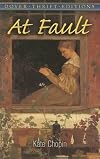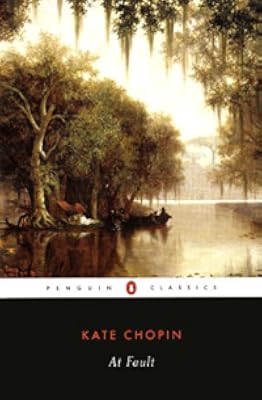
At Fault
by Kate Chopin
On This Page
Description
Groundbreaking author Kate Chopin was known for her innovative portraits of nineteenth-century heroines facing the challenges of life under strictly constrained gender roles. At Fault is a richly detailed historical romance set on a Louisiana plantation that delves deftly into the tangled web woven by a trio of star-crossed lovers whose lives have been rent asunder by misbegotten passion..
Tags
Recommendations
































Member Reviews
From the back cover:
“Widowed at thirty-two, beautiful, resourceful Therese Lafirme is left alone to run her Louisiana plantation. When Therese falls in love with David Hosmer, a divorced businessman, her strong moral and religious convictions make it impossible for her to accept his marriage proposal. Her determined rejection sets the two on a tumultuous path that involves Hosmer’s troubled former wife, Fanny.”
This was Chopin’s first novel, written eight years after she herself was widowed at 32 on a Louisiana plantation (though unlike Therese, Chopin had six kids at the time). Chopin then had a romance with a married man before abruptly moving back to St. Louis a couple of years later.
The idea of divorce in the 19th century was show more highly distasteful, and particularly so to conservative, Catholic, southern communities. In her personal life as well as in her writing, Chopin thus wrestles with the question of an individual’s happiness in light of social pressures and the ethics of the times, like Edith Wharton would shortly afterwards. The conclusions she draws are clear: to subvert one’s happiness for the sake of an arbitrary code of righteousness is a mistake.
As for the writing itself, ‘At Fault’ is rough around the edges; dramatic events seem a little forced and the ending is too clean. The treatment of African-American characters is also tough to take, not because of outright violence, but because of the casual racism evident in how they’re depicted, which is lazy and unintelligent – and this isn’t just from the characters in the novel; Chopin herself apparently had these prejudices.
However, I took this as one of the truths of the novel, in effectively transporting me back to a bayou plantation and St. Louis in the 1880’s. Chopin’s characters are interesting, from the Creoles to the society ladies who she satirizes. A recurring theme is the difficulty of carrying on through change or after loss, which I suppose has a bigger implication in the Reconstruction South, but it’s highly personalized here.
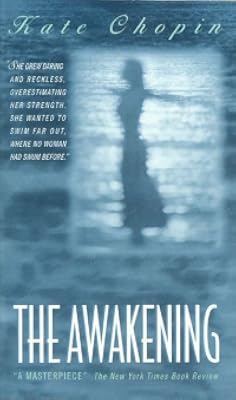
This is a first novel and must be forgiven a few sins, and if you want the more polished Chopin head directly her classic, ‘The Awakening’, but I found ‘At Fault’ interesting and enjoyable.
Just this quote, on decisions in life:
“She tried to convince herself that a very insistent sting of remorse which she felt, came from selfishness – from the pain that her own heart suffered in the knowledge of Hosmer’s unhappiness. She was not callous enough to quiet her soul with the balm of having intended the best. She continued to ask herself only ‘was I right?’ and it was by the answer to that question that she would abide, whether in the stony content of accomplished righteousness, or in an enduring remorse that pointed to a goal in whose labyrinthine possibilities her soul lost itself and fainted away.” show less
“Widowed at thirty-two, beautiful, resourceful Therese Lafirme is left alone to run her Louisiana plantation. When Therese falls in love with David Hosmer, a divorced businessman, her strong moral and religious convictions make it impossible for her to accept his marriage proposal. Her determined rejection sets the two on a tumultuous path that involves Hosmer’s troubled former wife, Fanny.”
This was Chopin’s first novel, written eight years after she herself was widowed at 32 on a Louisiana plantation (though unlike Therese, Chopin had six kids at the time). Chopin then had a romance with a married man before abruptly moving back to St. Louis a couple of years later.
The idea of divorce in the 19th century was show more highly distasteful, and particularly so to conservative, Catholic, southern communities. In her personal life as well as in her writing, Chopin thus wrestles with the question of an individual’s happiness in light of social pressures and the ethics of the times, like Edith Wharton would shortly afterwards. The conclusions she draws are clear: to subvert one’s happiness for the sake of an arbitrary code of righteousness is a mistake.
As for the writing itself, ‘At Fault’ is rough around the edges; dramatic events seem a little forced and the ending is too clean. The treatment of African-American characters is also tough to take, not because of outright violence, but because of the casual racism evident in how they’re depicted, which is lazy and unintelligent – and this isn’t just from the characters in the novel; Chopin herself apparently had these prejudices.
However, I took this as one of the truths of the novel, in effectively transporting me back to a bayou plantation and St. Louis in the 1880’s. Chopin’s characters are interesting, from the Creoles to the society ladies who she satirizes. A recurring theme is the difficulty of carrying on through change or after loss, which I suppose has a bigger implication in the Reconstruction South, but it’s highly personalized here.
This is a first novel and must be forgiven a few sins, and if you want the more polished Chopin head directly her classic, ‘The Awakening’, but I found ‘At Fault’ interesting and enjoyable.
Just this quote, on decisions in life:
“She tried to convince herself that a very insistent sting of remorse which she felt, came from selfishness – from the pain that her own heart suffered in the knowledge of Hosmer’s unhappiness. She was not callous enough to quiet her soul with the balm of having intended the best. She continued to ask herself only ‘was I right?’ and it was by the answer to that question that she would abide, whether in the stony content of accomplished righteousness, or in an enduring remorse that pointed to a goal in whose labyrinthine possibilities her soul lost itself and fainted away.” show less
On one level an engaging love story against a Louisianan backdrop, and on another e look at the conflict between love and honor, and the problem of interfering in the lives of others.
Ratings
Members
- Recently Added By
Lists

American Realism
15 works; 1 member
Author Information

194+ Works 20,971 Members
Kate Chopin was born Katherine O'Flaherty in St. Louis, Missouri, on February 8, 1851. Although she was brought up in a wealthy and socially elite Catholic family, Chopin's childhood was marred by tragedies. Her father was killed in a train accident when Chopin was just four years old, and in the following years she also lost her older brother, show more great-grandmother, and half-brother. In 1870, at the age of 19, she married Oscar Chopin, the son of a wealthy cotton-growing family in Louisiana. The couple had seven children together, five boys and two girls, before Oscar died of swamp fever in 1883. The following year, Chopin packed up her family and moved back to St. Louis to be with her mother, who died just a year later. To support herself and her family, Chopin started to write. Her first novel, At Fault, was published in 1890. Her most famous work, The Awakening, inspired by a real-life New Orleans woman who committed adultery, was published in 1899. The book explores the social and psychological consequences of a woman caught in an unhappy marriage in 19th century America, is now considered a classic of the feminist movement and caused such an uproar in the community that Chopin almost entirely gave up writing. Chopin did try her hand at a few short stories, most of which were not even published. Chopin died on August 22, 1904, of a brain hemorrhage, after collapsing at the World's Fair just two days before. (Bowker Author Biography) show less
Series
Belongs to Publisher Series
Work Relationships
Is contained in
Has as a reference guide/companion
Common Knowledge
- Canonical title
- At Fault
- Original publication date
- 1890
- People/Characters
- Thérèse Lafirme; David Hosmer
- First words
- When Jerome Lafirme died, his neighbours awaited the results of his sudden taking off with indolent watchfulness.
- Last words
- (Click to show. Warning: May contain spoilers.)It is time we were leaving them.
Classifications
- Genres
- Fiction and Literature, General Fiction, Suspense & Thriller, Romance
- DDC/MDS
- 813.4 — Literature & rhetoric American literature in English American fiction in English Later 19th Century 1861-1900
- LCC
- PS1294 .C63 .A63 — Language and Literature American literature American literature Individual authors 19th century
- BISAC
Statistics
- Members
- 132
- Popularity
- 247,405
- Reviews
- 2
- Rating
- (3.62)
- Languages
- English
- Media
- Paper, Ebook
- ISBNs
- 40
- ASINs
- 4