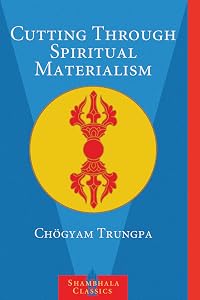
Cutting Through Spiritual Materialism
by Chogyam Trungpa
On This Page
Description
This modern spiritual classic highlights a trick we play on ourselves and offers a brighter reality: liberation by letting go of the self rather than working to improve itThe Tibetan meditation master Chögyam Trungpa calls attention to the commonest pitfall to which every aspirant on the spiritual path falls prey: what he calls spiritual materialism. "The problem is that ego can convert anything to its own use," he says, "even spirituality." The universal tendency is to see show more spirituality as a process of self-improvement—the impulse to develop and refine the ego when the ego is, by nature, essentially empty.
Trungpa's incisive, compassionate teachings serve to wake us up from these false comforts. Featuring a new foreward by his son and lineage holder, Cutting Through Spiritual Materialism has resonated with students for nearly thirty years—and remains as fresh as ever today. show less
Tags
Recommendations




Member Recommendations

Member Reviews
In this modern spiritual classic, the Tibetan meditation master Chögyam Trungpa highlights the commonest pitfall to which every aspirant on the spiritual path falls prey: what he calls spiritual materialism. The universal tendency, he shows, is to see spirituality as a process of self-improvement—the impulse to develop and refine the ego when the ego is, by nature, essentially empty. "The problem is that ego can convert anything to its own use," he said, "even spirituality." His incisive, compassionate teachings serve to wake us up from this trick we all play on ourselves, and to offer us a far brighter reality: the true and joyous liberation that inevitably involves letting go of the self rather than working to improve it. It is a show more message that has resonated with students for nearly thirty years, and remains fresh as ever today. show less
A very readable but somewhat repeatable book about (Buddhist) spirituality. Trungpa begins with showing some traps of many spiritual seekers, people who use the techniques to make their ego's stronger and find a definite story about reality. The fact that Trungpa was a well known teacher for the beat and hippy generation must have to do something to do with this.
After showing those pitfalls he does a great job in showing the workings of the mind with colourful allegoric images - like the narrative of a monkey in a house who sees the world thru the windows, but goes crazy because he can not escape. And explains that the true pad is to give up seeking and labeling of the world to see things 'as they are'.
For me the final 'goal' was not show more convincing. He gives an example that you can see e.g. the garbage as it really is. - To me this is not possible since the fact a person sees it as garbage is already an interpretation. For a rat it could well be a 'house'. show less
After showing those pitfalls he does a great job in showing the workings of the mind with colourful allegoric images - like the narrative of a monkey in a house who sees the world thru the windows, but goes crazy because he can not escape. And explains that the true pad is to give up seeking and labeling of the world to see things 'as they are'.
For me the final 'goal' was not show more convincing. He gives an example that you can see e.g. the garbage as it really is. - To me this is not possible since the fact a person sees it as garbage is already an interpretation. For a rat it could well be a 'house'. show less
This is the second book on Buddhism I ever read, and when I started reading it, I was an evangelical Christian. (Now I am something that defies a label!)
Trungpa tries to take us to another place when it comes to spirituality. Unlike most Christian books I was reading at the time, which were mostly on how to LOOK spiritual, Trungpa was actually talking about being spiritual by abandoning the notion of spirituality.
Needless to say I did not get it back when I was a confused college student, or even later when I was trying to make my way in the world. I am not sure I get it today, but i know it is worth reading and rereading.
Trungpa tries to take us to another place when it comes to spirituality. Unlike most Christian books I was reading at the time, which were mostly on how to LOOK spiritual, Trungpa was actually talking about being spiritual by abandoning the notion of spirituality.
Needless to say I did not get it back when I was a confused college student, or even later when I was trying to make my way in the world. I am not sure I get it today, but i know it is worth reading and rereading.
There were parts of this classic text that were really invaluable—the portions on being open to oneself, being a spiritual “collector,” the monkey, and a smooth bird’s eye view of the paramitas come to mind. The trouble for me was that 97% of its 240-some pages dwell in abstraction without stories to illustrate or make familiar the concepts presented, something that a lot of Buddhism books have excelled at since the publication of this one.
Not bad. A little dense
Worth it for just about anyone into spirituality. Highlights the almost inevitable pitfalls that one encounters.
Read this book and get honest. Absolute necessity.
Members
- Recently Added By
Lists

The Joe Rogan Experience Library
254 works; 3 members

Books About Non-Abrahamic Religions
98 works; 2 members
Author Information

174+ Works 9,476 Members
Chogyam Trungpa (February 29, 1939 -- April 4, 1987) was one of the most visibly active of the Tibetan Buddhist refugees to come to the West and to lay the foundation in Europe and North America for the study of the Tibetan traditions. Born the son of a farmer and considered the eleventh incarnation of Trungpa Tulku, he was given a traditional show more training in religious philosophy but in his teens had to be hidden from the invading Chinese. Fleeing in 1959 when the Communists invaded Tibet, he ultimately moved to Great Britain, where he studied comparative religion at Oxford University and established a Tibetan meditation center in Scotland. He moved to the United States in 1970 and established the Buddhist university, Naropa, in Colorado. Naropa became the center for seminars, many of which he cotaught with prominent American artists, scholars, and scientists. Among his contributions are the translation of numerous Tibetan texts. On September 28, 1986, he suffered cardiac arrest, requiring intensive care at the hospital, then at his home and finally, in mid-March 1987, back at the hospital, where he died on April 4, 1987. (Bowker Author Biography) show less
Awards and Honors
Series
Belongs to Publisher Series
Common Knowledge
- Canonical title
- Cutting Through Spiritual Materialism
- Original title
- Cutting Through Spiritual Materialism
- Original publication date
- 1973
- Dedication
- To Chokyi-lodro the Marpa Father of the Kagyu Lineage
- First words
- We have come here to learn about spirituality.
- Last words
- (Click to show. Warning: May contain spoilers.)He transcended his own individual existence so that, as we read his last teachings, there can be a sense of the universality of Milarepa, the example of enlightenment.
Classifications
- Genres
- Religion & Spirituality, Nonfiction, General Nonfiction, Philosophy
- DDC/MDS
- 294.3444 — Religion Other religions Buddhism/Hinduism Buddhism Buddhism - practice Religious experience, life, practice Religious life and practice
- LCC
- BQ4302 .T78 — Philosophy, Psychology and Religion Buddhism Buddhism Doctrinal and systematic Buddhism Special doctrines
- BISAC
Statistics
- Members
- 1,351
- Popularity
- 17,709
- Reviews
- 12
- Rating
- (4.22)
- Languages
- 11 — Chinese, Czech, Danish, Dutch, English, Finnish, French, German, Italian, Polish, Spanish
- Media
- Paper, Audiobook, Ebook
- ISBNs
- 28
- ASINs
- 13