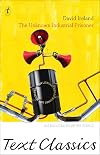
The Unknown Industrial Prisoner
by David Ireland
On This Page
Description
In an oil refinery on the shores of Sydney, an army of workers come and go . . . Winner of Australia's highest literary honor, the Miles Franklin Award,The Unknown Industrial Prisoner is a classic, fiercely brilliant comic portrait of a nation in the grip of a dehumanizing labor system.Tags
Recommendations















Member Reviews
Winner of the 1971 Miles Franklin award, and a seriously weird book. A 400 page rant about the evils of management versus the workers, interspersed with the worker's brothel and bar set up in the bush adjacent to the oil refinery. The refinery regularly blows up, catches fire or otherwise is shut down due to bad design, bad management or bad deeds by the employees. I'm not making this up.
The story is told in vignettes of a few lines to a few pages. Each is about an individual, all of which are known by a nickname/epithet.
The story is told in vignettes of a few lines to a few pages. Each is about an individual, all of which are known by a nickname/epithet.
Librarians have an invidious job, trying to allocate some books to the Subjects Catalogue. I really feel for whoever had to deal with David Ireland’s The Unknown Industrial Prisoner and eventually assigned it to these subject headings:
Manufacturing workers
Death
Working class
Economic development
Alienation
Well, yes, I can see why these subjects were assigned, but they are not really what the book is about. The Unknown Industrial Prisoner won the Miles Franklin Award in 1971 and I posted the opening lines of the novel here. It’s such a bitter and angry book that the word alienation seems inadequate to describe its concerns. Alienation today conjures up images of sulky adolescents lounging about in shopping malls instead of going to show more school, it just doesn’t begin to scour the depths of angst in Ireland’s novel. It’s the polarisation of society that interests Ireland: the brutal, amoral industrial world that traps the workers into imprisonment, a world which (he thinks) is invisible to complacent Australia.
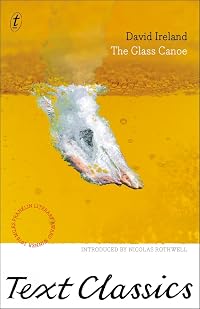
I’m calling it a novel, but it doesn’t always seem like one. There are extremely short episodes instead of chapters, and the writing style seems mostly (though not always) more like journalism than literary. The multiple characters are all named, in that sly Australian way, to reflect aspects of their personality. These include, for example, Two Pot Screamer, Doctor Death, the Volga Boatman and Calamity Jane the nurse, and the central characters The Great White Father, the Glass Canoe, the Samurai, Far Away Places and the Wandering Jew. (He isn’t Jewish, so the moniker is anti-Semitic.) Some of these monikers are apt but others are a bit opaque – perhaps the allusions derive from the vanished pub world that Ireland evoked in The Glass Canoe (see my review). Or perhaps it’s because I’m a woman not privy to the secret language of men. But it wasn’t just trying to decode the names that made The Unknown Industrial Prisoner a challenge. Far from it.
To read the rest of my review please visit https://anzlitlovers.com/2013/07/21/the-unknown-industrial-prisoner-by-david-ire... show less
Manufacturing workers
Death
Working class
Economic development
Alienation
Well, yes, I can see why these subjects were assigned, but they are not really what the book is about. The Unknown Industrial Prisoner won the Miles Franklin Award in 1971 and I posted the opening lines of the novel here. It’s such a bitter and angry book that the word alienation seems inadequate to describe its concerns. Alienation today conjures up images of sulky adolescents lounging about in shopping malls instead of going to show more school, it just doesn’t begin to scour the depths of angst in Ireland’s novel. It’s the polarisation of society that interests Ireland: the brutal, amoral industrial world that traps the workers into imprisonment, a world which (he thinks) is invisible to complacent Australia.
I’m calling it a novel, but it doesn’t always seem like one. There are extremely short episodes instead of chapters, and the writing style seems mostly (though not always) more like journalism than literary. The multiple characters are all named, in that sly Australian way, to reflect aspects of their personality. These include, for example, Two Pot Screamer, Doctor Death, the Volga Boatman and Calamity Jane the nurse, and the central characters The Great White Father, the Glass Canoe, the Samurai, Far Away Places and the Wandering Jew. (He isn’t Jewish, so the moniker is anti-Semitic.) Some of these monikers are apt but others are a bit opaque – perhaps the allusions derive from the vanished pub world that Ireland evoked in The Glass Canoe (see my review). Or perhaps it’s because I’m a woman not privy to the secret language of men. But it wasn’t just trying to decode the names that made The Unknown Industrial Prisoner a challenge. Far from it.
To read the rest of my review please visit https://anzlitlovers.com/2013/07/21/the-unknown-industrial-prisoner-by-david-ire... show less
In the end I decided I enjoyed this story of the working man put upon by a stupid, uncaring management. In some ways its a very nasty tale: everyone is out to take advantage of each other's misfortune. Deaths ensue, not much lamented by anyone. The only character to show any generosity of spirit at all (including paying for the beer in the Home Beautiful) is The Great White Father, who in the end has turned into the Great White Feather. And whats the point of being generous if nobody knows about it?
This is a very Australian satire, full of larrikin characters and behaviour and anti-establishment posturing. Maybe it has got a bit dated but it is pretty entertaining for all that.
This is a very Australian satire, full of larrikin characters and behaviour and anti-establishment posturing. Maybe it has got a bit dated but it is pretty entertaining for all that.
A satire which does not engage or inform. The message that industrial corporations are monsters that deprive people of their humanities may have been relatively fresh in 1972, but is rather dated today.
A fantasy, full of large-painted characters, as well as a satire. Almost magical realism.
Ratings
Members
- Recently Added By
Lists

Australia's Greatest Books, as chosen by Geoffrey Dutton (1985)
97 works; 6 members
Author Information
12 Works 469 Members
Awards and Honors
Awards
Notable Lists
Series
Belongs to Publisher Series
Common Knowledge
- Canonical title
- The Unknown Industrial Prisoner
Classifications
Statistics
- Members
- 91
- Popularity
- 352,925
- Reviews
- 5
- Rating
- (3.00)
- Languages
- English
- Media
- Paper, Ebook
- ISBNs
- 10
- ASINs
- 5